


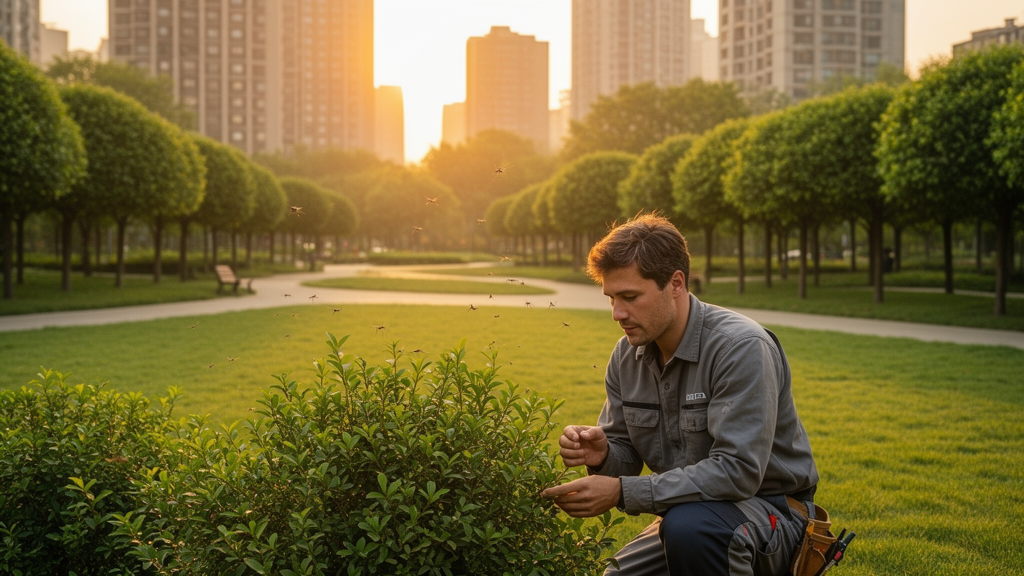
Urban green spaces have long been celebrated as one of public health’s most reliable allies. Parks cool overheated cities, soak up floodwater, encourage exercise, and offer psychological restoration to millions of residents who live far from the countryside. Yet a new opinion article published in PLOS Climate argues that these treasured landscapes are entering a period of profound tension, one in which the very features that make green spaces healthy may also make them hospitable to disease-carrying ticks and mosquitoes. An interdisciplinary team of researchers from the University of Exeter and the UK Health Security Agency, writing ahead of critical planning decisions in the twenty-first century, warns that policymakers can no longer treat green space provision, climate adaptation and vector-borne disease as separate policy silos.
The authors, led by Mark Ferguson and Joanne Garrett of the European Centre for Environment and Human Health, point out that the study of urban green spaces, climate change and vector-borne diseases are each mature and substantial research fields. The pairwise interactions among them are at least partly understood. What has been missing, they argue, is sustained attention to the intersection of all three domains simultaneously, precisely the place where the most consequential and least anticipated public health outcomes are likely to emerge. As cities race to plant trees, restore wetlands and build green corridors to cope with a warming climate, the question of who else benefits from that vegetation, and at what cost, has remained largely unexamined.
The health benefits of urban greenery are well documented and typically fall into three broad categories. Restoration covers processes such as stress recovery and mental restoration after cognitive fatigue. Capability building refers to green spaces’ role in facilitating physical activity, from jogging to children’s play. Protection from harms includes the cooling effect of vegetation during heatwaves and the capacity of parks and wetlands to manage stormwater and reduce flood risk. Interventions designed to capture these benefits now take many forms: green and blue infrastructure such as urban green corridors that encourage active travel, social programming including nature-based prescribing in clinical settings, and Nature-based Solutions that tackle multiple environmental, social and economic challenges at once, such as a wetland designed to improve water quality, provide recreation and boost biodiversity.
Into this largely benign picture, the authors introduce an uncomfortable cast of characters. The principal vector-borne diseases emerging in European urban areas include tick-borne infections such as Lyme disease and mosquito-borne infections such as dengue, chikungunya and Zika. Ticks infected with Borrelia, the bacterium responsible for Lyme disease, can travel into new areas on birds, moving from Lyme-endemic rural regions into cities and introducing the pathogen there. Urban green space design and management, including practices such as conservation grazing with livestock, may increase habitat suitability for ticks and their natural hosts, which include rodents, birds and deer. Those changes could facilitate the establishment of urban Lyme disease transmission cycles in places where they have historically been absent.
Mosquitoes present a parallel and arguably more alarming challenge. For diseases spread by invasive Aedes mosquitoes, such as dengue, Zika and chikungunya, the increased humidity and shelter provided by dense vegetation can create ideal resting sites. The same applies to the Culex mosquitoes that carry West Nile virus, which thrive in natural wetlands, container habitats and flooded areas. Coupled with the movement of infected migratory birds, these conditions could allow urban cycles of West Nile virus to become established. The economic stakes are considerable: while uncertainty surrounds future health care burdens under changing climates, the global historic costs of dengue, Zika and chikungunya have been estimated at a mean annual cost of 3.29 billion US dollars, and surveillance of disease-carrying vectors remains a major public health challenge associated with significant costs.
Climate change acts as an accelerant on every one of these dynamics. Beyond the direct health burden of heat and extreme weather, a warming world lengthens transmission seasons, expands the geographic range of vectors, and alters pathogen survival and replication rates. The evidence is already quantifiable. According to figures cited in the article from the 2025 Lancet Countdown report, climate change increased the transmission potential of dengue by Aedes albopictus and Aedes aegypti by 48.5 per cent and 11.6 per cent respectively between the decades of 1951 to 1960 and 2015 to 2024. Those are not projections of a distant future but measurements of a shift that has already occurred within living memory.
The climate is also reshaping how people actually use green spaces, which changes exposure patterns in ways that are difficult to predict. Vegetation growth conditions are shifting, with drought causing increased vegetation stress and forcing designers to rethink which species can survive and continue delivering cooling and other services. Human behaviour is adapting too. A study in Germany identified a temperature threshold of 30 degrees Celsius, above which park visits for activities such as jogging and playing with children declined sharply. A more recent study estimated that high temperature and humidity significantly reduce the recreational value of green spaces. Yet climate change may also push people to use parks during cooler periods of the day, in the mornings and at night, and during milder seasons, potentially shifting human-vector contact into hours and months when mosquitoes and ticks are most active.
It is at this behavioural intersection that the authors pose some of their most provocative questions. Will people still be jogging in green spaces if those spaces are hot, humid, or full of disease-carrying ticks and mosquitoes? Will more people picnic outdoors to escape overheated homes, increasing their vector exposure, particularly under trees where ticks might thrive? And, crucially, can urban green spaces be designed to deliver climate adaptation goals without simultaneously increasing vector presence or human-vector contact? What are the net public health outcomes when the substantial benefits of green spaces are weighed honestly against increased exposure risk? None of these questions currently has a confident answer, and the authors argue that this gap in knowledge is itself a policy risk.
The uncertainty extends deep into the tools that governments use to make decisions. Current limited understanding of the interactions and long-term feedbacks between climate change, biodiversity loss and gain, infection risk and ecosystem services makes it difficult for policymakers to evaluate the trade-offs and co-benefits of interventions aimed at climate adaptation, nature recovery and public health. Economic valuation in this context is only partial: certain health endpoints such as mortality risk are well studied, while the valuation of morbidity remains relatively underdeveloped. Assigning economic value to biodiversity loss or gain is difficult, and although some ecosystem services have been the focus of valuation studies, many cultural and spiritual dimensions of green space remain stubbornly hard to price. The authors call for research using integrated assessment models that link climate, ecological, epidemiological, behavioural and socioeconomic data to predict how environmental change and management interventions influence green space use, biodiversity, vector-borne disease risks and wider societal wellbeing. Systems-thinking approaches, which can capture dynamic processes, feedback loops and unintended consequences while simulating alternative policy and management scenarios, are also gaining visibility as a way to handle this complexity.
Because research takes time to translate into impact, and because empirical data can only reflect present or past states, the authors insist that action cannot wait for perfect evidence. Investments in green spaces are already being made, whether in creating new spaces in housing developments or transforming existing ones through planting and changed service provision. They therefore call for current planning and environmental policies that shape the design, management and development of urban green spaces to be amended now, accepting the unknowns. Concretely, they advocate balanced assessments of multiple risks alongside potential benefits, using Health Impact Assessment and the health components of Environmental Impact Assessment to ensure that green space interventions manage vector-borne disease risk while still creating opportunities for health promotion. They also call for a denser monitoring system of urban green spaces so that problems such as widespread tick infestation can be detected and mitigated swiftly, and they emphasise community participation in green space management to ensure inclusive designs and desired outcomes. The message is ultimately one of urgency rather than alarm: healthy, resilient and biodiverse ecosystems remain fundamental to human health, and the goal is not to abandon urban greening but to plan proactively, so that the parks of a hotter century deliver their benefits without quietly cultivating their costs.
Subject of Research: Interactions between urban green space management, climate change and vector-borne disease risk in public health decision-making
Article Title: Balancing urban green space benefits and vector-borne disease risk under climate change: Critical decision-making for 21st century public health
Article References: Balancing urban green space benefits and vector-borne disease risk under climate change: Critical decision-making for 21st century public health. (n.d.). https://doi.org/10.1371/journal.pclm.0001016
Image Credits: AI Generated
DOI: 10.1371/journal.pclm.0001016
Keywords: urban green space, vector-borne disease, climate change, Lyme disease, dengue, ticks, mosquitoes, Nature-based Solutions, public health, Health Impact Assessment, biodiversity, urban planning
Cite Scienmag News
Sloane Callahan. (October 10, 2026). Parks, Pathogens and a Warming Planet: The Hidden Trade-Off in Urban Green Space Design. Scienmag. https://scienmag.com/parks-pathogens-and-a-warming-planet-the-hidden-trade-off-in-urban-green-space-design/
Sloane Callahan. "Parks, Pathogens and a Warming Planet: The Hidden Trade-Off in Urban Green Space Design." Scienmag, 10 October 2026, https://scienmag.com/parks-pathogens-and-a-warming-planet-the-hidden-trade-off-in-urban-green-space-design/. Accessed 10 October 2026.
Sloane Callahan. "Parks, Pathogens and a Warming Planet: The Hidden Trade-Off in Urban Green Space Design." Scienmag. October 10, 2026. https://scienmag.com/parks-pathogens-and-a-warming-planet-the-hidden-trade-off-in-urban-green-space-design/


