


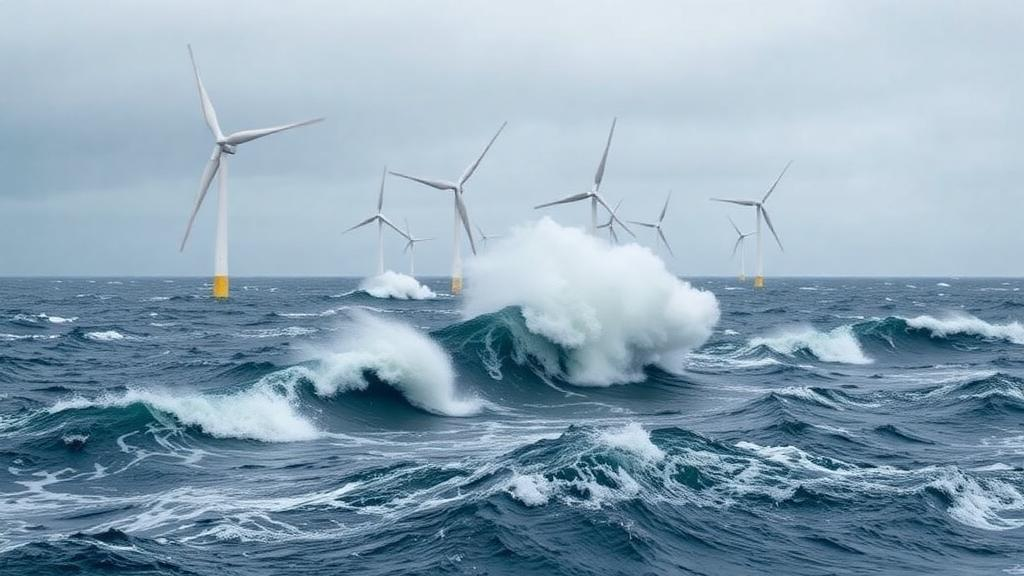
Every offshore wind farm begins its life as a gamble on the air itself. Engineers can measure how hard the wind blows and from which direction it comes with relative ease, and decades of research have made model-based wind speed maps trustworthy enough to bank on. But there is a quieter number in every project’s financial spreadsheet that has long resisted confident prediction: turbulence intensity, the measure of how violently the wind fluctuates around its mean. It is this number, more than average wind speed, that dictates how many cycles of stress a turbine’s blades, tower and drivetrain will endure over a design life of twenty to thirty years. A new preprint from researchers at Fraunhofer IWES and their collaborators now puts a hard, uncomfortable figure on just how uncertain our best regional weather models are when asked to estimate it over the North Sea.
The study, authored by Sandra Schwegmann, Tanguy Lunel, Lukas Vollmer and Martin Dörenkämper and published as a discussion preprint in the journal Wind Energy Science, tackles a deceptively simple question: can the Weather Research and Forecasting model, known throughout the atmospheric sciences simply as WRF, reproduce the turbulence intensity that instruments actually measure offshore? The team ran a full year of simulations over the North Sea, systematically varying the planetary boundary layer scheme, the spatial resolution of the model grid, and the mathematical route used to convert model output into a turbulence intensity value. The answer they arrived at is a sobering one for anyone hoping that simply cranking up model resolution would solve the problem.
Turbulence intensity, in the language of wind energy, is the ratio of the standard deviation of wind speed fluctuations to the mean wind speed, typically averaged over ten-minute intervals. It is the parameter that sits at the heart of international design standards for wind turbines, shaping fatigue loads from the very first day of planning. Yet while wind speed and direction have been validated in models across countless studies, turbulence has remained a stubborn blind spot. The reason is physical: most of the turbulent energy in the atmosphere resides in eddies far smaller than the grid cells of a mesoscale model, which typically operates at horizontal spacings of a few kilometers. Those energy-containing swirls of air simply cannot be resolved explicitly; they must be parameterized.
This is where the study’s central finding comes in. WRF, like most mesoscale models, carries a diagnostic quantity called subgrid-scale turbulent kinetic energy, or TKE, which represents the unresolved turbulent motion computed by the boundary layer physics scheme. The researchers found that when turbulence intensity is derived from this subgrid-scale TKE, the results come significantly closer to observations than when it is derived from the model-resolved wind speed fluctuations themselves. That may sound intuitive, but it carries a crucial implication: the useful turbulence information in a mesoscale simulation lives almost entirely in the parameterization, not in the explicitly simulated winds. The resolved fluctuations at kilometer scales capture a different, larger class of atmospheric motion than the ten-minute gustiness that fatigue engineers care about.
The numbers attached to this finding define the current ceiling of the method. Across all the planetary boundary layer schemes tested, all resolutions, and all test locations in the North Sea, the lowest errors the team could achieve were a root-mean-square error of about 0.024 in turbulence intensity and a mean absolute percentage error of roughly 30 percent. In other words, even under the most favorable configuration, a model-predicted turbulence intensity carries an uncertainty of nearly a third of its value. For a parameter that directly determines whether a turbine design survives its intended lifetime, that margin is far from trivial, and the authors are candid that it represents a floor rather than a solution.
Among the boundary layer schemes examined, one stood out. The MYNN scheme, a closure developed originally for aviation and air-quality applications that carries a sophisticated treatment of the turbulent kinetic energy budget, delivered the lowest deviation from observed turbulence intensity at a grid resolution of 2 kilometers. This detail matters practically, because scheme choice is one of the few free parameters a wind resource analyst actually controls. The result suggests that schemes which explicitly track the turbulent energy budget, rather than relying on simpler first-order closures, offer a more physically grounded bridge between model output and the turbulence statistics that turbine designers need.
Perhaps the most counterintuitive result concerns resolution. The researchers pushed their simulations into the so-called gray zone, the transitional regime between mesoscale and microscale modeling where grid spacings become small enough to partially resolve the largest turbulent eddies. Running the model at horizontal resolutions down to 111 meters, they found that turbulence intensity estimates rarely improved. The reason lies in how the model partitions turbulent energy: as resolution increases, more turbulent motion becomes explicitly resolved while the subgrid-scale TKE computed by the boundary layer scheme decreases. A conversion factor that worked at kilometer scales therefore becomes inconsistent at finer ones, and the factor used to translate TKE into turbulence intensity must be adapted if comparable values are to be obtained. Simply refining the grid, in other words, does not buy accuracy for free; it shifts the problem.
The study also examined how atmospheric stability shapes the picture, comparing conditions across different test locations in the North Sea over a complete annual cycle. Stability, the vertical stratification of the marine boundary layer, governs whether turbulence is generated mechanically by wind shear or suppressed by warm air over cold water, and it modulates both the observed turbulence and the model’s ability to reproduce it. The consistency of the error floor across locations and schemes suggests the limitation is structural, rooted in the parameterization of subgrid turbulence itself, rather than an artifact of any single configuration or site.
The authors are explicit about what would be required to move beyond the 30 percent error barrier. One path is large-eddy simulation, or LES, which resolves most of the turbulent energy spectrum explicitly and can deliver turbulence statistics of the fidelity that standards demand, but at computational costs that make it impractical for the multi-decade, site-wide assessments that wind farm planning requires. The other path is statistical: correction methods such as Measure-Correlate-Predict, a technique long used in the wind industry to transfer the statistical properties of a long-term reference dataset to a short-term measurement campaign, could be applied to bias-correct the model’s turbulence output against observations. Until one of these approaches is deployed, mesoscale TKE-based turbulence intensity should be treated as an estimate with quantified, and substantial, uncertainty.
The preprint is already drawing scrutiny through the journal’s open discussion process, with a referee recommending substantial revision and arguing that the evaluation, limited to two sites within the same basin, cannot yet claim comprehensiveness, and that the physical mechanisms behind the error metrics deserve deeper analysis, including examination of the turbulent kinetic energy budget within the boundary layer schemes themselves. That critique underscores a broader point: the study’s value lies less in delivering a finished tool than in drawing a precise boundary around what current mesoscale modeling can and cannot do for offshore wind. As turbines grow taller and are sited farther offshore, where the boundary layer they inhabit is deeper and more dynamically complex, the gap between modeled and measured turbulence becomes an increasingly expensive unknown. By quantifying that gap at roughly 30 percent, and showing that finer grids and different physics schemes cannot close it, the work gives the wind energy community a clear-eyed baseline from which the next generation of turbulence prediction methods must improve.
Subject of Research: Evaluation and uncertainty quantification of offshore turbulence intensity in WRF mesoscale simulations over the North Sea
Article Title: A comprehensive evaluation and uncertainty quantification of offshore turbulence intensity from WRF mesoscale simulations
Article References: Schwegmann, S., Lunel, T., Vollmer, L., & Dörenkämper, M. (2026). A comprehensive evaluation and uncertainty quantification of offshore turbulence intensity from WRF mesoscale simulations. https://doi.org/10.5194/wes-2026-103
Image Credits: AI Generated
DOI: 10.5194/wes-2026-103
Keywords: turbulence intensity, offshore wind energy, WRF model, North Sea, turbulent kinetic energy, planetary boundary layer schemes, MYNN, gray-zone simulations, wind resource assessment, fatigue loads, large-eddy simulation, uncertainty quantification
Cite Scienmag News
Alan Morgan. (October 9, 2026). How Well Can Weather Models Predict the Turbulence That Decides an Offshore Wind Farm’s Fate? Scienmag. https://scienmag.com/how-well-can-weather-models-predict-the-turbulence-that-decides-an-offshore-wind-farms-fate/
Alan Morgan. "How Well Can Weather Models Predict the Turbulence That Decides an Offshore Wind Farm’s Fate?" Scienmag, 9 October 2026, https://scienmag.com/how-well-can-weather-models-predict-the-turbulence-that-decides-an-offshore-wind-farms-fate/. Accessed 9 October 2026.
Alan Morgan. "How Well Can Weather Models Predict the Turbulence That Decides an Offshore Wind Farm’s Fate?" Scienmag. October 9, 2026. https://scienmag.com/how-well-can-weather-models-predict-the-turbulence-that-decides-an-offshore-wind-farms-fate/


