


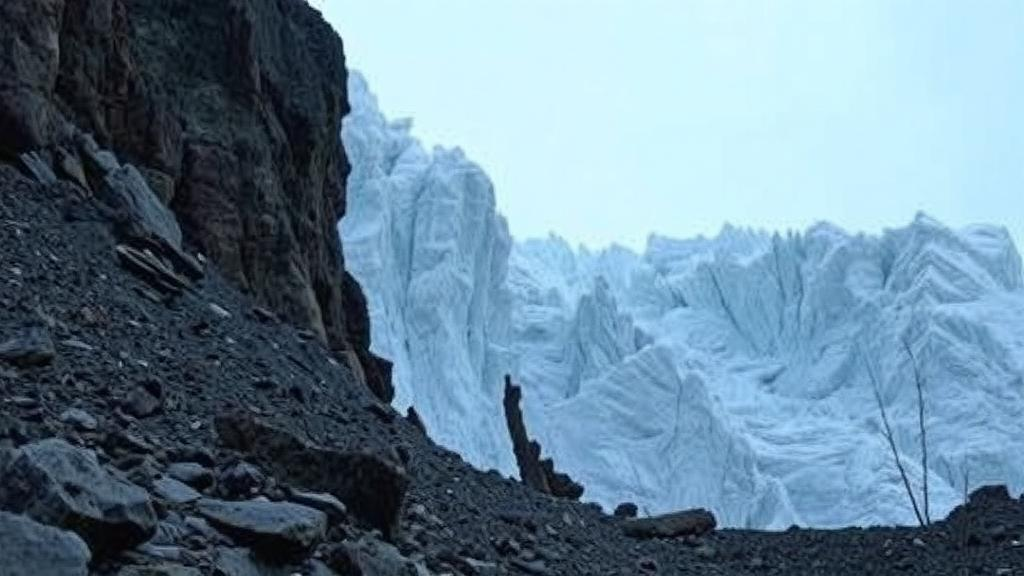
High in the world’s mountain ranges, a quiet transformation is underway. As global temperatures climb and glaciers retreat, more and more of their surfaces are becoming blanketed in rock debris shed from surrounding peaks. A new modelling study published in The Cryosphere by Florian Hardmeier, James C. Ferguson, and Andreas Vieli of the University of Zurich now reveals just how strange and deceptive the behavior of these debris-covered glaciers can be. Far from simply melting away in step with the climate, these glaciers respond on multiple, overlapping timescales, hiding dramatic changes beneath an apparently stable surface and then, in some cases, collapsing with startling speed after decades of apparent calm.
The insulating power of a rocky blanket has been recognized since the classic experiments of Østrem in 1959. A continuous debris layer just a few centimeters thick can dramatically slow the melting of ice beneath it, which is why many Himalayan and Alpine glaciers today sport long, sluggish tongues of debris-mantled ice that seem stubbornly resistant to warming. But the Zurich team argues that treating this debris layer as a static feature fundamentally misleads our understanding. Debris does not simply sit on a glacier; it is delivered by rockfalls and avalanches, entrained into the ice in the accumulation zone, carried along inside the glacier for centuries, and only much later melts out onto the surface in the ablation zone. Every stage of that journey couples back to the dynamics of the ice itself.
To capture this complexity, the researchers built a numerical flowline model based on the Shallow Ice Approximation that couples ice flow to a depth-resolved, two-dimensional advection scheme for englacial debris. Unlike earlier models that assumed a uniform debris concentration throughout the ice, their approach tracks debris concentration on a grid of 40 vertical layers and 50-meter horizontal spacing, allowing debris to be supplied at a prescribed rate and location entirely independently of the climate forcing. A novel entrainment scheme controls exactly how much debris enters the ice in the accumulation area, while a terminal ice-cliff boundary condition, in which surface debris slides off when ice thins below a critical height, prevents the unrealistic piling up of debris at the snout. The team validated the model against benchmark experiments from previous studies and tested its sensitivity to the ice rheology, grid resolution, and the so-called characteristic debris thickness that governs how strongly a given layer suppresses melt.
One of the study’s most striking quantitative results concerns how much warming debris cover can offset. The researchers introduced a metric they call dELA: the difference between the equilibrium line altitude of a debris-free glacier and that of a debris-covered glacier of equivalent size. They found that steady-state glacier size scales linearly with the rate of debris input, meaning that each increment of rocky supply buys a proportional amount of protection against a rising snowline. Intriguingly, this compensation is roughly independent of elevation, and because debris-covered tongues are long and thin, the effect on glacier length is about twice as strong as the effect on ice volume. More debris does not merely thicken the blanket; it stretches the glacier, and it does so in a predictable, linear fashion.
The real surprises emerged when the team subjected their model glaciers to abrupt climate change. When the equilibrium line altitude was raised by 100 meters, equivalent to roughly 1 to 1.25 degrees Celsius of warming, the debris-covered glacier entered a first phase lasting several decades in which its terminus refused to retreat at all, even as the ice beneath the debris thinned rapidly. Debris melted out of the stagnant ice and accumulated on the surface, expanding and thickening the insulating layer. Then came phase two: the weakened tongue suddenly collapsed, retreating abruptly within a few decades and shedding much of its debris cover in the process. Finally, in a third phase lasting centuries, the glacier slowly re-advanced as a thick new debris layer built up, eventually stabilizing at a length slightly beyond its post-collapse minimum. A debris-free glacier subjected to the same warming retreats smoothly and almost immediately by comparison.
This non-monotonic response, thinning, collapse, and then re-advance, is rooted in the slow journey of debris through the ice. When the climate warms, the equilibrium line climbs toward the debris source, shortening the englacial trajectory that debris must travel before melting out. Meanwhile, the thinner, slower glacier transports ice less efficiently, so the same absolute debris supply is spread over less ice flux, concentrating debris and thickening the surface layer. All three of these mechanisms push in the same direction: warming, counter-intuitively, increases both the extent and the thickness of debris cover. But because the enhanced debris concentrations must first be advected through the glacier interior, their full effect on the surface emerges only after a lag of centuries, producing the delayed re-advance that the authors identify as a previously unstudied feature of the debris-glacier system.
The model also demonstrates that debris-covered glaciers are extraordinarily good at filtering out short-term noise. When the researchers forced their glacier with sine-wave oscillations in climate or debris supply, fluctuations on decadal timescales had essentially no impact on glacier geometry. Even century-scale variations in debris input left the terminus almost perfectly stable, and only oscillations with wavelengths of 500 years produced a measurable response, one so phase-shifted that glacier volume appeared inversely related to debris supply. In practical terms, this means that the state of a debris-covered glacier today reflects long-term trends rather than recent disturbances, even more strongly than is the case for clean-ice glaciers. Short-term variability in rockfall activity or decade-scale climate wiggles simply never make it through the system’s long memory.
Large debris supply events are a different story. In a spike experiment, the team deposited a full meter of debris across the input zone in a single year, mimicking a catastrophic rock avalanche, and then watched the consequences unfold. The pulse of debris traveled englacially for centuries before surfacing, temporarily increasing both debris thickness and glacier extent for more than a hundred years. Similarly, step changes in debris input produced no reaction at all for roughly 300 years, followed by very slow adjustment. The authors caution that this debris advection response time depends critically on where debris enters the glacier relative to the equilibrium line: material deposited high in the accumulation zone travels a long, slow path through the ice, delaying its surface appearance by many centuries, whereas debris dropped directly onto the ablation zone takes effect almost immediately.
When the researchers moved from idealized forcing to something closer to reality, feeding their model a reconstructed 2,000-year equilibrium line history for the Alps followed by future scenarios from the IPCC, the filtering effect became even more apparent. Decadal fluctuations were smoothed out of the length response almost entirely, and the thick debris layers and re-advances seen in steady conditions only appeared during periods when the climate remained roughly constant for several centuries. Long-term climate variability, the study concludes, actively suppresses the formation of thick debris covers. Adding a realistic, undulated bed topography based on radar surveys of Switzerland’s Zmuttgletscher introduced yet another wrinkle: steep bedrock steps can cause sections of the thinning tongue to detach entirely, leaving pockets of stagnant dead ice and producing a stepped, stuttering retreat. Under the most extreme high-emission scenario, once the snowline climbed above the debris deposition zone into the headwall, the delayed re-advance vanished altogether and the glacier settled into centuries of extremely slow, relentless shrinkage.
The implications reach well beyond glacier modelling. Because englacial transport lags and dynamic feedbacks entangle the debris record with past climate and ice flow, reconstructing historical debris supply rates or climate conditions from the debris covers we observe today is inherently ambiguous, and may be impossible when both variables have changed. The authors also note that their results are sensitive to the characteristic debris thickness parameter, which varies widely between glaciers and studies, underscoring the need for glacier-specific field constraints. What the study offers instead is a clearer physical intuition: debris-covered glaciers are not simply slower versions of clean-ice glaciers but systems governed by their own distinct clock, one set by the centuries-long passage of rock through ice. Their apparent stability can be the most dangerous signal of all, masking thinning ice that may be poised for abrupt collapse, while their long memory means that today’s expanding debris covers are, in part, echoes of supply decisions made by mountains hundreds of years ago.
Subject of Research: Transient response and debris-transport feedbacks of debris-covered glaciers under changing climate and debris supply
Article Title: Feedbacks and timescales in the modelled transient response of debris-covered glaciers
Article References: Hardmeier, F., Ferguson, J. C., & Vieli, A. (2026). Feedbacks and timescales in the modelled transient response of debris-covered glaciers. The Cryosphere, 20(9), 5365-5392. https://doi.org/10.5194/tc-20-5365-2026
Image Credits: AI Generated
Keywords: debris-covered glaciers, glacier dynamics, englacial debris transport, ice flow modelling, climate change, response times, equilibrium line altitude, glacier retreat, The Cryosphere, numerical simulation, Himalaya, Alps
Cite Scienmag News
Sloane Callahan. (October 10, 2026). Buried in Rock: Why Debris-Covered Glaciers Collapse Suddenly After Decades of Silence. Scienmag. https://scienmag.com/buried-in-rock-why-debris-covered-glaciers-collapse-suddenly-after-decades-of-silence/
Sloane Callahan. "Buried in Rock: Why Debris-Covered Glaciers Collapse Suddenly After Decades of Silence." Scienmag, 10 October 2026, https://scienmag.com/buried-in-rock-why-debris-covered-glaciers-collapse-suddenly-after-decades-of-silence/. Accessed 10 October 2026.
Sloane Callahan. "Buried in Rock: Why Debris-Covered Glaciers Collapse Suddenly After Decades of Silence." Scienmag. October 10, 2026. https://scienmag.com/buried-in-rock-why-debris-covered-glaciers-collapse-suddenly-after-decades-of-silence/


