


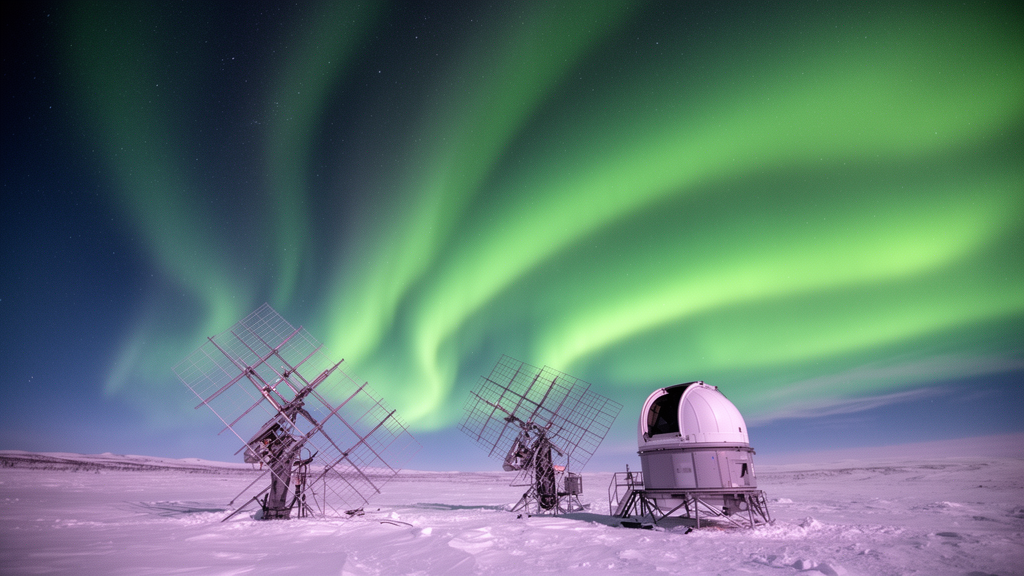
High above the Arctic island of Svalbard, on a quiet November afternoon in 2021, a series of shimmering auroral arcs drifted steadily toward the pole. To the naked eye they might have seemed like just another beautiful display of the northern lights. But for a team of space physicists, those arcs were the visible fingerprint of something far more consequential: ultra-low frequency waves in Earth’s magnetosphere doing something no one had directly caught them doing before — pushing ions of the atmosphere upward, toward space. A new study published in Annales Geophysicae presents what its authors describe as the first direct observations of ionospheric ion upflow generated by ULF wave driven auroral arcs, a finding that reshapes how scientists think about the constant exchange of mass and energy between our planet and near-Earth space.
The research, led by Charlotte M. van Hazendonk of The University Centre in Svalbard and the University of Bergen, together with Lisa J. Baddeley, Karl M. Laundal, and Noora Partamies, focuses on an event that unfolded between 13:00 and 14:30 Universal Time on 16 November 2021, under modest geomagnetic conditions with a Kp index of just 2. The team identified the event as a sequence of six auroral arcs marching poleward across the sky, visible primarily in the 630.0 nanometer oxygen emission line that glows at altitudes around 250 kilometers. Periodic arc sequences like these are the optical signature of ULF waves — magnetohydrodynamic oscillations with frequencies between one millihertz and one hertz — that transfer energy and momentum along geomagnetic field lines from the magnetosphere down into the ionosphere.
What makes the detection remarkable is the sheer breadth of instrumentation brought to bear on a single event. The team combined the European Incoherent Scatter Svalbard radar, a meridian scanning photometer at the Kjell Henriksen Observatory, and a chain of ground-based magnetometers with data from Defense Meteorological Satellite Program spacecraft, the Iridium constellation, and the Swarm satellites. Two inversion models tied the observations together: the ELSPEC method, which converts radar measurements of electron density into estimates of precipitating electron spectra and field-aligned currents, and the Lompe model, which fuses ground and space magnetometry with convection data to map the large-scale electrodynamics of the polar ionosphere. This multi-scale, multi-instrument strategy proved essential, because the event turned out to be far more complicated than any single dataset suggested.
The radar told the most dramatic part of the story. From 12:55 UT onward, the EISCAT Svalbard radar recorded periodic bursts of particle precipitation arriving roughly every ten minutes, each one heating the electron population and boosting electron densities in the E and F regions of the ionosphere. Crucially, the ion temperature stayed flat — there was no sign of frictional or Joule heating inside the narrow radar beam. That combination, enhanced electron temperatures and densities without ion heating, is the classic signature of what researchers call type 2 ion upflow. In this mechanism, hot electrons create an enhanced ambipolar electric field that drags the much heavier ions upward along the magnetic field, like a thermal elevator lifting atmospheric material toward the magnetosphere.
And the elevator was busy. Applying a standard detection criterion that requires upward ion velocities exceeding 100 meters per second across at least three consecutive altitude bins, the team calculated ion upflow fluxes ranging from 1 times 10 to the 13th to 1 times 10 to the 14th particles per square meter per second, with a median value of about 3.3 times 10 to the 13th. In the established classification scheme for Svalbard observations, that places the event squarely in the low-to-medium flux range — notable, because at such quiet geomagnetic activity one would normally expect only low fluxes. The upflow was real, measurable, and directly tied to the passing auroral arcs, yet satellite passes at 13:27 and 14:38 UT showed no evidence that the upflow had grown strong enough to escape as genuine ion outflow into the magnetosphere.
The energy accounting was equally striking. The ELSPEC inversion revealed field-aligned currents — vertical current systems that couple the ionosphere to the magnetosphere — reaching magnitudes of up to 6 microamperes per square meter during the brightest arcs, while the larger-scale Lompe analysis showed currents around 3 microamperes per square meter with an alternating up-down pattern across the arc region. Total energy fluxes peaked at 12 milliwatts per square meter in localized measurements and about 8 milliwatts per square meter at large scale, values confirmed independently by the DMSP satellites’ ultraviolet imager. Joule heating rates derived from the Lompe model reached 8 to 11 milliwatts per square meter in bands between oppositely directed current sheets. For context, these current and energy values are comparable to those previously reported for large-scale field line resonances — the grand, standing Alfvén waves of the magnetosphere — despite this event appearing, by several measures, to be small-scale.
That contradiction is the scientific heart of the paper. Ground magnetometers showed a phase variation exceeding the 180-degree change expected for a classical field line resonance, and a spectral power pattern inconsistent with a large-scale standing wave. The absence of ion temperature enhancements in the radar beam further argued against the frictional heating that field line resonances typically produce. Yet the current magnitudes and dissipation rates matched those of their large-scale cousins. The authors suggest several possible reconciliations: phase mixing may have broadened the frequency peak of an initially externally driven resonance, giving it small-scale characteristics; the radar beam, only about 3.5 kilometers wide at 250 kilometers altitude, may simply have missed the bulk of the Joule heating occurring to the south; or the wave energy may have been channeled preferentially into particle acceleration rather than resistive heating, a possibility hinted at by earlier work on kinetic Alfvén waves in the storm-time inner magnetosphere.
The study is also candid about the limits of the models. The Lompe inversion depends strongly on the assumed ionospheric conductance, and the team found that plausible variations in the poorly constrained background conductance could swing the inferred convection velocities and Joule heating rates substantially. Magnetometers, moreover, integrate currents over wide areas and are susceptible to ocean-induced signals that can contribute up to half of the measured disturbance, while small-scale ULF waves are often attenuated before they ever reach the ground. The five-minute analysis windows used in the model also smooth over a significant fraction of the wave’s fifteen-minute cycle. The authors therefore weight the direct radar and optical observations most heavily, and they call for future studies with space-based auroral imaging and spatially extended incoherent scatter measurements to pin down the conductance and complete the energy budget.
Why does this matter beyond the physics of pretty lights? Ion outflow is a fundamental source of plasma for the magnetosphere, influencing everything from satellite-damaging storm dynamics to the long-term evolution of planetary atmospheres. Establishing that even small-scale, quiet-time ULF waves can drive significant ion upflow — with energy dissipation rates rivaling their large-scale counterparts — means the contribution of these waves to the global mass and energy budget has likely been underestimated. It also validates the Samson-Rankin framework, in which field-aligned electric fields within the wave structure accelerate electrons downward to paint the arcs while simultaneously setting ions in motion upward. The Svalbard event, captured on closed magnetic field lines in the post-noon sector, demonstrates that the ionosphere and magnetosphere are coupled in both directions at once: energy pours down as accelerated particles, and matter climbs back up in response. For a phenomenon triggered by waves oscillating just once every fifteen minutes, the consequences ripple far beyond the auroral oval.
Subject of Research: First observations of ionospheric ion upflow driven by ULF wave auroral arcs at high latitude
Article Title: High-latitude observations of ULF wave driven ion upflow
Article References: van Hazendonk, C. M., Baddeley, L. J., Laundal, K. M., & Partamies, N. (2026). High-latitude observations of ULF wave driven ion upflow. Annales Geophysicae, 44(2), 697-714. https://doi.org/10.5194/angeo-44-697-2026
Image Credits: AI Generated
DOI: 10.5194/angeo-44-697-2026
Keywords: ion upflow, ULF waves, aurora, ionosphere, magnetosphere, Svalbard, EISCAT, field-aligned currents, Joule heating, field line resonance, space physics, Annales Geophysicae
Cite Scienmag News
Violet Maxwell. (October 9, 2026). Auroral Arcs Reveal First Observations of ULF Waves Driving Ion Upflow. Scienmag. https://scienmag.com/auroral-arcs-reveal-first-observations-of-ulf-waves-driving-ion-upflow/
Violet Maxwell. "Auroral Arcs Reveal First Observations of ULF Waves Driving Ion Upflow." Scienmag, 9 October 2026, https://scienmag.com/auroral-arcs-reveal-first-observations-of-ulf-waves-driving-ion-upflow/. Accessed 9 October 2026.
Violet Maxwell. "Auroral Arcs Reveal First Observations of ULF Waves Driving Ion Upflow." Scienmag. October 9, 2026. https://scienmag.com/auroral-arcs-reveal-first-observations-of-ulf-waves-driving-ion-upflow/


