


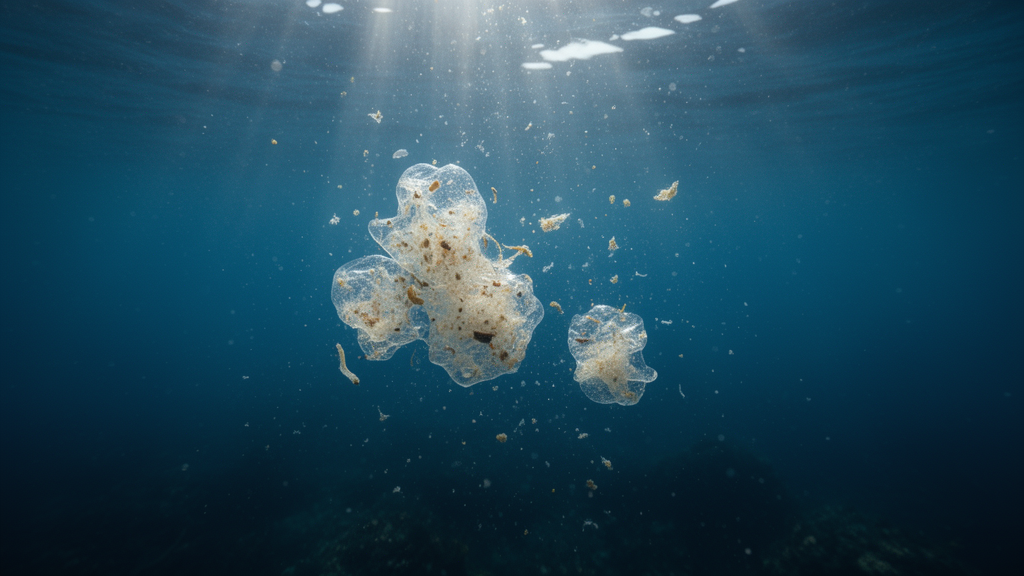
In the deep sea, it never stops snowing. But this snow bears no resemblance to the crystalline flakes that drift onto winter landscapes on land. Marine snow, as ocean scientists call it, is a continuous rain of tiny clumps of organic and inorganic detritus—mucus, fecal pellets, silt, dead plankton, and a shifting gallery of microbial life—that descends from the sunlit shallows toward the abyssal dark. These particles are far more than marine litter. They are the ocean’s principal conveyor belt for carbon, carrying the greenhouse gas locked into living tissue away from the atmosphere and down toward long-term storage on the seafloor. Scientists estimate that marine snow transports more than 10 gigatons of carbon away from the ocean’s surface every year, a staggering figure that dwarfs many human efforts to manage the carbon cycle. Yet only around two gigatons of that annual flux is believed to sink deep enough to be sequestered for hundreds to thousands of years. What happens to the rest, and why so much carbon never completes the journey, has been one of the most stubborn questions in ocean biogeochemistry.
A new study published on October 8 in the journal Science by researchers at the University of California San Diego’s Scripps Institution of Oceanography and the University of Lincoln offers a strikingly simple answer to part of that puzzle: the gooier the particle, the better it performs. The team found that the viscosity of marine snow—its thickness, its stickiness, its sheer sliminess—can have a decisive impact on how quickly bacteria break the particles down and how far they ultimately sink. According to the researchers’ estimates, high-viscosity marine snow can shuttle more than six times as much carbon into the deep ocean as its runnier, less viscous counterparts. In a field where global carbon budgets hinge on precisely these kinds of particle-level details, a sixfold difference tied to a single physical property is the sort of result that forces modelers and field scientists alike to rethink their assumptions about how the biological carbon pump actually works.
The breakthrough began, as many do, with a technical frustration. In 2021, Bryce Inman, then a postdoctoral scholar at Scripps Oceanography, set out to visualize what he describes as the muscoscape—the intricate, microscopic world of bacteria living within and upon mucus. The obstacle was fundamental: no one had ever directly observed individual bacteria interacting with the physical structure of mucus, whether in the ocean or anywhere else. For four years, Inman and his colleagues, including Farooq Azam, a microbiologist and professor emeritus at Scripps, attempted and failed to make such observations possible. Mucus is transparent, delicate, and notoriously difficult to image without destroying the very architecture researchers hoped to study. It was not until 2025 that the team finally cracked the problem, developing a method that allowed them to see, for the first time, the hidden topography of a particle that sinks past billions of microbes every day.
The solution combined 3D confocal microscopy with specialized fluorescent molecules designed to label the mucus itself. With this toolkit, the researchers could map the physical terrain of individual clumps of marine snow in three dimensions and watch how bacteria navigated that landscape in real time. The technical details of the imaging method are described in a companion paper published in Nature Communications. What the technique revealed was unexpected: marine snow is not a homogeneous blob of slime but a structured habitat, riddled with bulges, crevasses, and regions of dramatically different consistency. Mucus, Inman noted, has a surprising amount of structure at a scale smaller than bacteria—a physical microenvironment that scientists had never previously been able to examine directly. The finding effectively opens a new window onto a habitat that covers much of the living world.
That structure matters because it shapes the battle between sinking particles and the bacteria that consume them. Like snowflakes on land, no two marine snow particles are alike; each is assembled from a different combination of organic and inorganic molecules, and each differs in its gooeyness. Using their new imaging approach, the researchers determined that bacteria can colonize the less viscous zones near a particle’s surface far more easily than the denser, more viscous regions deeper inside. Bacteria, Inman explained, can latch onto the less viscous portions of each particle but cannot reach the more viscous regions until they break them down first. He offered a vivid analogy: it is like a worm in an apple, where the flesh is easy to penetrate but the core is tough to chew through. The outer layers of a marine snow particle are an open buffet; the interior is a fortress.
The consequences of that microbial siege are profound for the carbon cycle. In a series of laboratory experiments, the team found that more viscous marine snow takes significantly longer for bacteria to degrade and fragment. Every hour a particle resists consumption is another hour it spends sinking, and every additional meter of descent moves its carbon cargo further from the surface reservoir where it could quickly return to the atmosphere. Computer simulations extended the laboratory findings, suggesting that the more viscous a particle is, the deeper it will ultimately sink. When Inman and his colleagues translated those results into global terms, they estimated that high-viscosity marine snow can carry more than six times the carbon to the deep ocean compared with low-viscosity particles. How far marine snow can sink, Inman observed, is a surprisingly complicated problem, and the new work adds another—very gooey—piece to the puzzle.
The study is also notable for being the first time scientists have examined live bacteria interacting with the physical structure of marine snow, or with any mucus for that matter. That gap in knowledge was never trivial. Interactions between mucus and bacteria are critical to maintaining the health of life across the planet: coral reefs depend on their surface mucus layers to host protective microbial communities, kelp forests rely on similar partnerships, land plant root systems negotiate with bacteria through mucilaginous coatings, and animal and human digestive tracts function only because of the finely tuned relationships between gut mucus and resident microbes. A method that finally makes the muscoscape visible therefore has implications far beyond oceanography, offering researchers in medicine, microbiology, and ecology a new way to study how bacteria behave inside the slimy matrices they inhabit.
For ocean and climate scientists, the findings arrive at a moment of intense scrutiny of the biological carbon pump, the suite of processes by which marine life exports carbon from the surface ocean. Global carbon models have long struggled to reconcile the enormous annual flux of marine snow with the much smaller fraction that reaches long-term storage depths. Viscosity, the new work suggests, is a variable that has been largely absent from those calculations, yet it may help explain why some particles survive the gauntlet of degradation while others dissolve into remineralized carbon within the upper ocean. If the distribution of particle gooeyness varies across ocean regions, seasons, or warming-driven changes in plankton communities, then the efficiency of the ocean’s carbon sink may be far more sensitive to microbial ecology than current models assume. Incorporating viscosity into future estimates could sharpen predictions of how much atmospheric carbon the ocean will continue to absorb as the climate changes.
The research was supported in part by additional funding from the Simons Foundation and the Engineering and Physical Sciences Research Council, and it reflects a broader shift in marine science toward treating microscopic processes as the engines of planetary-scale phenomena. What began as an effort to image slime in a laboratory dish has ended up quantifying a property that helps determine the fate of gigatons of carbon each year. As Inman and his colleagues continue to explore the muscoscape, the message of the new study is clear: the ocean’s carbon future may depend, in no small part, on how sticky its snow turns out to be. In the deep sea, where the snow never stops falling, gooiness is not a curiosity—it is climate machinery.
Subject of Research: The role of marine snow viscosity in microbial degradation and deep-ocean carbon transport
Article Title: The gooier marine snow is, the better it is at transporting carbon, new study finds
Article References: The gooier marine snow is, the better it is at transporting carbon, new study finds. (n.d.). Original publication
Image Credits: AI Generated
DOI: Not provided
Keywords: marine snow, carbon cycle, ocean carbon sink, viscosity, bacteria, mucus, Scripps Institution of Oceanography, biological carbon pump, confocal microscopy, deep ocean, biogeochemistry, Science journal
Cite Scienmag News
Violet Maxwell. (October 9, 2026). Sticky Marine Snow Sinks Carbon Deeper, Study Reveals Slime’s Ocean Role. Scienmag. https://scienmag.com/sticky-marine-snow-sinks-carbon-deeper-study-reveals-slimes-ocean-role/
Violet Maxwell. "Sticky Marine Snow Sinks Carbon Deeper, Study Reveals Slime’s Ocean Role." Scienmag, 9 October 2026, https://scienmag.com/sticky-marine-snow-sinks-carbon-deeper-study-reveals-slimes-ocean-role/. Accessed 9 October 2026.
Violet Maxwell. "Sticky Marine Snow Sinks Carbon Deeper, Study Reveals Slime’s Ocean Role." Scienmag. October 9, 2026. https://scienmag.com/sticky-marine-snow-sinks-carbon-deeper-study-reveals-slimes-ocean-role/


