


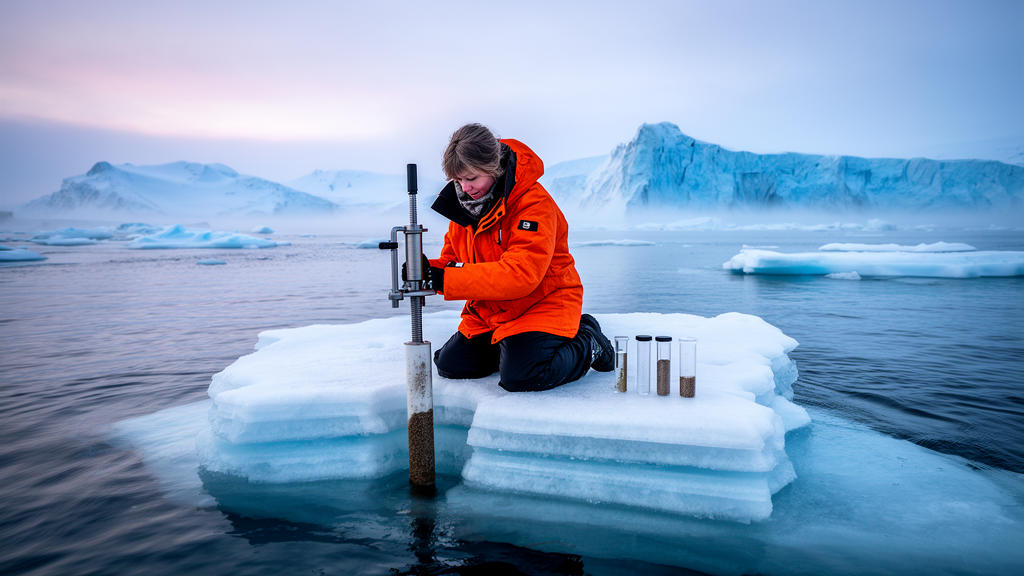
Deep in the strait between Greenland and Svalbard, the waters leaving the Arctic Ocean carry a hidden signature that scientists have learned to read like a passport stamp. It comes not from nature alone, but from nuclear reprocessing plants at Sellafield in the United Kingdom and La Hague in France, whose discharges decades ago tagged Atlantic waters with two long-lived radionuclides: iodine-129 and uranium-236. A new study published in Ocean Science by Marcel Scheiwiller of ETH Zurich and colleagues has now used these man-made tracers to reconstruct, year by year, how warm Atlantic-derived waters circulate through the Arctic and exit through Fram Strait, the single most important gateway between the Arctic Ocean and the subpolar North Atlantic.
The team combined measurements of iodine-129 and uranium-236 collected during expeditions aboard the research vessel Kronprins Haakon in August 2020 and July and August 2021, with earlier data from 2016, to build a six-year picture of change. In total, 119 samples for iodine-129 were collected in 2020 and 115 in 2021, along with uranium-236 measurements from a companion dataset. Because both isotopes behave conservatively in seawater and have half-lives measured in millions of years, their concentrations act as faithful recorders of when and where a water parcel last contacted the Atlantic surface. The key to decoding them lies in the different timing of their inputs: the major pulse of iodine-129 entered the ocean in the late 1990s, while the peak of uranium-236 arrived much earlier, in the 1960s, largely from atmospheric nuclear weapons tests.
By comparing the ratio of these two tracers in a sample against known input curves at the entrance to the Arctic Ocean, the researchers could estimate how long the water had been in transit. They applied two complementary models. The first, a binary mixing model, assumes purely advective flow and yields a single tracer age for surface Polar Water. The second, a Transit Time Distribution model, goes further: it treats each water parcel as a blend of many transit times, producing a mean age, a most probable age, and a mixing parameter that quantifies how much different water parcels have stirred together. Crucially, the team extended the Transit Time Distribution approach to the surface layer for the first time, after correcting for dilution by freshwater and by Pacific-derived waters carrying only the weak global fallout background.
The results revealed striking year-to-year variability that no single snapshot could have captured. Water exiting the strait in 2020 showed a markedly higher degree of mixing throughout the water column, along with a stronger influence from the Amerasian Basin, the half of the Arctic Ocean that includes the Canada Basin and the Beaufort Gyre. By contrast, waters sampled in 2021 had generally longer transit times, consistent with either slower circulation or longer, more circuitous transport pathways. Mean tracer ages of surface Polar Water rose from about 18 years in 2016 to 22 years in 2020 and 23 years in 2021, while the most probable ages of the mid-depth Arctic Atlantic Water layer also increased in 2021, with several samples exceeding 20 years.
One of the most remarkable discoveries came from the Greenland Shelf, where a small cluster of three samples in 2020 displayed an unusual combination of low iodine-129 and high uranium-236 concentrations. That signature points to old water, with most probable ages between 21 and 28 years, and the researchers attribute it to a distinct water parcel that followed a long circulation route originating in the Canada Basin before reaching the strait. Elsewhere on the shelf, samples with the lowest uranium-236 concentrations of the entire dataset likely reflected waters that had recirculated locally, possibly within the East Greenland Coastal Current, where dilution reduced their tracer content. These fine-scale structures would be nearly impossible to detect with conventional temperature and salinity measurements alone.
The 2020 findings also illuminate the behavior of Recirculating Atlantic Water, the portion of the warm inflow that never enters the Arctic basin but instead loops back within the strait and joins the southward-flowing East Greenland Current. Roughly half of the Atlantic Water entering Fram Strait is estimated to recirculate, driven in part by mesoscale eddies. In 2020, mid-depth samples from the central strait showed young most-probable ages of just 7 to 9 years paired with very broad mixing parameters, a combination the authors interpret as evidence of substantial blending between freshly recirculated Atlantic Water and older water that has completed a full circuit of the Arctic Ocean.
Why does this variability matter? The Atlantic Water layer is the Arctic Ocean’s principal source of oceanic heat, and its progressive intrusion into the basin, a process known as Atlantification, weakens vertical stratification, promotes upward heat flux, and accelerates sea ice melt. The Arctic is warming more than twice as fast as the global average, and climate projections suggest a seasonally ice-free Arctic Ocean by mid-century. Understanding how quickly heat-bearing waters move through the basin, and how much they mix along the way, is therefore essential for predicting how fast that heat reaches the sea ice and how the Arctic will feed back into the wider climate system, including the Atlantic Meridional Overturning Circulation, whose lower limb depends on waters exported from the Arctic.
The study also carries a methodological warning. The researchers found that simple tracer ages agreed well with the more sophisticated Transit Time Distribution estimates only when mixing was minimal. Where mixing was strong, the two approaches diverged systematically, meaning that tracer ages can paint a deceptively uniform picture of surface flow. As sea ice retreats, more wind energy is transferred to the ocean, generating turbulence and increasing mixing, so the authors argue that distribution-based methods will become increasingly important for accurate age estimates across the Arctic. They also note that the 2020 shift toward Amerasian source waters may be linked to the post-2019 release of freshwater accumulated in the Beaufort Gyre, while the 2021 return toward Eurasian-dominated waters is consistent with a reversion to cyclonic circulation following an anomalously high Arctic Oscillation index in 2020.
Looking ahead, the authors emphasize that sustained tracer observations at Fram Strait are crucial for constraining changes in the circulation of the heat-bearing Atlantic Water layer. They advocate a comprehensive multi-tracer strategy, combining iodine-129 and uranium-236 with chlorofluorocarbons, sulfur hexafluoride, tritium, and naturally occurring tracers such as neodymium isotopes and colored dissolved organic matter, to reduce uncertainties and disentangle the contributions of Pacific and Atlantic source waters. Because different tracers respond uniquely to boundary conditions and source histories, integrating them would yield more robust transit-time estimates independent of any single tracer’s quirks. In an ocean whose circulation is being reshaped by warming, these radioactive fingerprints offer one of the few direct ways to watch the Arctic’s plumbing change in real time, and the year-to-year swings documented between 2016 and 2021 suggest that the plumbing is anything but static.
Subject of Research: Circulation timescales and water mass mixing of Atlantic-derived waters in Fram Strait traced with anthropogenic radionuclides iodine-129 and uranium-236
Article Title: Enhanced water mass mixing in Fram Strait in 2020 and elevated circulation timescales of Atlantic-derived waters in 2021 based on transient tracers I-129 and U-236
Article References: Scheiwiller, M., Wefing, A.-M., Pérez-Tribouillier, H., Vockenhuber, C., Dodd, P. A., Gwynn, J. P., & Casacuberta, N. (2026). Enhanced water mass mixing in Fram Strait in 2020 and elevated circulation timescales of Atlantic-derived waters in 2021 based on transient tracers I-129 and U-236. Ocean Science, 22(5), 2779-2808. https://doi.org/10.5194/os-22-2779-2026
Image Credits: AI Generated
Keywords: Fram Strait, Arctic Ocean, iodine-129, uranium-236, Atlantic Water, transit time distribution, water mass mixing, Atlantification, nuclear reprocessing tracers, ocean circulation, Beaufort Gyre, climate change
Cite Scienmag News
Violet Maxwell. (October 9, 2026). Nuclear Fallout Fingerprints Reveal a Shifting, Warming Arctic Gateway. Scienmag. https://scienmag.com/nuclear-fallout-fingerprints-reveal-a-shifting-warming-arctic-gateway/
Violet Maxwell. "Nuclear Fallout Fingerprints Reveal a Shifting, Warming Arctic Gateway." Scienmag, 9 October 2026, https://scienmag.com/nuclear-fallout-fingerprints-reveal-a-shifting-warming-arctic-gateway/. Accessed 9 October 2026.
Violet Maxwell. "Nuclear Fallout Fingerprints Reveal a Shifting, Warming Arctic Gateway." Scienmag. October 9, 2026. https://scienmag.com/nuclear-fallout-fingerprints-reveal-a-shifting-warming-arctic-gateway/


