


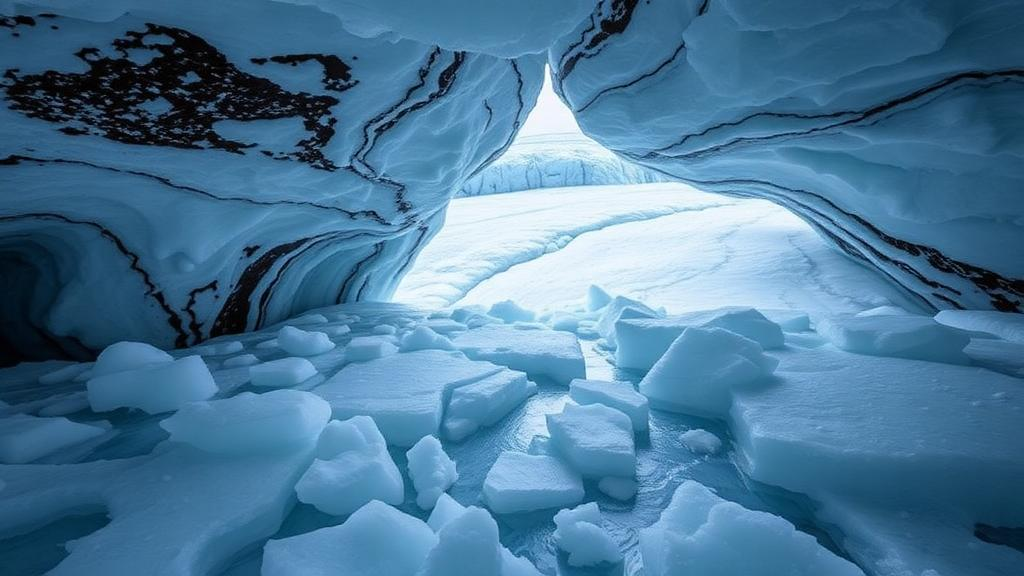
Deep inside some of the Alps’ smallest glaciers, scientists have discovered a hidden architecture of cold and warm ice that could make these vanishing ice bodies more dangerous than anyone assumed. A team led by Janosch Beer of ETH Zurich drilled into six small Swiss glaciers and lowered thermistor strings into the boreholes, producing the most detailed picture yet of ice temperatures in the poorly studied elevation band between 2700 and 3800 meters. Their finding is striking: half of the glaciers surveyed are polythermal, meaning they harbor both cold ice below the melting point and temperate ice at the pressure melting point within the same ice body. Because cold ice can seal drainage pathways and trap meltwater under pressure, the discovery suggests that hazardous glacier configurations may be far more common in the Alps than the sparse observational record has implied.
The physics of why a glacier can be simultaneously frozen and thawing is subtle. Englacial temperature reflects a tug-of-war between several heat sources and sinks: the surface energy balance that drives the winter cold wave downward, strain heating produced as ice deforms under its own weight, the modest geothermal heat flux from below, and latent heat released when meltwater percolates into the ice and refreezes. A glacier is classified as temperate when all of its ice sits at the pressure melting point, cold when it remains entirely below that threshold, and polythermal when both regimes coexist. The boundary between the two, known as the cold-temperate transition surface, or CTS, is a critical feature because it controls where water can move freely and where it becomes imprisoned.
Until now, almost all englacial temperature measurements in the Alps came from high-elevation accumulation zones above 3800 meters, in the Monte Rosa, Mont Blanc and Bernese Alps massifs, where cold firn has historically dominated. The ablation zones at lower elevations, where ice is actively melting away, were essentially unmeasured, with only a handful of exceptions dating back to pioneering nineteenth-century observations and a few studies from the 1970s. The new study targeted precisely this gap. The team selected six glaciers smaller than half a square kilometer, chosen for their minimal strain heating, limited crevassing, and, at two sites, the availability of historical borehole data for comparison. Between the summers of 2024 and 2025 they drilled 23 boreholes, using a portable steam drill for shallow holes and a hot-water drill system for deeper ones reaching up to 58.3 meters down to the glacier bed.
The measurement campaign was technically demanding. Tinytag loggers with an accuracy of plus or minus 0.2 degrees Celsius were installed in shallow boreholes, while multi-sensor Geoprecision thermistor chains, accurate to 0.05 degrees Celsius, were deployed in the deep holes after calibration in an ice bath and a temperature-controlled alcohol bath. Sensors were corrected for surface melt that thinned the ice above them during the year of deployment. To extend the point measurements into a spatial picture, the team ran ground-penetrating radar surveys along glacier centerlines and, at one site, flew an uncrewed aerial vehicle carrying an 80-megahertz radar antenna in a grid pattern with four-meter line spacing. The radar exploits a simple contrast: cold ice, lacking liquid water, is nearly transparent to radar waves, whereas temperate ice containing water at grain boundaries scatters the signal diffusely.
The results confirmed polythermal conditions at three glaciers: Alphubel South, Chessjengletscher and Hohsaasgletscher. In each case the cold-temperate transition surface lay between 17 and 38 meters below the surface, and ice temperatures ranged from temperate at depth down to minus 2.1 degrees Celsius near frozen termini. A consistent spatial pattern emerged across all three sites: temperate ice occupied the higher reaches of each glacier, while the tongues were fully or partially cold-based. At Alphubel, the only site with direct evidence of a completely frozen terminus, temperatures at the bed dropped as low as minus 2.1 degrees Celsius, and the vertical structure was inverted in an unusual way, with a temperate core sandwiched between a cold surface layer and a cold bed. At Chessjen, a borehole that reached temperate basal ice in early August had cooled to minus 0.43 degrees Celsius by mid-December, revealing a seasonally evolving basal regime in which meltwater sustains warmth through summer and refreezing sets in once melt ceases.
The radar surveys broadly corroborated the borehole thermometry, with enhanced scattering marking temperate zones and clean, transparent signal characterizing cold ice. At Chessjen and Hohsaas, near-bed scattering hinted that temperate basal conditions extend beyond what the borehole network could resolve. At Alphubel, the radar profile was unexpectedly clean even where boreholes confirmed temperate ice, likely because the survey took place in mid-May, when liquid water content at 3800 meters is at its seasonal minimum. The team also compared their data with historical measurements at two sites. At Glacier du Sex Rouge, where a polythermal structure with a roughly 20-meter cold surface layer was documented in 2013 to 2015, the new data suggest that structure likely persists, with about 20 meters of surface ice lost to ablation since then complicating direct comparison. At Vadret dal Corvatsch, which registered around minus 4 degrees Celsius at 13 meters depth in 1999 and 2000, the glacier has thinned so dramatically that its entire ice column, now just 9.3 meters thick, is subject to seasonal fluctuations, yet it remains below freezing year-round, aided by its exposed ridge geometry that promotes lateral heat loss.
The most consequential insight of the study concerns firn, the multi-year snowpack that blankets glacier accumulation zones. Firn acts as a thermal reservoir: meltwater percolates into its porous structure and refreezes at depth, releasing latent heat that warms the underlying ice. When firn cover is lost, that heat source vanishes. Meltwater instead runs off over impermeable ice or refreezes at the surface, where its heat escapes quickly to the atmosphere. The team reconstructed firn cover evolution at all six sites from 1970 to 2025 using a distributed mass balance model calibrated with stake readings and snow-probing data from the GLAMOS monitoring network. The correlation was unmistakable: sites that lost their firn earliest, such as Sex Rouge, Tortin and Corvatsch, which have been firn-free for more than three decades, show the most advanced cooling, while Alphubel, firn-free for less than a decade at the borehole locations, retains temperate ice beneath its upper reaches. At Chessjen and Hohsaas, the depth of the transition surface tracks the local history of firn loss, deepest where firn disappeared first.
Counterintuitively, this means that warming air temperatures can drive glaciers to cool from the inside out. The loss of retained latent heat from refreezing meltwater can outweigh other heat inputs, allowing the winter cold wave to penetrate ever deeper. Conductive cooling of a temperate layer tens of meters thick proceeds over decades, and the observed transition depths of 17 to 20 meters align well with the roughly 20 to 25 meters of cooling expected over the firn-free period. Residual pore water refreezing ahead of the descending cold front, along with meltwater still draining from remnant firn patches through crevasses and bergschrunds, slows the process and sustains temperate cores longer than pure conduction would predict. In the 1980s, the authors argue, these glaciers were likely entirely temperate, warmed by extensive firn, vigorous crevassing that channeled water inward, and faster flow that generated more strain heating. Sustained warming has since dismantled each of those heat sources in turn.
The hazard implications are sobering. Polythermal glaciers are not inherently dangerous, but a configuration combining a frozen terminus with a temperate upper glacier is known to promote meltwater accumulation beyond a glacier’s drainage capacity, because cold ice inhibits the development of efficient drainage systems. The 2022 collapse of the Marmolada Glacier in the Dolomites, which killed eleven people, has been linked to just such a configuration, in which cold basal ice likely prevented meltwater from draining, leading to a frontal ice break-off. During drilling at Alphubel, the team witnessed a dramatic illustration of the mechanism: pressurized water escaped from a borehole at about 15 meters depth, producing a fountain three to five meters high, evidence that water pressure locally exceeded the ice overburden and that meltwater had been trapped with no escape route.
How many other glaciers share this configuration? Filtering the Swiss Glacier Inventory 2023 for glaciers smaller than 0.5 square kilometers between 2900 and 3800 meters yields approximately 515 candidates in Switzerland alone, a figure the authors consider an underestimate because small hanging glaciers are often mapped as parts of larger accumulation areas. The team’s borehole records have been added to the global glenglat database, and the researchers call for systematic regional-scale thermal observations and modeling to assess which of these glaciers may be developing hazardous polythermal structures. As the Alps continue to warm and firn lines climb ever higher, the invisible thermal architecture inside the smallest glaciers may prove to be one of the most consequential, and least expected, legacies of climate change.
Subject of Research: Borehole thermometry revealing polythermal ice conditions in small Swiss Alpine glaciers and their link to firn cover loss
Article Title: Polythermal conditions in small glaciers in the Swiss Alps
Article References: Beer, J., Jacquemart, M., Huss, M., Santin, I., Clara Racz, G., Ogier, C., Gindraux, S., Hösli, L., Moser, R., Irving, J., Fischer, M., & Farinotti, D. (2026). Polythermal conditions in small glaciers in the Swiss Alps. The Cryosphere, 20(9), 5453-5473. https://doi.org/10.5194/tc-20-5453-2026
Image Credits: AI Generated
Keywords: glaciology, polythermal glaciers, Swiss Alps, firn cover, borehole thermometry, ground-penetrating radar, englacial temperature, glacier hazards, climate change, cold-temperate transition surface, Marmolada, The Cryosphere
Cite Scienmag News
Sloane Callahan. (October 9, 2026). Hidden zones of frozen ice are spreading inside Switzerland’s shrinking glaciers. Scienmag. https://scienmag.com/hidden-zones-of-frozen-ice-are-spreading-inside-switzerlands-shrinking-glaciers/
Sloane Callahan. "Hidden zones of frozen ice are spreading inside Switzerland’s shrinking glaciers." Scienmag, 9 October 2026, https://scienmag.com/hidden-zones-of-frozen-ice-are-spreading-inside-switzerlands-shrinking-glaciers/. Accessed 9 October 2026.
Sloane Callahan. "Hidden zones of frozen ice are spreading inside Switzerland’s shrinking glaciers." Scienmag. October 9, 2026. https://scienmag.com/hidden-zones-of-frozen-ice-are-spreading-inside-switzerlands-shrinking-glaciers/


