


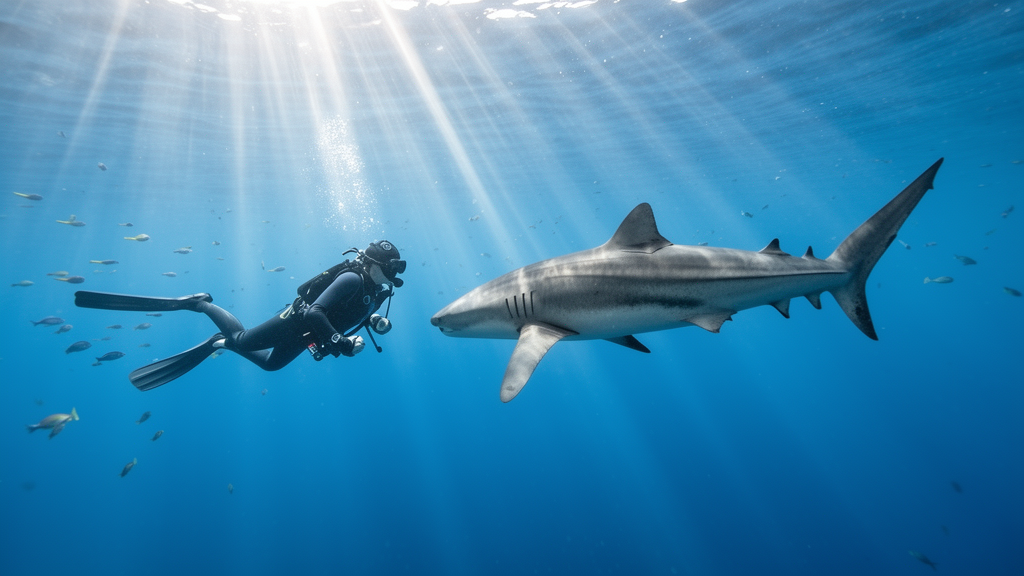
A single encounter with a shark in open water may do far more than deliver an adrenaline rush. A new longitudinal study published in npj Ocean Sustainability provides some of the strongest evidence yet that nature-based tourism can produce conservation behavior that persists long after the wetsuit dries. Researchers followed people who participated in a shark ecotourism program in Hawaiʻi and found that, two years later, they were substantially more likely to engage in shark conservation actions than members of the general public who had never taken part in the program.
The research, led by Carmen Dobszewicz and Michele Barnes of the University of Sydney, together with colleagues at James Cook University, the University of Sydney’s School of Social and Political Sciences, the University of Manchester, and Dalhousie University, tackled a stubborn gap in the literature on nature-based solutions. Shark ecotourism is widely promoted as a way to align ocean economies with ocean protection, but most studies of its effects rely on surveys taken immediately after an experience, when enthusiasm is at its peak. Whether that enthusiasm translates into durable behavior change has been notoriously difficult to demonstrate.
To get around this problem, the team employed a quasi-experimental, longitudinal design. They surveyed shark tour participants at the time of their tour and again two years later, and they surveyed a comparison group drawn from the general public over the same period. This structure matters because simply measuring people before and after an experience cannot separate the effect of the experience itself from broader trends, such as rising environmental awareness across society or the tendency of already-committed conservationists to sign up for shark dives in the first place.
The analytical approach was correspondingly rigorous. The researchers used a Bayesian model designed for quasi-experimental repeated cross-sections, combined with inverse-probability weighting and attrition adjustment. In practical terms, these techniques allowed the team to correct for baseline differences between tour participants and non-participants, and to account for the fact that some respondents dropped out of the study between the first and second survey rounds. Without such corrections, the apparent effect of the tour could have been inflated by self-selection: people who choose to swim with sharks may already care more about the ocean than the average beachgoer.
The headline result is striking. Participation in the shark ecotourism program was associated with a 40 percent increase in the likelihood of engaging in shark conservation behavior two years after the tour, with a credible interval of 26 to 55 percent. In other words, even after statistically accounting for who signs up for such experiences and who stayed in the study, the tour itself emerged as a strong predictor of lasting pro-conservation action. The Bayesian framing also means the estimate expresses uncertainty transparently rather than resting on a single binary significance threshold.
Importantly, the study found that overall conservation engagement increased among all respondents during the study period, not just among tour participants. This is precisely why the comparison group was essential. If everyone in Hawaiʻi was becoming more conservation-minded over those two years, a naive before-and-after comparison of tour participants might have credited the tour for a societal trend. Instead, the sustained gap between participants and non-participants provides suggestive evidence that the experiential component of the tourism program produced an effect above and beyond the background rise in environmental engagement.
The researchers also looked closely at what kinds of conservation behavior people actually adopted. The most common forms of engagement were relatively low-barrier actions, such as sharing shark conservation content on social media and making donations to conservation causes. These findings are telling for anyone designing outreach campaigns. Ecotourism appears to convert awe into accessible forms of advocacy rather than immediately producing deep commitments like volunteering or policy engagement. That pattern suggests a pipeline: experiences create emotional connection, emotional connection fuels visible and shareable advocacy, and that advocacy may normalize pro-shark attitudes across wider social networks.
Just as valuable are the study’s insights into barriers. By identifying what prevents participants from moving from casual engagement to deeper involvement, the research offers actionable guidance for conservation organizations. If the main obstacles are practical, such as lack of information about where to direct support, then simple follow-up communication from tour operators could bridge the gap. If the obstacles are motivational or structural, different interventions would be needed. Either way, the study frames ecotourism not as a magic bullet but as one entry point in a longer pathway of engagement that operators, NGOs, and policymakers can deliberately extend.
The implications extend well beyond sharks. Marine ecotourism is a growing industry worldwide, from whale watching in Norway to manta ray dives in the Maldives, and it is frequently pitched to governments and investors as a nature-based solution that pays for itself. Demonstrating a measurable, persistent behavioral effect strengthens the economic and social case for these programs. It also raises the bar for the industry: if the conservation dividend depends on the quality of the experience, then operators have an incentive to invest in education, interpretation, and meaningful wildlife encounters rather than spectacle alone.
Caveats remain, and the authors are careful about them. The design is quasi-experimental rather than a randomized trial, so the findings are described as suggestive evidence of a durable effect rather than definitive proof of causation. The study examined a single program in a single location, and Hawaiʻi’s distinctive cultural relationship with sharks may not generalize everywhere. Still, the combination of longitudinal follow-up, a public comparison group, and sophisticated statistical adjustment represents a major methodological advance for a field long dominated by one-off exit surveys. If replicated across other programs and species, the result could reshape how conservation funders think about experiential nature tourism, treating it not merely as revenue or recreation but as a scalable, measurable investment in long-term environmental behavior.
Subject of Research: Long-term effects of shark ecotourism on conservation behavior in Hawaiʻi
Article Title: Nature-based experiences support lasting conservation behavior: longitudinal evidence from shark ecotourism in Hawaiʻi
Article References: Dobszewicz, C., Banchik, A., Pepin-Neff, C., Sutcliffe, S., MacNeil, M. A., & Barnes, M. L. (2026). Nature-based experiences support lasting conservation behavior: longitudinal evidence from shark ecotourism in Hawaiʻi. npj Ocean Sustainability. https://doi.org/10.1038/s44183-026-00247-5
Image Credits: AI Generated
DOI: 10.1038/s44183-026-00247-5
Keywords: shark ecotourism, conservation behavior, Hawaiʻi, nature-based solutions, longitudinal study, Bayesian analysis, marine conservation, quasi-experimental design, pro-environmental behavior, ocean sustainability, npj Ocean Sustainability, wildlife tourism
Cite Scienmag News
Margaret Porter. (October 9, 2026). Swimming With Sharks Leaves a Two-Year Mark on Conservation Behavior. Scienmag. https://scienmag.com/swimming-with-sharks-leaves-a-two-year-mark-on-conservation-behavior/
Margaret Porter. "Swimming With Sharks Leaves a Two-Year Mark on Conservation Behavior." Scienmag, 9 October 2026, https://scienmag.com/swimming-with-sharks-leaves-a-two-year-mark-on-conservation-behavior/. Accessed 9 October 2026.
Margaret Porter. "Swimming With Sharks Leaves a Two-Year Mark on Conservation Behavior." Scienmag. October 9, 2026. https://scienmag.com/swimming-with-sharks-leaves-a-two-year-mark-on-conservation-behavior/


