


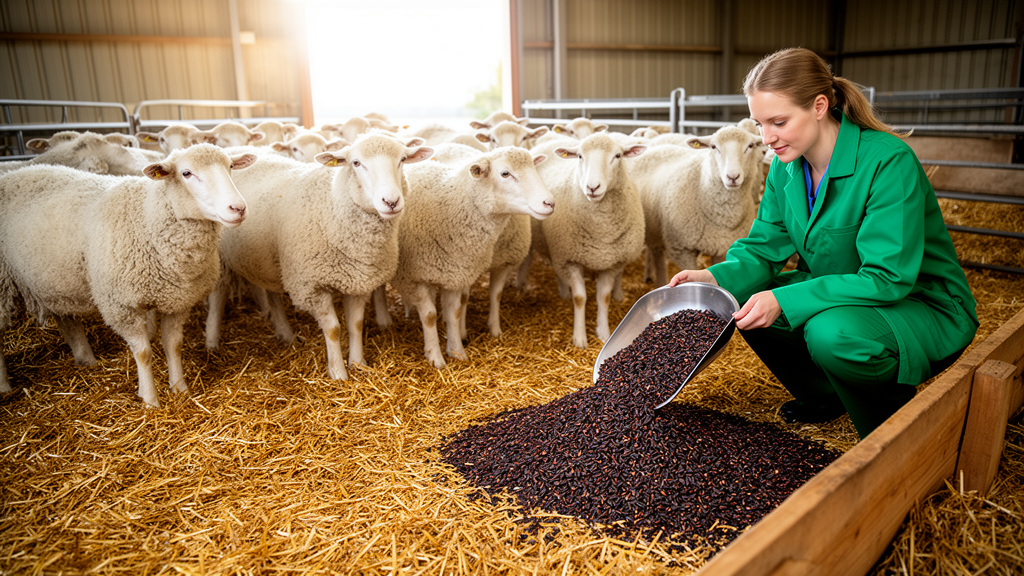
For sheep farmers around the world, the non-breeding season is a stubborn economic bottleneck. Ewes naturally cycle only during certain months, and coaxing them to conceive out of season typically requires hormonal synchronization protocols that are costly and imperfect. For decades, researchers have explored whether nutrition could give those protocols a boost, and one idea has proven especially seductive: feeding oilseeds rich in polyunsaturated fatty acids to fine-tune the reproductive hormones that govern ovulation, implantation, and pregnancy. A new study from Türkiye now delivers a sobering reality check on one of the most promising candidates, the safflower seed, showing that a short course of supplementation does nothing measurable to improve fertility in anestrous ewes.
The research, published in the journal Archives Animal Breeding by Metehan Kutlu of Necmettin Erbakan University and Halef Doğan of Tekirdag Namik Kemal University, set out to test a hypothesis grounded in solid biochemistry. Safflower seeds contain between 20 and 40 percent oil, and in the high-linoleate variety used in the trial, linoleic acid made up the bulk of that oil. Linoleic acid is an essential omega-6 fatty acid that ruminants cannot synthesize themselves. If enough of it survives the rumen’s relentless biohydrogenation machinery and reaches the small intestine, it can be converted through a chain of enzymatic steps into arachidonic acid, the primary precursor for prostaglandin F2 alpha, a hormone-like lipid that orchestrates luteolysis, ovulation, and uterine function. The researchers reasoned that flooding the diet with linoleic acid might therefore shift the endocrine landscape in favor of conception.
There was a second, more exotic reason for optimism. Safflower is not just a fat source; it also carries a payload of polyphenolic compounds, including lignans and flavones with known phytoestrogenic activity. These molecules can interact with estrogen receptors, and safflower-derived preparations have shown estrogen-related effects in biomedical models of estrogen deficiency and bone metabolism. Traditional medicine systems have long employed safflower for menstrual disorders and female infertility. Taken together, the fatty acid pathway and the phytoestrogen pathway offered two plausible mechanisms by which the seed might elevate circulating estradiol, sharpen estrus behavior, and ultimately put more lambs on the ground.
To test this, the team worked with 44 clinically healthy multiparous Hungarian Merino ewes, three to four years old and weighing 55 to 60 kilograms, on a commercial farm in Adana Province during April, the depths of the non-breeding season. Serum progesterone concentrations below one nanogram per milliliter confirmed that every ewe was in anestrus before the trial began. The animals were randomly allocated to two balanced groups of 22, matched for body weight, parity, and body condition score. One group received the standard ration alone; the other had 75 grams of whole safflower seed per ewe per day sprinkled onto that ration during the seven days of hormonal treatment. The dose was deliberately conservative: the seed contained 31 percent crude fat, so supplementation added roughly 23 grams of fat per day, keeping total dietary fat safely below the 6 to 7 percent of dry matter threshold above which rumen fermentation begins to suffer.
The synchronization protocol itself was standard for the industry. Each ewe received an intravaginal sponge impregnated with 60 milligrams of medroxyprogesterone acetate for seven days. At sponge removal, all animals were injected with 500 international units of equine chorionic gonadotropin to kick-start follicular development. Teaser rams began detecting estrus twelve hours later, with observations twice daily, and ewes showing standing heat were hand mated with proven fertile Merino rams at a ratio of five ewes per ram. A second service covered animals that failed to conceive or never showed estrus the first time. Blood samples were drawn on the day of sponge insertion, the day of removal, and immediately after mating, allowing the researchers to track serum estradiol and PGFM, the 13,14-dihydro-15-keto metabolite of prostaglandin F2 alpha that serves as a reliable proxy for uterine prostaglandin secretion. Pregnancy was diagnosed by transabdominal ultrasonography fifty days after mating, and litter size was recorded at parturition.
The results were unambiguous, and disappointing for the supplementation hypothesis. Across first, second, and overall services, there were no statistically significant differences between the safflower group and the controls in estrus rate, pregnancy rate, lambing rate, or litter size, with all comparisons yielding p values above 0.05. Notably, no pregnancy losses occurred between the ultrasound diagnosis and lambing in either group, indicating that the synchronization protocol itself performed reliably. The oilseed, in short, added nothing that the hormones had not already accomplished.
The endocrine data told a subtler and more interesting story. Serum estradiol concentrations rose significantly from the day of sponge insertion to the day of mating in both groups, exactly what one would expect as eCG-stimulated follicles matured and began secreting steroid hormones. Conversely, PGFM concentrations declined markedly by the day of mating in both groups. But these temporal shifts were entirely protocol-driven: statistical analysis using a repeated-measures general linear model found a highly significant effect of time for both hormones, with p values below 0.0001, yet no significant effect of treatment group and no treatment-by-time interaction. The safflower-fed ewes climbed and fell on precisely the same hormonal trajectory as their unsupplemented flockmates. A slight, non-significant uptick in PGFM after seven days of safflower feeding was observed, but it translated into no fertility advantage.
Why did the intervention fail? The authors dissect several plausible culprits, and their analysis reads as a masterclass in the gap between biochemical theory and physiological reality. First, seven days is a remarkably short exposure compared with the multi-week lipid supplementation regimens that have shown benefits in cattle and goats. Second, the seeds were fed whole and unprocessed, meaning a substantial proportion of their unsaturated fatty acids was almost certainly hydrogenated by rumen microbes before it could be absorbed, blunting the delivery of bioavailable linoleic acid to the intestine. Third, the linoleic acid content of the safflower used sat at the lower end of reference ranges for the species, further attenuating any expected omega-6 effect. Fourth, the powerful exogenous hormonal control exerted by the progestagen-eCG regimen may simply have overwhelmed any nutritionally mediated signal. Finally, with 22 animals per group, the study was powered to detect only reasonably large effects; a modest benefit could have slipped through undetected.
The findings also highlight how context-dependent lipid supplementation really is. Previous work in dairy cows has linked safflower oil supplementation during the transition period with increased serum PGFM, and pre-mating omega-6 supplementation in ewes has been associated with higher plasma progesterone and PGFM in other trials. Species differences, physiological state, dose, duration, and the physical form of the lipid all modulate the outcome. Seasonal anestrus, moreover, represents a profound physiological constraint: the hypothalamic-pituitary-ovarian axis is actively suppressed by photoperiod, and a week of extra dietary fat may be insufficient to overcome that brake even with hormonal assistance. The study’s authors are careful to note that their negative result does not close the door on safflower; it simply defines the boundaries of what a short, low-dose, whole-seed intervention can achieve.
Looking forward, the researchers outline a roadmap for future trials that could finally unlock safflower’s potential, if it exists. Supplementation should be extended to three to six weeks before and through synchronization, with formal dose-response evaluation. Whole seeds should be compared against rumen-protected lipid sources, and high-linoleic cultivars against high-oleic ones, to isolate the fatty acid species responsible for any effect. Mechanistic endpoints such as detailed lipid profiles, mid-luteal progesterone, serial PGFM measurements, luteinizing hormone pulses, and luteal blood flow would reveal where the intervention acts. Larger sample sizes, calculated from predefined minimal clinically important differences, would guard against false negatives. For now, the practical message for producers is clear: whole safflower seed cannot be recommended as a short-term nutritional adjunct for improving out-of-season reproductive performance in ewes. In the economics of sheep farming, where every gram of feed must justify itself in lambs, that is a conclusion worth knowing before the sponges go in.
Subject of Research: Effects of short-term safflower seed supplementation on reproductive performance and endocrine responses in anestrous ewes synchronized with progestagen
Article Title: Reproductive and endocrine responses to short-term safflower seed supplementation in anestrous ewes synchronized with progestagen
Article References: Kutlu, M., & Doğan, H. (2026). Reproductive and endocrine responses to short-term safflower seed supplementation in anestrous ewes synchronized with progestagen. Archives Animal Breeding, 69(3), 421-429. https://doi.org/10.5194/aab-69-421-2026
Image Credits: AI Generated
Keywords: safflower seed, ewes, estrus synchronization, progestagen, linoleic acid, prostaglandin F2alpha, PGFM, estradiol, seasonal anestrus, sheep reproduction, nutritional supplementation, Hungarian Merino
Cite Scienmag News
Alan Morgan. (October 9, 2026). Safflower Seed Supplement Fails to Boost Fertility in Anestrous Ewes, Study Finds. Scienmag. https://scienmag.com/safflower-seed-supplement-fails-to-boost-fertility-in-anestrous-ewes-study-finds/
Alan Morgan. "Safflower Seed Supplement Fails to Boost Fertility in Anestrous Ewes, Study Finds." Scienmag, 9 October 2026, https://scienmag.com/safflower-seed-supplement-fails-to-boost-fertility-in-anestrous-ewes-study-finds/. Accessed 9 October 2026.
Alan Morgan. "Safflower Seed Supplement Fails to Boost Fertility in Anestrous Ewes, Study Finds." Scienmag. October 9, 2026. https://scienmag.com/safflower-seed-supplement-fails-to-boost-fertility-in-anestrous-ewes-study-finds/


