


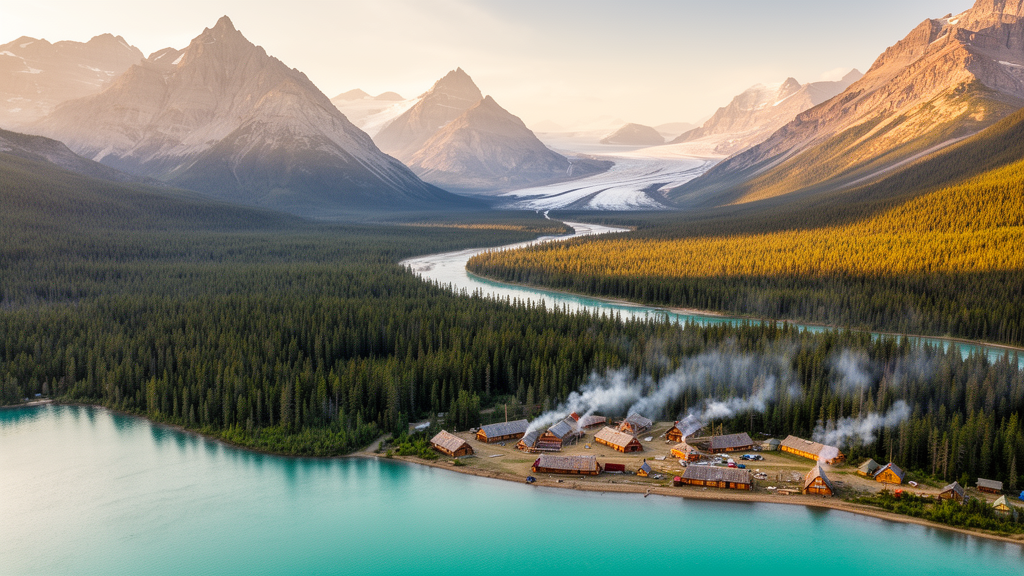
A sweeping new spatial analysis of Canada’s protected areas has revealed a striking overlap between the country’s biological and cultural wealth. The study, published in Discover Conservation, examined 35 localities recognized by the United Nations Educational, Scientific and Cultural Organization—Natural World Heritage Sites, Biosphere Reserves and Global Geoparks—and found that although these sites cover less than five percent of Canada’s land area, they intersect the geographic ranges of nearly ninety percent of the nation’s amphibian, bird, terrestrial mammal, plant, reptile and selected freshwater species, along with the territories of more than a quarter of its Indigenous languages. The findings suggest that a tiny fraction of Canadian geography could anchor a coordinated strategy to conserve both nature and culture at a moment when the planet is rapidly losing each.
The research, conducted by L. J. Gorenflo of Pennsylvania State University, builds on a growing body of evidence that linguistic and biological diversity tend to co-occur across the globe. Previous work has documented this biocultural pattern at global, continental and regional scales, and some studies have gone further, showing that the two measures are not merely neighbors on a map but statistically correlated—places with more Indigenous languages also tend to host more species. Why this relationship exists remains one of the intriguing open questions in conservation science, but its practical implication is clear: if species and languages share geographic space, then conservation actions designed for one may deliver benefits for the other.
Canada makes an ideal testing ground for this idea. The world’s second-largest country holds roughly twenty-four percent of the planet’s wetlands and about nine percent of its forests, and it is home to a rich mosaic of Indigenous peoples, including more than 630 First Nations communities, nine main Inuit groups and eight government-recognized Métis communities. Neither the country’s species counts nor its language counts are exceptionally high by global standards—Canada hosts an estimated 80,000 species, many of them viruses and bacteria, and 81 Indigenous languages, far fewer than the more than 900 spoken on New Guinea. But what Canada lacks in raw numbers it makes up for in vast, intact habitat and Indigenous communities that remain strongly connected to their cultural heritage and actively work to maintain it.
To quantify the overlap, the study used geographic information system technology to overlay the boundaries of the 35 UNESCO sites with species range data from the International Union for Conservation of Nature and BirdLife International, and with language territory polygons from Ethnologue, the frequently updated global language catalogue compiled by SIL Global. The species datasets, dating to 2025, cover amphibians, birds, terrestrial mammals, reptiles, terrestrial plants and a suite of freshwater groups including fishes, mollusks, crustaceans and aquatic plants. Language data included geographic extent, language family, speaker numbers and vitality, assessed through the Expanded Graded Intergenerational Disruption Scale, with languages classified as threatened, shifting or moribund—and those with fewer than 10,000 speakers—treated as endangered.
The results are remarkable. The ranges of nearly 1,600 species from the groups examined fall at least partially within the 35 sites, more than 88 percent of all Canadian species in those categories with known ranges. More than 93 percent of the country’s bird species with documented ranges occur in these localities. The 11 Natural World Heritage Sites alone, covering just 2.1 percent of Canada, contain the ranges of nearly 1,200 species—almost 65 percent of the national total—while the 19 Biosphere Reserves, on 2.2 percent of the land, host nearly 87 percent. The five Global Geoparks, despite occupying a mere 0.2 percent of the country, intersect the ranges of more than 860 species, nearly 48 percent of the Canadian total. Endangered species show the same pattern: 120 of them, nearly 78 percent of all endangered Canadian species with known ranges, occur within the sites.
The linguistic picture is equally striking. The ranges of 20 Indigenous languages intersect the UNESCO sites, representing more than 26 percent of the 76 languages in Canada categorized as Indigenous with mapped ranges. Biosphere Reserves perform best, touching the territories of 16 languages, followed by World Heritage Sites with 11 and Geoparks with three. The analysis also flagged three languages that evolved in Canada after European contact—Hutterisch, Maritime Sign Language and Quebec Sign Language—which the study counts as Indigenous by virtue of having emerged in place, though 17 of the languages are affiliated with native peoples, including Plains Sign Language.
Perhaps most compelling is what happens when the analysis zooms in further. The subsections of UNESCO sites that actually host an Indigenous language cover slightly more than 100,000 square kilometers—about one percent of Canada’s terrestrial area—yet within those small footprints occur the ranges of nearly 1,450 species, more than 80 percent of the Canadian total. Statistical tests confirmed that the densities of languages and species across the sites are positively correlated, with moderately strong and highly significant relationships for all species combined and for each taxonomic group individually, computed using non-parametric Spearman’s rho and Kendall’s tau measures because the data were not normally distributed.
Satellite-derived land cover data from the European Space Agency’s WorldCover 2021 dataset, interpreted at ten-meter resolution using United Nations land categories, added environmental context. Tree cover dominates most sites, accounting for nearly half of the World Heritage Sites and Biosphere Reserves and more than 81 percent of the Geoparks, while snow and ice blanket nearly 16 percent of the World Heritage Sites, reflecting the vast icy expanses of Kluane National Park and Tatshenshini-Alsek Provincial Park. Human-modified land—cropland and built-up areas—remains limited overall but concentrates in Biosphere Reserves, which by definition incorporate human settlement. Intriguingly, biodiversity is highest precisely in those reserves where human presence is greatest, hinting that conditions favorable to people may also favor other species.
What explains the correlation between languages and species? The study lays out several hypotheses without claiming a definitive answer. Environments rich in biodiversity may attract multiple sociocultural systems by offering abundant ecosystem services. Conversely, Indigenous landscape management guided by traditional ecological knowledge may create the habitat heterogeneity that sustains more species. Biologically diverse settings may provide enough resources for cultural groups to remain independent rather than merging with neighbors in hard times. Or the relationship may be cyclical, with biodiversity fostering cultural diversity that in turn manages landscapes in ways that sustain biodiversity. Complicating any single explanation, ten of the UNESCO sites with considerable biodiversity hosted no Indigenous languages at all—likely a legacy of the relocation and massive depopulation that Indigenous peoples in Canada have endured over centuries.
The practical message is that effective conservation in a small fraction of Canada could safeguard a disproportionate share of both its species and its Indigenous languages—but only if the sites are managed well. Research consistently shows that protected area status alone does not guarantee conservation success, and isolated reserves can fail both species, which need connectivity to maintain genetic diversity, and languages, whose speakers need contact with other speakers. The study argues that the 35 UNESCO sites should serve as foundations for broader networks of interconnected protected areas, an approach consistent with Parks Canada’s ongoing ecological corridors initiative. It also aligns with the United Nations Conference of the Parties 15 recommendations to integrate Indigenous guidance into biodiversity conservation and with the UN International Decade of Indigenous Languages spanning 2022 to 2032. With Canada increasingly recognizing Indigenous rights and co-governance of protected areas, and with the UNESCO label amplifying visibility and potentially supporting biocultural ecotourism, the pieces are in place. If Canada succeeds in weaving its UNESCO geography, its government agencies and its Indigenous partners into a single integrated conservation strategy, the country could offer a template for every nation grappling with the twin losses of nature and culture.
Subject of Research: Co-occurrence of biodiversity and Indigenous language diversity in Canadian UNESCO sites and its implications for integrated conservation
Article Title: Enlisting UNESCO sites to conserve biodiversity and Indigenous languages in Canada
Article References: Gorenflo, L. J. (2026). Enlisting UNESCO sites to conserve biodiversity and Indigenous languages in Canada. Discover Conservation, 3(1), Article 41. https://doi.org/10.1007/s44353-026-00110-1
Image Credits: AI Generated
DOI: 10.1007/s44353-026-00110-1
Keywords: biodiversity, biocultural diversity, UNESCO, Indigenous languages, Canada, conservation, World Heritage Sites, Biosphere Reserves, Global Geoparks, species ranges, traditional ecological knowledge, protected areas
Cite Scienmag News
Margaret Porter. (October 9, 2026). Canada’s UNESCO Sites Hold Most of Its Species and a Quarter of Its Indigenous Languages. Scienmag. https://scienmag.com/canadas-unesco-sites-hold-most-of-its-species-and-a-quarter-of-its-indigenous-languages/
Margaret Porter. "Canada’s UNESCO Sites Hold Most of Its Species and a Quarter of Its Indigenous Languages." Scienmag, 9 October 2026, https://scienmag.com/canadas-unesco-sites-hold-most-of-its-species-and-a-quarter-of-its-indigenous-languages/. Accessed 9 October 2026.
Margaret Porter. "Canada’s UNESCO Sites Hold Most of Its Species and a Quarter of Its Indigenous Languages." Scienmag. October 9, 2026. https://scienmag.com/canadas-unesco-sites-hold-most-of-its-species-and-a-quarter-of-its-indigenous-languages/


