


Neonatal jaundice is one of the most common conditions in newborn medicine, affecting roughly 60 to 80 percent of term infants and more than 80 percent of preterm babies. In most cases it is a transient and harmless consequence of the normal breakdown of fetal hemoglobin, which releases unconjugated bilirubin into the circulation during the first days of life. Yet the same pigment, when it accumulates to high concentrations, is neurotoxic. Severe hyperbilirubinemia, commonly defined as total serum bilirubin above 20 mg/dL, occurs in fewer than 2 percent of term infants but can cause acute bilirubin encephalopathy, hearing loss, and the devastating permanent condition known as kernicterus, which affects an estimated 10 to 30 percent of newborns with very high bilirubin levels. The clinical dilemma is one of timing: bilirubin concentrations typically peak between the third and fifth day of life, precisely the window in which many newborns have already been discharged from the hospital and are no longer under direct medical observation.
The problem has intensified as early postnatal discharge, often within 36 to 48 hours of birth, has become routine in many health systems. A baby who appears well at 36 hours may reach a dangerous bilirubin concentration three days later at home, and jaundice remains the most frequent reason for mother-infant separation and early readmission after delivery. During the COVID-19 pandemic, perinatal care pathways were reorganized to reduce hospital access, limit mobility, and support even earlier discharge, sharpening concerns that clinically significant hyperbilirubinemia could go undetected in the community. Those pressures prompted clinicians in northeastern Italy to ask a deceptively simple question: could the bilirubin test come to the baby, rather than the baby coming to the hospital?
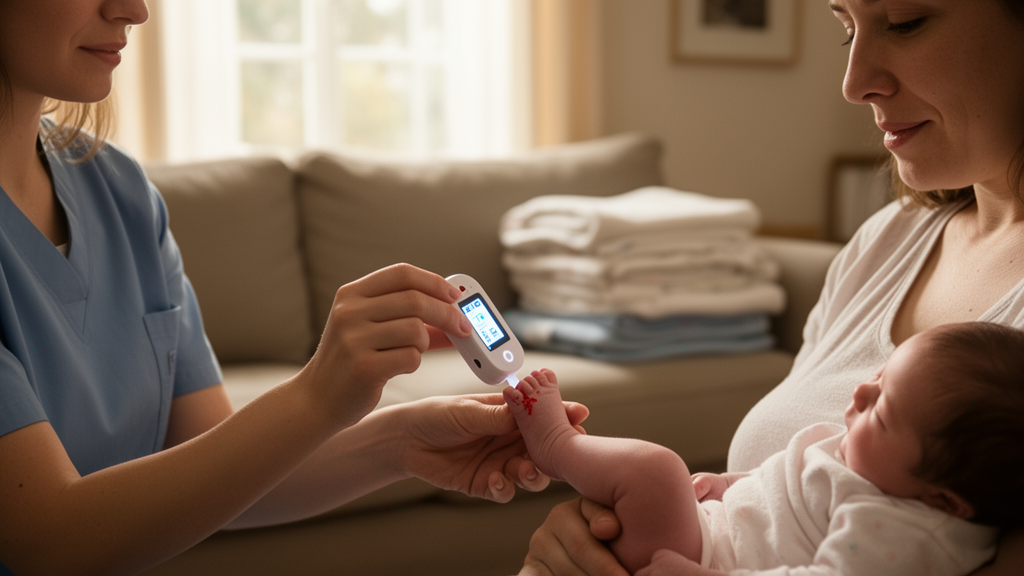
A new study published in Pediatric Research offers the first real-world answer. Researchers led by Irene Lapucci, Lorenzo Zucchini, and Laura Travan evaluated a structured hospital-to-community pathway in which trained midwives measured bilirubin in newborns using the Bilistick System 2.0, a portable point-of-care device developed by Bilimetrix in Trieste. The device requires only a small capillary blood sample obtained by heel stick and delivers a quantitative total serum bilirubin result within approximately 60 to 90 seconds, depending on the sample’s hematocrit. That speed matters: the result can be reviewed during the same home visit or outpatient appointment, discussed immediately with hospital physicians if concerning, and used to apply guideline-based thresholds for repeat testing, referral, or phototherapy without ever transporting a sample to a centralized laboratory.
The study was conducted within the Local Health Authority Azienda Sanitaria Universitaria Giuliano Isontina (ASUGI) in the Friuli Venezia Giulia region, an area whose catchment includes the tertiary referral hospital IRCCS Burlo Garofolo, with roughly 1,400 to 1,500 deliveries per year, and San Polo Hospital in Monfalcone, with about 850 mostly low-risk deliveries. A Diagnostic-Therapeutic Assistance Pathway, approved by the authority’s medical directorate in June 2021, defined which newborns were eligible for out-of-hospital bilirubin testing and how they should be routed. Eligibility hinged on the Bhutani nomogram, an hour-specific percentile chart that predicts the risk of subsequent severe hyperbilirubinemia from a discharge bilirubin value. Infants with jaundice at discharge and a Bhutani percentile above the 75th, without additional risk factors, or between the 40th and 75th percentile with risk factors such as cephalohematoma, bruising, or family history, qualified for community follow-up. High-risk infants, babies whose checks would fall on weekends or Mondays when community services were closed, and infants with late-onset jaundice after 15 days of age were excluded from community testing.
Implementation rested on the Community Health Family Services, known locally as Consultori Familiari, which operate within a UNICEF Baby-Friendly Initiative framework that has long integrated birth hospitals with community care. Midwives, who already perform home visits and outpatient assessments of the mother-infant dyad in the first days after discharge, underwent a structured multi-phase training program covering the physiology of neonatal jaundice, capillary blood sampling technique, and hands-on operation of the Bilistick device. All five participating sites applied identical procedures, referral criteria, and device instructions, allowing the network to be evaluated as a single integrated care model. The researchers then retrospectively reviewed community and hospital records for newborns born between February 2022 and February 2023 who met the pathway’s criteria for post-discharge bilirubin follow-up.
The results are striking for what did not happen. Of 397 newborns initially identified, 244 were included after excluding infants whose scheduled assessments fell on weekends, holidays, or Mondays. Of these, 108, or 44.3 percent, were referred to community monitoring, 135, or 55.3 percent, went directly to hospital follow-up, and one was lost to follow-up. Among the community group, 97 infants, or 89.8 percent, completed their entire bilirubin monitoring without ever needing a hospital referral; 83 finished after a single assessment and 14 after multiple checks. Eleven infants were escalated to the hospital, and seven of them received phototherapy. In the hospital group, only six of 135 infants, or 4.4 percent, required phototherapy, underscoring how conservative direct hospital referral can be. Across the entire cohort, no sampling-related adverse events, no exchange transfusions, no missed phototherapy, and no cases of kernicterus were recorded.
The pathway also demonstrated that it could catch the babies who genuinely needed rescue. The highest bilirubin concentration recorded in the community group was 23.6 mg/dL, identified in an infant during routine follow-up; the baby was promptly referred, treated with phototherapy, and recovered without adverse outcome. Tracking bilirubin trajectories using age-specific percentile categories added further reassurance. Among 86 community-monitored infants who started in the 40th to 75th Bhutani percentile range, 44.2 percent fell below the 40th percentile at follow-up, 38.4 percent stayed put, and 17.4 percent crossed above the 75th percentile, including 3.5 percent who reached the 95th percentile or higher. Every infant in that highest-risk category was referred for hospital evaluation. Upward crossing, in other words, occurred in a minority of cases and was reliably detected within the structured monitoring system.
The two groups were not identical, and the authors are careful about that. Newborns sent to community services had lower bilirubin concentrations at discharge, a median of 10.9 mg/dL versus 12.2 mg/dL in the hospital group, and were more often exclusively breastfed, at 88.9 percent versus 70.4 percent, a difference that existed before the pathway could have had any effect and should not be read as a benefit of community care. The first follow-up also occurred later in the community, a median of two days after discharge versus one day in hospital, reflecting the cautious selection of lower-risk infants. Direct hospital referral was driven mainly by a discharge Bhutani percentile above the 75th, cited for 63.7 percent of that group, along with clinical risk factors, organizational considerations, and in a few cases parental request or associated conditions such as trisomy 21. The researchers interpret the split as evidence of a deliberately cautious first implementation phase rather than a fixed division of labor.
Beyond the clinical numbers, the organizational and economic implications are considerable. Local administrative estimates put the personnel cost of a hospital-based bilirubin reassessment at 55.15 euros per visit, compared with 22.85 euros for a community assessment including about 1.50 euros in Bilistick consumables, a direct difference of 32.30 euros per reassessment. The authors stress this is a conservative local estimate, not a formal health-economic analysis, and that neither service charged families. The less tangible benefits may matter more: avoiding an extra hospital trip preserves mother-infant contact, protects established breastfeeding routines, and reduces travel and waiting burdens during the most fragile days of the postpartum period. The model also aligns with the 2022 American Academy of Pediatrics hyperbilirubinemia guideline and Italian Society of Neonatology recommendations, since immediate quantitative results make it far easier to apply age-specific thresholds for repeat testing, referral, and phototherapy at the point of care.
The study has limits the authors acknowledge plainly. Its retrospective, single-authority design cannot establish causation, the community cohort was selected for lower risk, and the sample size cannot precisely estimate very rare adverse outcomes. Patient and provider experience measures were also outside the scope of the analysis. Even so, the findings provide something the field has lacked: real-world evidence that point-of-care bilirubin testing can be woven into routine community midwifery rather than bolted on as a research exercise. The success of the pathway likely depended on the unusually mature hospital-community integration of the Baby-Friendly framework in Trieste, and the authors call for prospective, multicenter studies to test whether the model generalizes to other health systems. If it does, the humble heel stick, performed on a kitchen table by a trained midwife with a handheld reader, could become a standard safeguard against one of the oldest and most preventable threats to newborn brains.
Subject of Research: Community-based point-of-care monitoring of neonatal jaundice with the Bilistick System 2.0
Article Title: Community-based monitoring of neonatal jaundice using the point-of-care Bilistick® System 2.0
Article References: Lapucci, I., Tambascia, G., Zucchini, L., Calipa, M. T., Sola, M. V., Ronfani, L., Travan, L., the Jaundice Working Group, the midwives working in CHFS, De Rota, B., Marocco, S., Giornelli, R., Marina, S., Cerutti, R., the neonatologists and nurses of the Rooming in Unit, Bua, J., Marrazzo, F., Trappan, A., Dragovich, D., … Coda-Zabetta, C. D. (2026). Community-based monitoring of neonatal jaundice using the point-of-care Bilistick® System 2.0. Pediatric Research. https://doi.org/10.1038/s41390-026-05521-3
Image Credits: AI Generated
DOI: 10.1038/s41390-026-05521-3
Keywords: neonatal jaundice, hyperbilirubinemia, point-of-care testing, Bilistick, bilirubin, midwives, community health, phototherapy, kernicterus, Bhutani nomogram, Baby-Friendly Initiative, post-discharge care
Cite Scienmag News
Harold Sullivan. (October 9, 2026). Portable Blood Test Lets Midwives Track Newborn Jaundice at Home, Study Finds. Scienmag. https://scienmag.com/portable-blood-test-lets-midwives-track-newborn-jaundice-at-home-study-finds/
Harold Sullivan. "Portable Blood Test Lets Midwives Track Newborn Jaundice at Home, Study Finds." Scienmag, 9 October 2026, https://scienmag.com/portable-blood-test-lets-midwives-track-newborn-jaundice-at-home-study-finds/. Accessed 9 October 2026.
Harold Sullivan. "Portable Blood Test Lets Midwives Track Newborn Jaundice at Home, Study Finds." Scienmag. October 9, 2026. https://scienmag.com/portable-blood-test-lets-midwives-track-newborn-jaundice-at-home-study-finds/


