


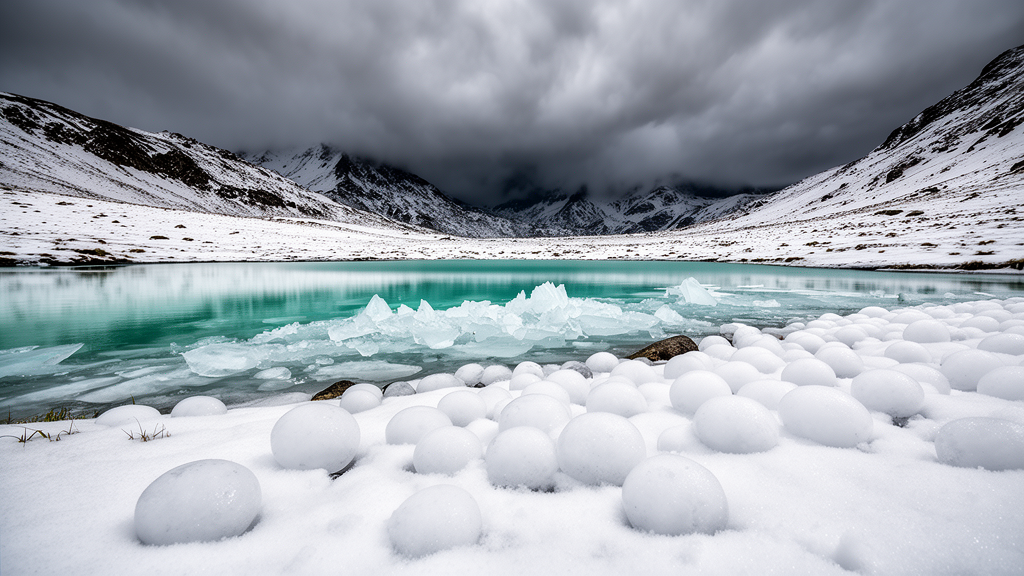
Hail is one of Switzerland’s most destructive natural hazards, capable of shredding crops, smashing cars and denting roofs across entire regions in a single afternoon. Yet for decades, scientists have struggled to explain why one summer brings repeated hailstorms while the next stays strangely quiet. A new study published in Weather and Climate Dynamics by Lena Wilhelm of the University of Bern and her colleagues now offers the most comprehensive answer yet, showing that the fate of a Swiss hail season may be written months in advance in the snowfields of Eurasia and the sea surface temperatures of the Pacific Ocean.
The team’s breakthrough was made possible by a recently developed 64-year reconstruction of hail days covering 1959 to 2022, built by combining a radar-based hail proxy with environmental predictors drawn from the ERA5 atmospheric reanalysis. Because systematic hail observations in Switzerland only begin around 2002, this reconstruction gave the researchers something they had never had before: a long, statistically homogeneous record of daily hail occurrence for two regions, one north and one south of the Alpine crest. From this record they identified the ten most and ten least active hail seasons in each region, corresponding to roughly the top and bottom fifteen percent of years, and then composited atmospheric, oceanic and land-surface conditions across the entire Northern Hemisphere for those seasons.
The results reveal that active hail seasons are not the product of a single freak weather pattern but of a recurring large-scale circulation regime. North of the Alps, the most active seasons display a zonally oriented Rossby wave train in the mid-troposphere, an alternating ridge-trough-ridge pattern of 500-hectopascal geopotential height anomalies stretching from the Atlantic into Central Europe. Crucially, the study shows using a recurrence metric that this pattern is not a single persistent anomaly. Instead, similar ridge-trough configurations are repeatedly re-established throughout the season, each episode advecting warm, moist air into northern Switzerland while upstream troughs provide the dynamical lift needed for convection.
That circulation works hand in hand with a preconditioned surface state. During active northern seasons, surface temperatures over Central Europe run well above average, specific humidity is enhanced, and the Mediterranean and Bay of Biscay show positive sea surface temperature anomalies. The combination produces boundary layers that are warm and moist but not saturated, driving up convective available potential energy, or CAPE, while leaving a moderate cap of convective inhibition, or CIN. That balance matters: a moderate cap suppresses premature, disorganized storms and allows instability to accumulate until a mesoscale trigger, such as convergence along the Prealpine foothills, releases it in the form of long-lived, organized supercells capable of growing large hailstones.
South of the Alps, the picture changes in a way that underscores how sharply the Alpine divide separates two climatic worlds. Active hail seasons in the south are tied to a meridionally oriented dipole: strong blocking over Greenland and the northwestern Atlantic, a deep trough over the British Isles, and high pressure over the Mediterranean and southern Europe. This configuration drives persistent southwesterly flow across Central Europe, advecting warm, relatively dry air from the Iberian Peninsula aloft over a moist Mediterranean boundary layer. The result is a recurrent elevated dry layer, a capping inversion that delays convection until forced ascent from fronts or the Alps erodes it, unleashing intense storms. Similar elevated mixed layers have been documented for giant-hail events in the Po Valley.
The regional contrast extends to which ingredient limits hail production. When the researchers standardized their anomalies by local variability, the largest signals north of the Alps appeared in surface temperature and sea surface temperature, marking the north as a temperature-limited regime that needs strong seasonal warming to cross the convective threshold. South of the Alps, the same thermodynamic anomalies emerge but with much weaker amplitudes, because the climatological environment there is already close to favorable for convection. Indeed, the reconstruction shows hail occurs on about twelve percent of all days south of the Alps versus roughly ten percent to the north, and modest synoptic perturbations are enough to tip the balance.
One of the study’s most striking findings comes from comparing seasonal background conditions with the environments of individual hail days. In the north, large-scale circulation, sea surface temperature and surface temperature anomalies are already present on non-hail days within active seasons, marking them as genuine seasonal preconditioning. Variables like CAPE, CIN and low-level humidity, by contrast, only become strongly anomalous on hail days themselves, indicating they characterize event-scale environments. Hail days in ordinary seasons look qualitatively like hail days in exceptional seasons; what distinguishes a hail-rich year is not a fundamentally different kind of storm but a higher recurrence of the same favorable conditions, embedded in a warmer, moister background state.
Perhaps most tantalizing are the precursors. Winters preceding active hail seasons in both regions show enhanced Eurasian snow cover, widespread continental cooling across Central Europe, Scandinavia and western Russia, and Pacific sea surface temperature anomalies resembling the positive phase of the Pacific Decadal Oscillation, with a cool eastern and central Pacific and a warm Gulf of Alaska. The authors caution that these signals may reflect co-occurrence rather than causation, and that disentangling driver from response would require targeted numerical sensitivity experiments. Even so, because sea surface temperature anomalies evolve slowly and can be predicted months ahead with reasonable skill, they offer a genuine foothold for seasonal forecasting of a hazard long considered unpredictable beyond a few days.
The study also places Swiss hail within the broader architecture of Northern Hemisphere climate variability. Correlation analysis shows that the East Atlantic and Scandinavian patterns, rather than the often-invoked North Atlantic Oscillation, exhibit the strongest and most consistent relationships with hail frequency in both regions, with generally higher correlations south of the Alps. The weak NAO signal makes physical sense: positive NAO phases suppress large-scale lifting while enhancing moisture transport, so competing dynamical and thermodynamic influences largely cancel out. Hail variability, the authors conclude, is shaped by a combination of teleconnections rather than any single dominant mode.
The implications reach well beyond academic interest. Severe convective storms were the most damaging natural hazard globally in 2023, and projections suggest both the frequency and severity of Swiss hailstorms will rise under climate change, sharpening the stakes for the insurance and agricultural sectors that absorb the losses. By identifying coherent circulation regimes, persistent surface boundary conditions and winter-season precursor signals, the Bern-led team has laid the groundwork for subseasonal to seasonal hail prediction, potentially through machine learning frameworks trained on the patterns documented here. The authors recommend extending the same analysis to other parts of Central Europe to determine which mechanisms are regionally specific and which are universal drivers of hail variability, a step that could transform how a continent braces for its most violent summer storms.
Subject of Research: Interannual variability of hail in Switzerland and its large-scale atmospheric, oceanic and land-surface drivers
Article Title: Towards understanding the interannual variability of hail in Switzerland
Article References: Wilhelm, L., Feldmann, M., Schröer, K., Schwierz, C., & Martius, O. (2026). Towards understanding the interannual variability of hail in Switzerland. Weather and Climate Dynamics, 7(3), 1681-1707. https://doi.org/10.5194/wcd-7-1681-2026
Image Credits: AI Generated
Keywords: hail, Switzerland, severe convective storms, Rossby wave train, Pacific Decadal Oscillation, Mediterranean sea surface temperature, soil moisture, convective available potential energy, seasonal prediction, ERA5 reanalysis, atmospheric blocking, teleconnections
Cite Scienmag News
Sloane Callahan. (October 9, 2026). Swiss Hail Seasons Leave Fingerprints in Winter Oceans and Snow. Scienmag. https://scienmag.com/swiss-hail-seasons-leave-fingerprints-in-winter-oceans-and-snow/
Sloane Callahan. "Swiss Hail Seasons Leave Fingerprints in Winter Oceans and Snow." Scienmag, 9 October 2026, https://scienmag.com/swiss-hail-seasons-leave-fingerprints-in-winter-oceans-and-snow/. Accessed 9 October 2026.
Sloane Callahan. "Swiss Hail Seasons Leave Fingerprints in Winter Oceans and Snow." Scienmag. October 9, 2026. https://scienmag.com/swiss-hail-seasons-leave-fingerprints-in-winter-oceans-and-snow/


