


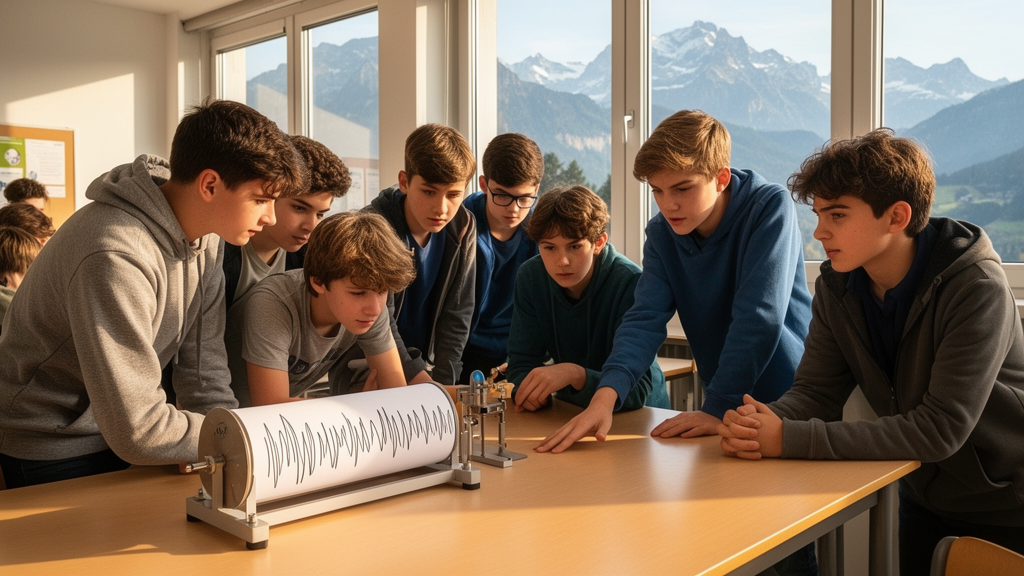
Switzerland is not a country most people associate with devastating earthquakes, yet seismologists rank seismic events as the natural hazard with the greatest potential for casualties and economic losses in the Alpine nation. The problem is one of memory: damaging earthquakes strike Switzerland only roughly every 100 to 150 years, and few residents have ever felt strong shaking, either at home or abroad. That gap between real risk and public perception is exactly what a team led by the Swiss Seismological Service (SED) at ETH Zurich set out to close. In a new study published in Geoscience Communication, the researchers describe how they revived and expanded the seismo@school programme, turning classrooms across the country into miniature seismic observatories and equipping teachers with ready-made, curriculum-aligned materials in four languages.
The two-year project, launched in May 2023 under the Increasing Earthquake Awareness in Switzerland initiative and funded through the Swiss National Science Foundation’s AGORA programme, targeted 12- to 18-year-olds. It built on an earlier pilot in the French-speaking cantons of Vaud and Valais, where the University of Lausanne, the applied university HES-SO Valais-Wallis and the Earthquake Prevention Learning Centre in Sion had installed 23 vertical-component Raspberry Shake geophones in schools. By joining forces with the SED, the consortium scaled the network nationwide, ultimately deploying 46 low-cost seismometers in secondary schools from Basel to the Alps. The historical stakes are tangible: the magnitude 6.6 Basel earthquake of 1356 and the magnitude 5.8 Sierre earthquake of 1946, still recalled by some locals, remind scientists that the hazard is real even if the intervals between major events span generations.
At the heart of the educational effort lies a suite of five thematic teaching modules, developed jointly by scientists and teachers after an initial online survey of classroom needs. The modules cover general earthquake knowledge, earthquake monitoring with Raspberry Shake instruments, seismic hazard and risk in Switzerland, induced seismicity, and misinformation and media literacy. Each combines explanatory texts with graphics, quizzes, experiments and hands-on activities designed to be completed within one to two hours. Because Switzerland has four official languages, the materials were translated into German, French, Italian and English and published on a dedicated SED webpage, allowing teachers to slot them flexibly into science and geography lessons either as stand-alone topics or as complete units.
The content goes well beyond textbook seismology. Students learn how stress accumulates along tectonic boundaries and is released as P-waves, S-waves and surface waves, and how magnitude differs from intensity. They explore Switzerland’s national hazard and risk models, discovering why dense urban centres such as Basel, Geneva, Zurich and Bern carry higher risk than remote mountain valleys despite similar hazard levels. An interactive exercise with the SED Earthquake Risk Tool lets them compare damage scenarios, from building losses and fatalities to the number of people seeking shelter. The induced seismicity module tackles a genuinely contested Swiss issue: deep geothermal energy, a pillar of the country’s net-zero-by-2050 strategy, whose Basel (2006) and St. Gallen (2013) projects were cancelled after induced earthquakes. Role-play debates cast students as residents, authorities, environmental groups and energy companies, forcing them to weigh renewable energy against seismic risk.
Perhaps the most forward-looking module addresses misinformation. Drawing on cases from the 2023 Türkiye-Syria and Morocco earthquakes, it teaches students to distinguish misinformation, disinformation, fake news and conspiracy theories, and shows how social media and messaging apps amplify false narratives after disasters. Practical exercises confront common earthquake myths about causes and forecasting, contrasting them with the current scientific understanding and its limits. The final section builds transferable media-literacy skills, training students to evaluate sources critically and to take responsibility for what they share online, competencies that extend far beyond seismology itself.
The 46 Raspberry Shake seismometers form the programme’s scientific backbone, and their integration into the national monitoring infrastructure is technically sophisticated. Because data from these consumer devices normally route through the manufacturer’s servers, the SED built a parallel data stream using a simple UDP protocol, feeding each station through a Seedlink plugin that converts the signals to SED standards for network, station, location and channel naming and MiniSEED formatting. The school data now flow into the same workflows used for monitoring, archiving and distribution as the more than 200 permanent stations of the Swiss National Seismic Network. Installation guidance was equally meticulous: sensors were to be placed on firm, level surfaces, ideally in basements or server rooms, away from vibration sources, with three-component units oriented north and secured. The team replaced standard SD cards with industrial-grade 16 GB versions, a common point of failure, and shipped preconfigured units by post once installation documentation proved reliable.
The school sensors are noisier than professional instruments, particularly during school hours when footsteps and machinery raise the noise floor above roughly 1 Hz, as daily Power Spectral Density analyses at the SED confirm. Yet they perform better than their price suggests. The devices routinely detect local earthquakes of magnitude 2.5 and larger at distances up to about 330 kilometres, plus moderate and large regional and teleseismic events, often more cleanly at night, on weekends or during holidays. They contributed valuable data, especially for depth determination, to a magnitude 3.0 earthquake near Affoltern am Albis outside Zurich in July 2025 and a swarm near Ebnat-Kappel in June 2025. Although not used for automatic detection, the school stations feed machine-learning relocation pipelines, contribute amplitudes to automatic magnitude estimates and fill spatial gaps for focal mechanisms and tomography. In October 2025, a suspicious signal at a school sensor in Vaud even triggered a search for the path of a meteorite whose entry had shaken the ground across western Switzerland.
The network also captures phenomena far beyond earthquakes, and one event became an instant teaching classic. On 28 May 2025, a massive landslide in Blatten, in the Valais canton, generated ground motion equivalent to a magnitude 3.1 earthquake, and the entire school network recorded it from more than 175 kilometres away. Teachers seized on the event, amplified by intense media coverage, to discuss mass movements in the context of climate change, whose influence on landslide frequency in Switzerland has grown over the past decade. Students also learn that seismometers register traffic, sonic booms and even the so-called Swift quakes from a Taylor Swift concert in Zurich. Simpler jump tests, in which classes gather near the sensor and leap in increasing numbers, turn abstract wave physics into something students can feel and see on screen in real time.
To reach younger or less well-equipped classrooms, the team designed the Lambda Slinky Seismometer, a do-it-yourself kit named for its distinctive shape. A wooden base supports a homemade coil, a load and an Arduino-driven display, while a gallows structure holds a Slinky spring with two magnets, one for measurement and one for centring and damping. The 3D-printable housing and standard electronics make the roughly 40-centimetre-tall device buildable in about 30 minutes with a video tutorial, and the Arduino can be reprogrammed by teachers or students for further experimentation. Around 20 to 21 kits have been distributed so far. The designers explicitly invoke the IKEA effect: learners value tools they build themselves, and watching one’s own footsteps appear as a seismic trace cements the physics in a way no lecture can.
Evaluation suggests the approach is working. A survey of participating teachers conducted between August and September 2025 drew 18 responses, a 40.9 percent response rate. Some 78 percent rated their participation very positively, 89 percent said the initiative inspired their teaching and 83 percent said it raised earthquake awareness among students and teachers. The Raspberry Shake had already been used with more than 955 students, 72 percent of teachers agreed it helps explain earthquakes more clearly, and among those who had viewed the new modules, more than 80 percent rated them good or very good. The team also ran workshops for roughly 60 teachers, supervised Matura research theses, and connected internationally with educational seismology programmes in ten countries, supporting an earthquake learning exhibition in Nepal that reached about 2,000 pupils and measurably improved knowledge and preparedness. The authors acknowledge the survey’s limited sample size and short window, and note that earthquakes receive only sparse explicit coverage in Swiss curricula such as Lehrplan 21, leaving implementation dependent on cantonal priorities and individual teachers. Sustaining the network, they argue, will require long-term funding and, ultimately, an earthquake education policy. Still, the model demonstrates that even in moderate-hazard regions, a classroom seismometer, a slinky spring and open data can turn rare and abstract risks into something students monitor, question and carry home.
Subject of Research: Educational seismology and earthquake awareness in Swiss schools
Article Title: Increasing earthquake awareness: seismo-at-school Switzerland
Article References: Böse, M., Valenzuela, N., Hetényi, G., Roduit, R., Dallo, I., Bircher, K., Clinton, J., Fässler, U., Haslinger, F., Jaeger, T., Marti, M., Racine, R., Sauron, A., Subedi, S., & Wiemer, S. (2026). Increasing earthquake awareness: seismo-at-school Switzerland. Geoscience Communication, 9(2), 223-237. https://doi.org/10.5194/gc-9-223-2026
Image Credits: AI Generated
Keywords: earthquake awareness, educational seismology, Raspberry Shake, Switzerland, seismo@school, citizen science, seismic hazard, seismic risk, teaching resources, geoscience education, misinformation, STEM education
Cite Scienmag News
Violet Maxwell. (October 9, 2026). Swiss Schools Get Their Own Seismometers to Shake Up Earthquake Awareness. Scienmag. https://scienmag.com/swiss-schools-get-their-own-seismometers-to-shake-up-earthquake-awareness/
Violet Maxwell. "Swiss Schools Get Their Own Seismometers to Shake Up Earthquake Awareness." Scienmag, 9 October 2026, https://scienmag.com/swiss-schools-get-their-own-seismometers-to-shake-up-earthquake-awareness/. Accessed 9 October 2026.
Violet Maxwell. "Swiss Schools Get Their Own Seismometers to Shake Up Earthquake Awareness." Scienmag. October 9, 2026. https://scienmag.com/swiss-schools-get-their-own-seismometers-to-shake-up-earthquake-awareness/


