


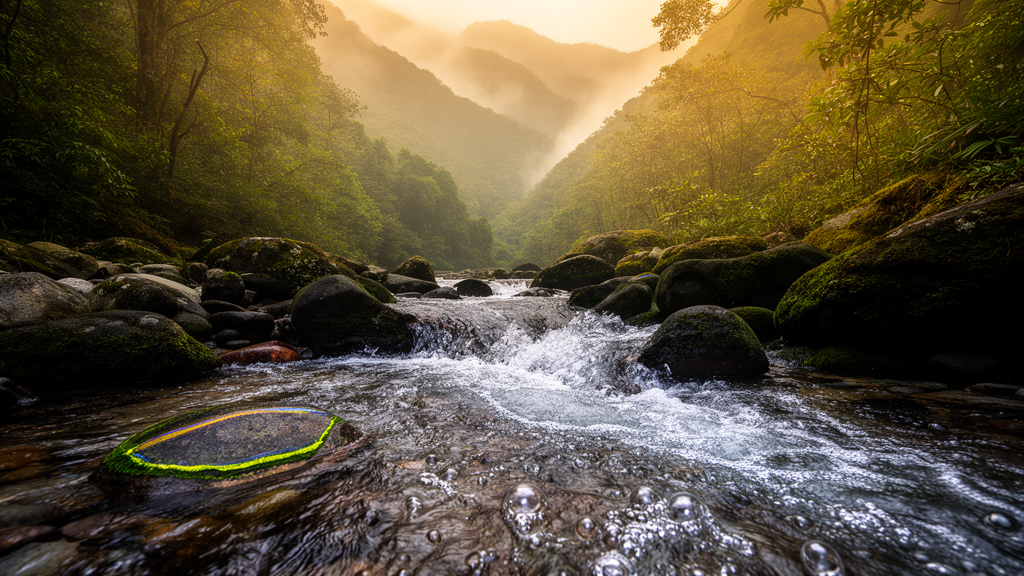
Deep in the mountains of southeastern Taiwan, where tectonic plates collide and rivers carve through some of the fastest-eroding landscape on Earth, an international team of scientists has discovered that even the smallest inhabitants of these turbulent waters play a measurable role in the global carbon cycle. A new study published in the journal Biogeosciences quantifies, for the first time, how planktonic microorganisms in the Beinan River contribute to carbon dioxide fluxes along a river system that is constantly being shaken, scoured, and rebuilt by geological forces. The findings challenge long-standing assumptions that microbial metabolism in such physically extreme environments is negligible, and they offer a rare window into how carbon moves through mountain rivers that have been largely overlooked in global carbon budgets.
The Beinan River drains a catchment of roughly 1,600 square kilometers composed primarily of schist and slate, rocks that are being uplifted at rates of up to several centimeters per year. This rapid uplift, combined with torrential monsoon rains and frequent typhoons, generates extraordinary sediment loads that rank among the highest in the world. Rivers like the Beinan carry pulverized rock fragments downstream, keeping the water chronically turbid and physically unstable. For decades, scientists assumed that such conditions would suppress planktonic life, because suspended sediment blocks sunlight and because thin soils provide few organic substrates for microbial respiration. The new research demonstrates that this assumption is only partially correct, and that the reality is far more nuanced and biologically interesting than previously imagined.
To probe the metabolic activity of river microorganisms directly, the research team led by Jhen-Nien Chen and Pei-Ling Wang of National Taiwan University employed a technique that goes beyond the traditional reliance on dissolved oxygen sensors. They collected river water from five sites spanning the catchment, from forested headwater tributaries down to the river mouth near the estuary, and incubated it with carbon-13 labeled compounds. By adding isotopically labeled dissolved inorganic carbon, they could track how much carbon dioxide microorganisms fixed into biomass through photosynthesis and chemosynthesis. By adding carbon-13 labeled amino acids, specifically glycine and leucine, they could measure how rapidly heterotrophic microbes consumed organic molecules and respired them back into carbon dioxide. This dual approach allowed the team to separate the contributions of autotrophy, the process by which organisms build their own biomass from inorganic carbon, and heterotrophy, the process by which organisms consume organic matter and release carbon dioxide as a waste product.
The results revealed a striking seasonal pattern. Metabolic rates were consistently higher during the wet season, which runs from June through November, than during the dry season. Water temperatures were roughly six degrees Celsius warmer in the wet season, suspended sediment concentrations increased by an average factor of eleven, and ammonium concentrations rose significantly. All of these factors appeared to stimulate microbial activity. More remarkably, the team found that heterotrophic catabolic rates, meaning the speed at which microbes respired organic carbon into carbon dioxide, exceeded autotrophic carbon fixation rates by one to two orders of magnitude. This imbalance indicates that the planktonic community of the Beinan River is strongly net heterotrophic, functioning as a net producer of carbon dioxide rather than a net consumer.
When the researchers scaled their measured rates up to the entire catchment, they calculated that planktonic microbial metabolism produces approximately 7.89 times ten to the seventh moles of carbon dioxide per year. This figure represents about 3.8 percent of the total carbon dioxide flux generated by the catchment, which includes contributions from pyrite-induced carbonate weathering, the oxidation of ancient petrogenic carbon buried in the bedrock, and the physical exchange of carbon dioxide between the river surface and the atmosphere. While 3.8 percent may seem modest, the researchers emphasize that this is a substantial and previously unquantified component of the carbon budget in a system where geological processes overwhelmingly dominate. The total river-atmosphere carbon dioxide evasion for the catchment was estimated at roughly 2.08 times ten to the ninth moles per year, a figure consistent with the extraordinarily high weathering rates documented for active mountain belts worldwide.
One of the most intriguing discoveries concerns the identity of the microorganisms responsible for carbon fixation in the absence of light. At sites where suspended sediment concentrations were highest, dark incubations revealed significant uptake of labeled dissolved inorganic carbon even when photosynthesis was impossible. Genetic sequencing of the microbial communities showed that taxa capable of oxidizing sulfur compounds and ammonia were abundant during the wet season, particularly members of the genera Thiobacillus and Sulfuricurvum. These lithoautotrophic bacteria derive their energy not from sunlight but from chemical reactions involving reduced inorganic compounds, such as the sulfide and ferrous iron supplied by eroding pyrite-bearing rocks and by groundwater discharge. The team proposes that the constant pulverization and abrasion of slate and schist in the river channel exposes fresh mineral surfaces that fuel these chemoautotrophic communities, effectively linking geological erosion directly to biological carbon fixation in the water column.
The microbial community composition shifted dramatically between seasons and along the river’s length. In the dry season, when waters ran clearer and suspended sediment loads were lower, phototrophic organisms such as cyanobacteria dominated at upstream sites, taking advantage of the improved light penetration. In the wet season, these photosynthetic populations were displaced by sulfur-oxidizing and nitrogen-oxidizing lithoautotrophs that thrived on the chemical substrates released by sediment mobilization. At the most downstream site near the river mouth, heterotrophic bacteria capable of degrading complex dissolved organic matter predominated year-round, reflecting the accumulation of organic compounds transported from the entire upstream catchment. This longitudinal transition from rock-driven to organic-matter-driven metabolism echoes classical ecological frameworks such as the River Continuum Concept, but with a geological twist unique to tectonically active settings.
The study also revealed fascinating details about how these microbes process organic substrates. Glycine was consistently preferred over leucine as an energy source, a selectivity the authors attribute to the metabolic efficiency of glycine-centered biochemical pathways. The reductive glycine pathway and the glycine cleavage system require less energy to operate than the multi-step enzymatic breakdown required for leucine catabolism. In the dry season, when nutrient supplies were scarce, microbial communities diverted nearly all available amino acids toward respiration for basic cellular maintenance rather than biomass production. In the wet season, with abundant particulate organic matter available, a larger fraction of consumed substrates was channeled into growth and biosynthesis. These physiological shifts underscore how tightly microbial carbon processing is coupled to the hydrological and geological rhythms of the catchment.
The broader implications of this work extend well beyond Taiwan. Mountainous catchments cover 27 percent of Earth’s land surface and drain more than 30 percent of global runoff, yet they remain severely underrepresented in global carbon models. Inland waters collectively release between 0.65 and 2.1 petagrams of carbon per year as carbon dioxide, a flux comparable in magnitude to the ocean’s annual carbon dioxide uptake. If planktonic metabolism contributes a measurable fraction of this flux even in the most physically hostile river environments, then current global estimates that neglect or underestimate microbial contributions from mountain rivers may require revision. The researchers note that their planktonic measurements exclude the benthic and hyporheic compartments, the riverbed and subsurface zones where additional microbial processing almost certainly occurs, particularly during the dry season when clear water allows light to reach coarse streambed sediments.
Looking forward, the team advocates for high-frequency monitoring during storm events, kinetic experiments that measure substrate uptake at environmentally realistic concentrations, and RNA-based molecular approaches that can distinguish actively metabolizing microorganisms from merely abundant ones. They also emphasize the need for parallel measurements of benthic and hyporheic metabolism to construct a complete picture of river carbon cycling in these dynamic systems. What is already clear, however, is that even in oligotrophic, sediment-choked, tectonically restless rivers, planktonic microorganisms constitute a vital and quantifiable link in the chain that connects mountain erosion to atmospheric carbon dioxide. As climate change intensifies both monsoon precipitation and the frequency of extreme hydrological events in mountainous regions worldwide, understanding how these microbial communities respond to disturbance will become increasingly important for predicting future carbon fluxes and refining the global carbon inventory.
Subject of Research: Planktonic microbial metabolism and carbon dioxide fluxes in a tectonically active mountainous river catchment in Taiwan
Article Title: Roles of planktonic metabolism in CO2 fluxes along the river-estuary continuum in a rapidly uplifting catchment of eastern Taiwan
Article References: Chen, J.-N., Chen, P.-E., Yen, Y.-S., Tu, T.-H., Wang, L.-Y., Lien, W.-Y., Lin, Y.-T., & Wang, P.-L. (2026). Roles of planktonic metabolism in CO 2 fluxes along the river-estuary continuum in a rapidly uplifting catchment of eastern Taiwan. Biogeosciences, 23(19), 6781-6802. https://doi.org/10.5194/bg-23-6781-2026
Image Credits: AI Generated
Keywords: river metabolism, carbon dioxide flux, planktonic microbes, mountain rivers, Taiwan, Biogeosciences, heterotrophy, autotrophy, carbon-13 labeling, microbial communities, chemical weathering, tectonic uplift
Cite Scienmag News
Violet Maxwell. (October 9, 2026). Tiny River Microbes Leave a Measurable Mark on Carbon Dioxide in Taiwan’s Rugged Mountains. Scienmag. https://scienmag.com/tiny-river-microbes-leave-a-measurable-mark-on-carbon-dioxide-in-taiwans-rugged-mountains/
Violet Maxwell. "Tiny River Microbes Leave a Measurable Mark on Carbon Dioxide in Taiwan’s Rugged Mountains." Scienmag, 9 October 2026, https://scienmag.com/tiny-river-microbes-leave-a-measurable-mark-on-carbon-dioxide-in-taiwans-rugged-mountains/. Accessed 9 October 2026.
Violet Maxwell. "Tiny River Microbes Leave a Measurable Mark on Carbon Dioxide in Taiwan’s Rugged Mountains." Scienmag. October 9, 2026. https://scienmag.com/tiny-river-microbes-leave-a-measurable-mark-on-carbon-dioxide-in-taiwans-rugged-mountains/


