


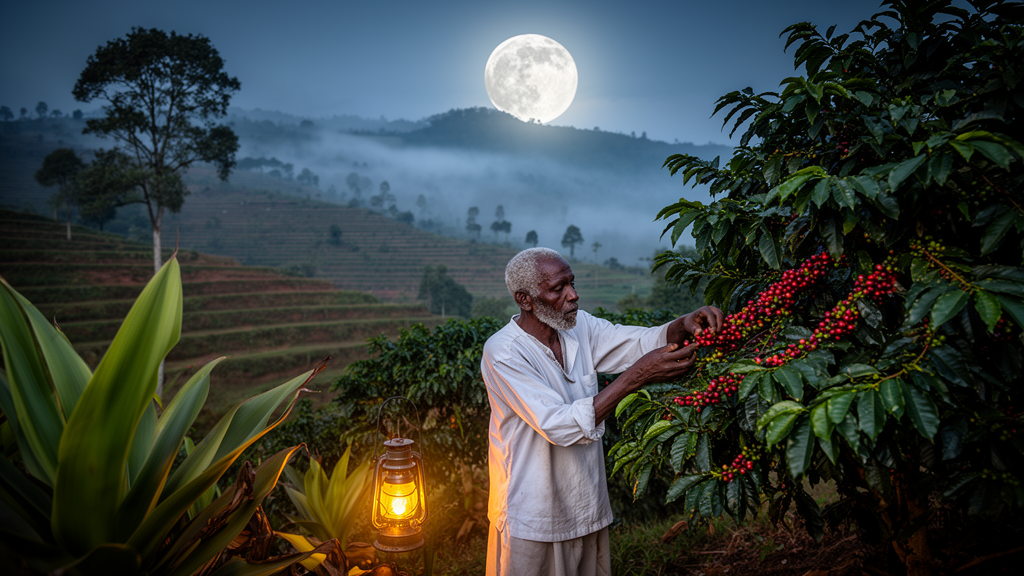
High in the coffee forests of southern Ethiopia, the phases of the Moon do far more than light the night sky. For the Gedeo people, an indigenous society of the Ethiopian highlands, the lunar cycle functions as a living calendar that organizes marriage, agriculture, ritual life, and even the reading of war, disease, peace, and rain. A new study published in SN Social Sciences by a team of researchers based at Dilla University and Addis Ababa University documents this system in detail, offering one of the most thorough accounts to date of how a single celestial body can be woven into the fabric of an entire culture.
The research, led by Negessa Tilahun Shukure with co-authors Mekonen Geleta, Solomon Ijigu, Girma Degaga, and Eftu Fereda, sits within the field of cultural astronomy, sometimes called ethnoastronomy. This discipline examines how societies around the world have observed the sky and embedded those observations in myth, ritual, timekeeping, and practical decision-making. Africa has a long record in this field, from the Namoratunga stone alignments in Kenya, proposed in 1978 as the first archaeoastronomical evidence in sub-Saharan Africa, to studies of the Borana calendar and the weather-forecasting traditions of Borana Oromo and Gujii pastoralists. The Gedeo study adds a richly documented lunar system to this growing body of indigenous astronomical knowledge.
At the heart of the Gedeo system is a sequence of named lunar phases, each carrying its own social meaning and practical consequences. The new moon, known as Sa’imarroo, marks a period in which marriage ceremonies are traditionally prohibited. Intriguingly, the same phase is believed to carry positive implications for childbirth, so the dark of the Moon is simultaneously a time of restraint for weddings and of auspicious expectation for new life. This pairing of prohibition and promise illustrates how the Gedeo interpret the lunar cycle not as a simple clock but as a rhythm of openings and closures in social life.
As the Moon waxes toward its first quarter, the phase called Baate, the social atmosphere shifts. Baate is associated with hope and marks the beginning of periods in which marriage becomes permissible for young men and women. The phase also serves predictive purposes, allowing community members to anticipate what the rest of the lunar month may bring. In effect, the first quarter functions as a threshold: the restrictions of the new moon lift, courtship and ceremony resume, and the community reads the sky for signs of what lies ahead.
The researchers describe a further observational practice that bridges the first quarter and the full moon. As the Moon approaches fullness, Gedeo elders watch for a signal known as Koncora, which prompts preparation for the coming full moon. This detail is significant because it shows that lunar knowledge in Gedeo society is not passive stargazing but an active, institutionalized monitoring practice, with designated elders responsible for tracking the sky and alerting the community. The system depends on trained observers, shared terminology, and a communication network that turns individual observation into collective action.
The full moon, called Goobana, holds the most consequential role in the Gedeo lunar calendar. Culturally, Goobana is interpreted as an indicator for major events that shape communal life: Bagedo, meaning war; Dhukkuba, meaning disease; and Nage’a, meaning peace, which is also associated with Xeena, or rain. In other words, the appearance and character of the full moon are read as omens or signals bearing on conflict, health, and rainfall. For an agricultural society in the highlands, where rain determines the fate of crops and herds, tying the full moon to such forecasts embeds celestial observation directly into survival strategy.
Beyond these named phases, the study emphasizes that lunar cycles influence agricultural activities and communal rituals across the Gedeo year. The Gedeo are renowned for their home-garden agroforestry, a sustainable land-use system in the Gedeo zone that has attracted attention for its socio-ecological benefits. The new research suggests that the timing of farming and ritual work is coordinated with the Moon, so that celestial and terrestrial calendars reinforce one another. This integration of sky-watching with land management exemplifies what scholars of indigenous knowledge describe as knowledge systems that preserve cultural identity while offering perspectives on sustainable living and environmental stewardship.
Methodologically, the study draws on qualitative approaches standard in ethnographic research, working with Gedeo elders whose knowledge anchors the account. The authors acknowledge contributions from Gedeo elders and Gedio communication, and the study received ethical approval from Dilla University, with partial funding from the university under grant number DU/2015/12. The research team, whose members contributed equally in several roles spanning manuscript writing, methodology design, and data collection, note that they used generative AI tools for language correction and illustrative images, with review and responsibility remaining with the authors. The study was published on 15 September 2026 in volume 6 of the journal, as article number 437.
The findings place the Gedeo within a worldwide pattern of sophisticated sky cultures. From the skywatchers of ancient Mexico documented by archaeoastronomer Anthony Aveni to the first-fruits celebrations of the Nguni peoples of southern Africa, societies have long used celestial cycles to regulate ceremony and subsistence. What makes the Gedeo case striking is the completeness of the lunar sequence: a prohibition phase, a hope phase, a preparation signal, and a full-moon oracle, each with a distinct name and function. The system demonstrates that careful, generational observation of the Moon’s phases can yield a framework precise enough to govern when weddings happen, when preparations are made, and how communities brace for war, disease, or welcome rain.
The authors argue that such indigenous knowledge systems deserve attention not only as cultural heritage but as living science. In a region where formal meteorological infrastructure can be distant, lunar-based forecasting and seasonal regulation represent accumulated empirical knowledge tested over generations. Documenting these traditions, the researchers suggest, helps preserve them for younger generations while offering valuable perspectives on sustainable living and environmental stewardship. As the Moon waxes and wanes over the Gedeo highlands, it continues to mark the rhythm of marriages, harvests, and communal hope, a reminder that the sky has long been humanity’s most widely shared calendar.
Subject of Research: The role of lunar phases in the cultural astronomy, social customs, and agricultural practices of Ethiopia's indigenous Gedeo society
Article Title: Cultural astronomy: on the connection between the moon and Gedeo society
Article References: Shukure, N. T., Geleta, M., Ijigu, S., Degaga, G., & Fereda, E. (2026). Cultural astronomy: on the connection between the moon and Gedeo society. SN Social Sciences, 6(9), Article 437. https://doi.org/10.1007/s43545-026-01722-z
Image Credits: AI Generated
DOI: 10.1007/s43545-026-01722-z
Keywords: cultural astronomy, ethnoastronomy, Gedeo society, Ethiopia, lunar phases, indigenous knowledge, new moon, full moon, marriage customs, agriculture, weather forecasting, environmental stewardship
Cite Scienmag News
Grant Pearson. (October 9, 2026). How the Moon Rules Life in Ethiopia’s Gedeo Highlands. Scienmag. https://scienmag.com/how-the-moon-rules-life-in-ethiopias-gedeo-highlands/
Grant Pearson. "How the Moon Rules Life in Ethiopia’s Gedeo Highlands." Scienmag, 9 October 2026, https://scienmag.com/how-the-moon-rules-life-in-ethiopias-gedeo-highlands/. Accessed 9 October 2026.
Grant Pearson. "How the Moon Rules Life in Ethiopia’s Gedeo Highlands." Scienmag. October 9, 2026. https://scienmag.com/how-the-moon-rules-life-in-ethiopias-gedeo-highlands/


