


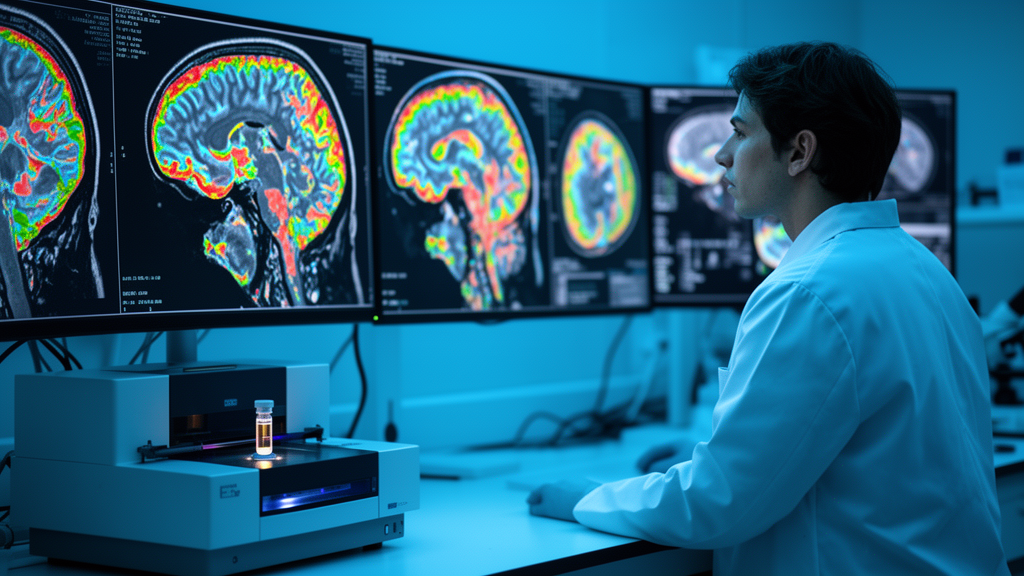
Attention-deficit hyperactivity disorder is one of the most heritable conditions in psychiatry, yet the path from inherited genetic liability to the restless, inattentive behavior that defines it has remained stubbornly opaque. Twin and family studies have long indicated that genetic factors account for the majority of variation in ADHD risk, and large-scale genome-wide association studies have catalogued dozens of risk loci. But a genetic variant, on its own, says nothing about circuits. Now a team of researchers led by Xueke Shan, Ming Xu, Dongmei Zhi and Jing Sui of Beijing Normal University, working with collaborators in China and the United States, has published a study in Nature Mental Health that closes part of that gap, identifying reproducible brain imaging signatures that track an individual’s inherited ADHD risk and, in turn, predict the disorder’s two core behavioral dimensions: inattention and hyperactivity.
The study drew on the Adolescent Brain Cognitive Development Study, or ABCD, the largest long-term study of brain development and child health in the United States. From this cohort the researchers analyzed data from 6,001 children, combining each child’s genome with multimodal magnetic resonance imaging and detailed behavioral assessments. The genetic measure at the heart of the work is the polygenic risk score, a single number that aggregates the small effects of thousands of common genetic variants spread across the genome. Individually, these variants contribute almost nothing; summed together, they capture a meaningful slice of inherited liability. Polygenic risk scores for ADHD have previously been shown to predict attention problems in population samples and to relate to white matter microstructure and subcortical connectivity, but earlier efforts typically examined one imaging modality at a time, leaving the joint structure-function picture incomplete.
To overcome that limitation, the team deployed a supervised multimodal fusion framework called MCCAR, a method designed to find patterns that covary together across different types of brain data while remaining anchored to an external variable of interest, in this case the ADHD polygenic risk score. Rather than asking which brain regions differ between children with and without an ADHD diagnosis, the approach asks a subtler question: which coordinated combinations of brain features, spanning functional activity and gray matter volume, vary in step with inherited genetic risk across the entire population? This genetically anchored strategy is powerful because it does not depend on diagnostic categories, which are themselves noisy and heterogeneous, and because it can detect risk-related brain organization in children who may never meet clinical criteria for the disorder.
The signatures that emerged were strikingly concentrated in two systems long implicated in ADHD neurobiology. The first comprises hubs of the cognitive control network, including prefrontal regions that govern attention, planning, impulse inhibition and the flexible allocation of mental resources. Decades of lesion studies, pharmacology and functional imaging have established that catecholamines, particularly dopamine and norepinephrine, tune the gain of dorsolateral prefrontal circuits, and that stimulant medications act on precisely these systems. The second set of regions lies in the midbrain, in nuclei that include the ventral tegmental area and neighboring dopaminergic cell groups, the source neurons that manufacture and project dopamine to the striatum and prefrontal cortex. Crucially, the genetic risk signal was expressed in both directions of brain organization: the affected regions showed aberrations in functional activity, the moment-to-moment fluctuations measured by resting-state fMRI, and in gray matter volume, the structural tissue measure derived from anatomical scans.
Reproducibility, the perennial Achilles heel of brain-wide association studies, received unusually rigorous treatment. A landmark 2022 analysis in Nature showed that many celebrated brain-behavior correlations collapse when sample sizes fall below thousands of participants, fueling skepticism about small neuroimaging findings. The new study confronted this problem head-on. The researchers confirmed that their identified signatures held up across ancestry-defined subsamples and across sex-stratified groups, demonstrating that the patterns were not artifacts of population structure or of the genetic differences between demographic strata that can contaminate polygenic score analyses. This kind of internal replication, performed within a single large cohort but across independent strata, provides a level of confidence that single-split analyses rarely achieve, and it addresses one of the most common criticisms leveled at imaging genetics research.
Specificity was tested with equal care. Psychiatric disorders are genetically entangled: genome-wide analyses have revealed substantial sharing of common variant liability among ADHD, autism, depression, bipolar disorder and schizophrenia, which means a brain signature tied to ADHD genes might plausibly also track risk for related conditions. To rule this out, the team compared their ADHD polygenic risk-associated brain pattern against data spanning eleven psychiatric disorders. The signature proved highly specific to ADHD, distinguishing it from the multimodal patterns associated with the other conditions. That result matters for the emerging transdiagnostic framework in psychiatry, which emphasizes dimensions and shared mechanisms over diagnostic silos. The findings suggest that while some neural features may be shared across neurodevelopmental conditions, the circuit pattern coupled to ADHD’s inherited risk is distinctive enough to serve as a disorder-anchored marker.
The final and arguably most consequential test was predictive. If a genetically informed brain signature truly forms part of the biological pathway from genes to symptoms, it should carry information about behavior. Across the discovery cohort, the signature robustly predicted scores on the two cardinal behavioral phenotypes of ADHD, inattention and hyperactivity. The team then took the pattern derived in ABCD and applied it to the independent ADHD-200 cohort, a publicly available multisite dataset assembled from a completely different set of scanners, protocols and participants. The predictive relationship held, underscoring that the brain signature is not a quirk of one dataset but a generalizable neural correlate of ADHD’s behavioral traits. This discovery-to-validation arc, spanning two independent cohorts, is exactly the structure that critics of neuroimaging psychiatry have demanded for years.
Mechanistically, the convergence on midbrain dopaminergic nuclei and cognitive control hubs reads like a vindication of the disorder’s oldest neurobiological hypothesis. Since the 1950s, the paradoxical calming effect of stimulants in hyperactive children has pointed toward dopamine, and modern work has refined that idea into models in which altered dopaminergic signaling disrupts the prefrontal circuits that normally filter distractions, suppress premature responses and sustain goal-directed effort. The new study adds a genetic bridge: common variants that collectively raise ADHD liability appear to leave their imprint on exactly the structures that produce and respond to dopamine, and on the control networks those structures regulate. The study’s authors frame the work as offering key insights into developing genetically anchored, ADHD-specific brain signatures with transdiagnostic potential, bridging polygenic risk to symptomatology.
The practical implications are still some distance away, but they are coming into view. Polygenic risk scores for ADHD currently explain only a modest fraction of variance, and no responsible clinician will diagnose a child from a genome and a brain scan. Yet markers of this kind could eventually help stratify children before symptoms fully emerge, identify those most likely to benefit from specific interventions, and provide objective endpoints for treatment trials. The researchers have made their tools available: the core fusion code of MCCAR has been released and integrated into the public Fusion ICA Toolbox, and the analysis scripts supporting the study are posted on GitHub, lowering the barrier for other teams to replicate and extend the approach. Genotype, imaging and behavioral data from ABCD remain accessible through the NIMH Data Archive, and the ADHD-200 data are openly available, so the entire analytical chain can be independently audited.
What the study ultimately delivers is a proof of concept that the longest-standing puzzle in ADHD biology, the link between inherited risk and observable behavior, can be traced through the brain with methods rigorous enough to survive modern reproducibility standards. By fusing genetics and multimodal imaging under a supervised framework, and by validating across ancestries, sexes, diagnostic categories and independent cohorts, the work sketches a concrete biological itinerary: from thousands of common variants, to dopaminergic midbrain nuclei and prefrontal control hubs, to the everyday struggles with attention and impulse that define the condition. For a disorder that affects millions of children worldwide and has too often been dismissed as either overdiagnosed or underexplained, that itinerary is more than a technical achievement. It is a step toward grounding ADHD in measurable biology, on the disorder’s own terms.
Subject of Research: Linking ADHD polygenic risk to reproducible multimodal neuroimaging signatures that predict core behavioral phenotypes
Article Title: ADHD polygenic risk converges on reproducible neuroimaging signatures predicting core behavioral phenotypes
Article References: Shan, X., Xu, M., Zhi, D., Qi, S., Jiang, R., Fu, Z., Stevens, M., Pearlson, G., & Sui, J. (2026). ADHD polygenic risk converges on reproducible neuroimaging signatures predicting core behavioral phenotypes. Nature Mental Health. https://doi.org/10.1038/s44220-026-00720-7
Image Credits: AI Generated
DOI: 10.1038/s44220-026-00720-7
Keywords: ADHD, polygenic risk score, neuroimaging, multimodal fusion, ABCD study, dopamine, cognitive control network, gray matter volume, inattention, hyperactivity, ADHD-200, reproducibility
Cite Scienmag News
Cassandra Pierce. (October 9, 2026). Genes to Brain Scans: Scientists Trace ADHD Risk to Reproducible Neural Signatures. Scienmag. https://scienmag.com/genes-to-brain-scans-scientists-trace-adhd-risk-to-reproducible-neural-signatures/
Cassandra Pierce. "Genes to Brain Scans: Scientists Trace ADHD Risk to Reproducible Neural Signatures." Scienmag, 9 October 2026, https://scienmag.com/genes-to-brain-scans-scientists-trace-adhd-risk-to-reproducible-neural-signatures/. Accessed 9 October 2026.
Cassandra Pierce. "Genes to Brain Scans: Scientists Trace ADHD Risk to Reproducible Neural Signatures." Scienmag. October 9, 2026. https://scienmag.com/genes-to-brain-scans-scientists-trace-adhd-risk-to-reproducible-neural-signatures/


