


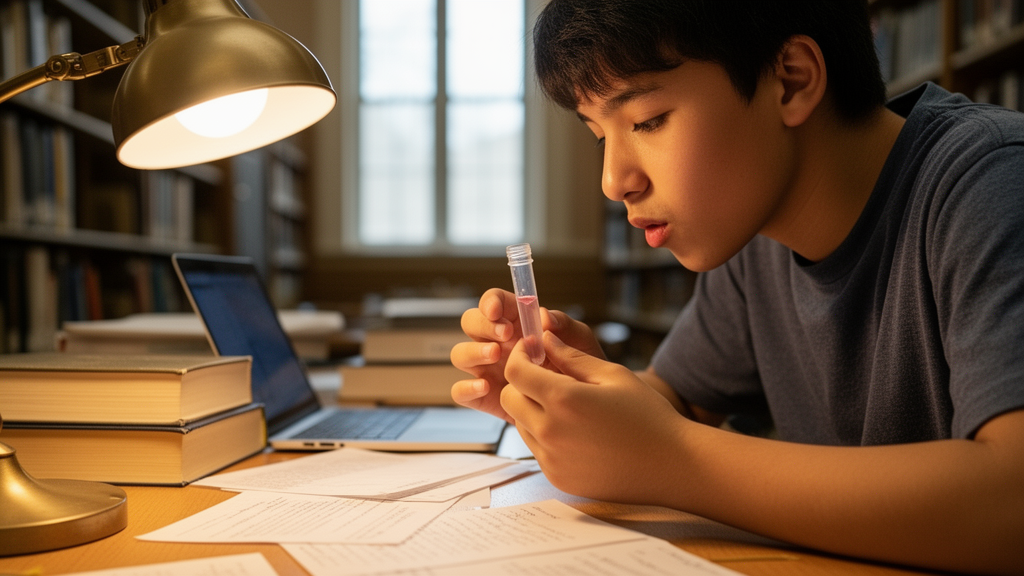
College life has long been described anecdotally as one of the most stressful periods in a person’s life, but a new study has put hard numbers on that burden—and, more strikingly, captured its chemical fingerprint in the saliva of students. A cross-sectional investigation published in PLOS Mental Health surveyed 637 undergraduates and found that more than nine in ten reported moderate to high levels of perceived stress. The research, led by Hongyu Xu and colleagues, went a step beyond questionnaires by profiling stress-related biomarkers in a subset of students, revealing measurable disruptions across the nervous, endocrine, immune, and circadian systems.
The scale of the psychological burden was the study’s first headline finding. Using standardized psychometric assessments, the researchers determined that 90.4 percent of the 637 undergraduates surveyed experienced moderate-to-high perceived stress. That figure is remarkable even for a population assumed to be under pressure, and it suggests that stress among university students is not an occasional complaint of exam season but a near-universal condition of contemporary student life. Perceived stress, as measured in the study, reflects how overwhelmed and out of control individuals feel about the demands placed on them, and it is a well-established predictor of downstream mental health problems including anxiety and depression.
Crucially, the psychological data did not exist in isolation. The researchers found that higher perceived stress correlated significantly with two of the most common complaints among students: fatigue and poor sleep. Stress levels correlated with fatigue at a correlation coefficient of 0.41 and with poor sleep quality at 0.35, both statistically significant at the p < 0.01 level. In practical terms, students who felt more stressed were also markedly more exhausted and slept worse—creating a feedback loop in which stress degrades sleep, and degraded sleep, in turn, erodes the physical and cognitive resources needed to cope with stress.
To understand what these subjective reports look like in the body, the team conducted a second, laboratory-based component of the study. They recruited 33 participants representing high-stress and low-stress profiles and performed diurnal biomarker profiling—that is, they measured stress-related molecules in saliva across the day rather than at a single snapshot in time. This approach matters because many physiological stress systems follow daily rhythms, and a single measurement can miss the pattern of dysregulation that distinguishes a chronically stressed individual from a well-rested one.
Saliva proved to be a surprisingly rich medium for this detective work. Among the molecules measured was alpha-amylase, an enzyme released by salivary glands under the control of the sympathetic nervous system—the branch of the autonomic nervous system responsible for the fight-or-flight response. Students in the high-stress group showed elevated alpha-amylase, a signature of sympathetic activation, indicating that their bodies were effectively idling in a state of heightened alertness even during ordinary daily activities.
The hormone cortisol, the classic chemical messenger of the hypothalamic-pituitary-adrenal axis, told a more nuanced story. Rather than a simple elevation, the high-stress students displayed altered diurnal cortisol patterns, which the researchers interpret as dysregulation of the HPA axis—the central hormonal machinery that mobilizes the body’s response to stress. A healthy cortisol rhythm rises sharply after waking and declines through the day; flattening or distorting that curve is one of the most consistent biological hallmarks of chronic stress, and its presence here suggests that the students’ stress had become embedded in their physiology rather than remaining a purely subjective experience.
Perhaps the most unexpected finding concerned melatonin, the hormone that signals darkness to the body and orchestrates the onset of sleep. High-stress students showed elevated melatonin, which the researchers read as a marker of circadian disruption. The interpretation is subtle: chronically stressed individuals often experience mistimed or fragmented circadian signaling, and abnormal melatonin dynamics fit with the poor sleep quality reported in the survey data. Together, the cortisol and melatonin findings paint a picture of students whose internal clocks—normally precise coordinators of sleep, wakefulness, and hormone release—had been knocked out of alignment by sustained psychological pressure.
The immune system, too, bore visible marks. Salivary immunoglobulin A and lysozyme, two frontline components of mucosal immunity that defend the mouth and throat against pathogens, were both elevated in the high-stress group. Mucosal immune activation of this kind is consistent with the body mounting a low-grade defensive posture under chronic stress, a state that in the long run can paradoxically impair immune effectiveness. The researchers also uncovered a striking degree of coordination between the nervous and immune systems: alpha-amylase and lysozyme levels were coupled across participants, with a correlation coefficient of 0.52, significant at p < 0.001. This coupling, the authors suggest, reflects neuro-immune coordination—the idea that the sympathetic nervous system and mucosal immunity do not operate independently but respond in tandem to the body’s stress state.
Taken together, the two components of the study demonstrate that salivary biomarker profiles are associated with perceived stress in ways that span multiple physiological systems simultaneously. The value of this integrated approach lies precisely in its breadth: while cortisol alone has been studied extensively in student populations, few investigations have examined neuroendocrine, immune, and circadian markers side by side in the same individuals. By doing so, the study shows that chronic stress in students is not a single-hormone phenomenon but a whole-body pattern involving sympathetic arousal, hormonal dysregulation, circadian disturbance, and immune activation, all detectable in a noninvasive bodily fluid that can be collected without needles or clinical settings.
The authors are careful about what the study can and cannot establish. As a cross-sectional design, it captures associations at a single point in time and cannot prove that stress causes the biomarker changes, nor that the biomarker patterns drive the fatigue and sleep problems students reported. The researchers explicitly flag sleep quality and fatigue as warranting further investigation as potential intervention targets in future longitudinal studies—work that would follow students over time to see whether improving sleep, for example, normalizes stress physiology. Even so, the findings carry an urgent public health message. With stress-related mental health disorders recognized globally as a major concern, and with more than 90 percent of surveyed students reporting moderate-to-high stress, the study suggests that universities are confronting not merely a wellness issue but a measurable physiological burden—one written in cortisol curves, melatonin rhythms, and immune molecules, and readable in a few milliliters of saliva.
Subject of Research: Salivary biomarkers of stress, sleep quality, and circadian disruption in college students
Article Title: The hidden burden of college life: Stress, sleep, and salivary biomarkers in students—A cross-sectional study
Article References: The hidden burden of college life: Stress, sleep, and salivary biomarkers in students—A cross-sectional study. (n.d.). https://doi.org/10.1371/journal.pmen.0000717
Image Credits: AI Generated
DOI: 10.1371/journal.pmen.0000717
Keywords: perceived stress, college students, cortisol, alpha-amylase, melatonin, salivary biomarkers, sleep quality, fatigue, HPA axis, circadian rhythm, mucosal immunity, immunoglobulin A
Cite Scienmag News
Glenn Wilkins. (October 9, 2026). Stress Leaves a Chemical Signature in the Saliva of Stressed College Students. Scienmag. https://scienmag.com/stress-leaves-a-chemical-signature-in-the-saliva-of-stressed-college-students/
Glenn Wilkins. "Stress Leaves a Chemical Signature in the Saliva of Stressed College Students." Scienmag, 9 October 2026, https://scienmag.com/stress-leaves-a-chemical-signature-in-the-saliva-of-stressed-college-students/. Accessed 9 October 2026.
Glenn Wilkins. "Stress Leaves a Chemical Signature in the Saliva of Stressed College Students." Scienmag. October 9, 2026. https://scienmag.com/stress-leaves-a-chemical-signature-in-the-saliva-of-stressed-college-students/


