


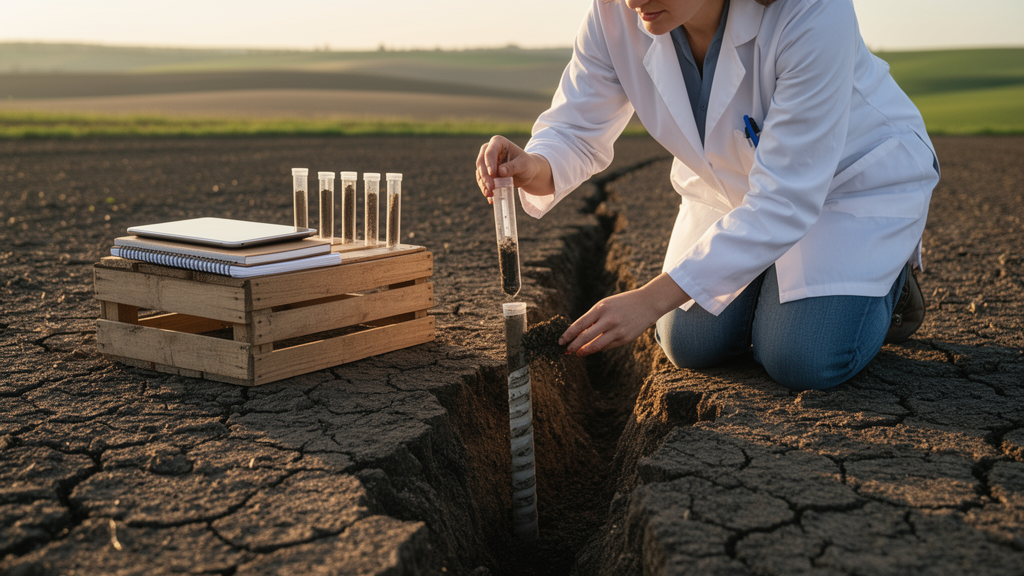
In the sun-baked olive groves of Jumilla, in southeastern Spain, a quiet scientific drama has been unfolding for more than a decade. Researchers from the Spanish National Research Council and Italian agricultural institutes have spent eleven years measuring the carbon accumulating in the soil of an organic olive orchard, then asked a deceptively simple question: can one of the world’s most widely used soil carbon models reproduce what actually happened in the field? The answer, published in the journal SOIL, is a sobering mix of reassurance and warning for anyone betting on agricultural soils to help solve the climate crisis.
The stakes could hardly be higher. Soil organic carbon is a cornerstone of the global carbon cycle, and schemes that pay farmers to sequester carbon in their fields—from voluntary carbon markets to emerging European certification frameworks—depend on trustworthy numbers. If models and measurements disagree, the entire architecture of agricultural carbon credits wobbles. The new study, led by Francisco Contreras of CEBAS-CSIC in Murcia, is one of the rare long-term experiments designed to test exactly that agreement, and its findings expose weaknesses on both sides of the ledger.
The experiment ran from 2013 to 2024 in a certified organic grove sitting 423 metres above sea level in a cold semiarid Mediterranean climate, where average annual rainfall is a meagre 263 millimetres. The soil is a sandy loam Haplic Calcisol with an alkaline pH and modest starting organic carbon content of 1.30 percent. The team set up a randomized complete block design with twelve plots and four treatments: compost produced on-farm from two-phase olive mill waste, pruning residues and sheep manure; biochar; a mixture of 90 percent compost and 10 percent biochar; and an unamended control. Amendments were applied five times over the trial at a rate of 20 megagrams of dry matter per hectare, spread along the drip lines of the trees and manually incorporated into the soil.
Seventeen sampling campaigns tracked carbon in the top 20 centimetres of soil, with outliers filtered using a robust median absolute deviation method that removed just over 10 percent of observations. By the end of the experiment, every treatment had gained carbon, even the control, with final concentrations of 1.80, 2.56, 2.84 and 3.01 grams per 100 grams of soil for control, compost, mixture and biochar respectively. Both the field data and the model agreed on the headline ranking: biochar was the most effective amendment for carbon accumulation, followed by the mixture and then compost. But when the researchers converted those concentrations into sequestration rates, the two approaches parted ways dramatically.
Field measurements pointed to soil carbon sequestration rates of 1.67 to 2.66 megagrams of carbon per hectare per year across the amended treatments. The RothC model, a multi-compartment carbon turnover model developed at Rothamsted Research and used worldwide, simulated rates of 2.98 to 5.34 megagrams—roughly double the field-based figures. The model systematically overestimated soil organic carbon stocks, and the size of the error depended on what had been added to the soil. Compost and the compost-biochar mixture showed the closest agreement between simulation and reality, with coefficients of determination of 0.43 and 0.39. Biochar, by contrast, was the worst performer, with an R² of just 0.10 and a root mean square error of 19.44 megagrams of carbon per hectare, the highest of any treatment.
Getting the model to work at all in this environment required serious technical surgery. Standard RothC struggles in semiarid regions, where it demands unrealistically high carbon inputs to match observations, so the team adopted a modified soil moisture function that allows soils to dry out thoroughly and slows decomposition accordingly. They also used a version of RothC adapted for amended soils, which adds three extra pools for exogenous organic matter—decomposable, resistant and humified—each with its own size and decay rate. Compost parameters were calibrated by inverse modelling against carbon dioxide fluxes measured in laboratory incubations of similar composts in three Mediterranean soils. Biochar could not be calibrated this way because its mineralisation emissions were simply too low, so the researchers instead derived pool parameters from the char’s thermal stability and hydrogen-to-carbon molar ratio, following a method proposed by Leifeld and colleagues in 2024.
The model’s initialization proved equally consequential. Because the grove had been converted from low-intensity agriculture to olives in 1997 and had received compost before the trial began, the soil was not at equilibrium. The team ran a historical spin-up, simulating a thousand years of equilibrium under the previous land use and then transitioning through the olive orchard phase, so that carbon pool sizes carried forward realistically. Even so, the model failed to reproduce the carbon accumulation observed in the unamended control plots, where field measurements showed a steady rise of about 0.04 grams of carbon per 100 grams per year. The researchers attribute this partly to the shredding and incorporation of olive pruning residues—inputs that are notoriously difficult to quantify—and to the growing biomass of the maturing trees, which their remote-sensing-based above-ground biomass model captured only imperfectly.
Biochar emerged as the study’s most provocative character. On paper, and in the model, it is a carbon storage champion: the simulations estimated that 98.1 percent of the added biochar carbon remained in the soil at the end of the experiment, and projected a permanence fraction of 97.9 percent after a century—figures consistent with the upper range of published estimates and with IPCC guidance. Yet in the field, biochar-derived carbon appeared far less abundant than expected, with only 49.3 percent of added carbon apparently remaining. The likely culprit is not decomposition but detection. Biochar persists as discrete, lightweight, highly concentrated particles rather than blending homogeneously into the soil matrix like compost, so a spade sample either hits a particle-rich pocket or misses it entirely. This fine-scale horizontal variability inflates uncertainty, and the outlier filtering procedure flagged some of the highest soil carbon values in the entire experiment within the biochar plots—values whose exclusion may have depressed the final estimate.
The implications ripple directly into carbon markets. Voluntary carbon market methodologies such as those of Verra and Gold Standard increasingly require both measured and modelled estimates of soil carbon change, with explicit uncertainty assessments, and recent European certification rules acknowledge that some amendments, biochar chief among them, resist accurate quantification by field sampling alone. The study suggests that compost-amended soils are comparatively predictable and verifiable, while biochar-based interventions carry a double uncertainty: field sampling struggles with its particulate heterogeneity, and models may overstate its persistence because parameters derived from thermal stability do not fully capture ageing, fragmentation and interactions with the soil environment. Allocating carbon credits to biochar projects, the authors argue, demands a cautious approach that integrates field measurements, adapted modelling and thorough upstream characterisation of the material itself.
Ultimately, the researchers are not asking anyone to abandon either tool. Modelling remains a fast, cheap and scalable way to project soil carbon dynamics across landscapes and decades, and it correctly captured the direction and relative ranking of treatment effects over eleven years. Field sampling remains indispensable for validating those trends against reality. What the Jumilla experiment makes unmistakably clear is that the two approaches are not interchangeable, and that neither is equally reliable for every kind of organic amendment. As governments and corporations pour money into soil carbon as a climate solution, this decade-long reality check from a Spanish olive grove delivers an uncomfortable but necessary message: the numbers on which carbon credits rest are only as good as the sampling designs, model calibrations and honest uncertainty estimates behind them.
Subject of Research: Soil organic carbon modelling and measurement in an amended organic olive grove
Article Title: Challenges in soil carbon modelling and measurement: a decade of experimental data vs. RothC simulations in an organic olive grove
Article References: Contreras, F., Cayuela, M. L., Sánchez-García, M., Ronchin, E., Mondini, C., & Sánchez-Monedero, M. A. (2026). Challenges in soil carbon modelling and measurement: a decade of experimental data vs. RothC simulations in an organic olive grove. SOIL, 12(2), 773-790. https://doi.org/10.5194/soil-12-773-2026
Image Credits: AI Generated
Keywords: soil organic carbon, RothC model, biochar, compost, carbon sequestration, olive grove, carbon accounting, voluntary carbon market, soil sampling, Mediterranean agriculture, organic amendments, climate mitigation
Cite Scienmag News
Alan Morgan. (October 9, 2026). Eleven Years of Soil Data Reveal Cracks in Carbon Accounting Models. Scienmag. https://scienmag.com/eleven-years-of-soil-data-reveal-cracks-in-carbon-accounting-models/
Alan Morgan. "Eleven Years of Soil Data Reveal Cracks in Carbon Accounting Models." Scienmag, 9 October 2026, https://scienmag.com/eleven-years-of-soil-data-reveal-cracks-in-carbon-accounting-models/. Accessed 9 October 2026.
Alan Morgan. "Eleven Years of Soil Data Reveal Cracks in Carbon Accounting Models." Scienmag. October 9, 2026. https://scienmag.com/eleven-years-of-soil-data-reveal-cracks-in-carbon-accounting-models/


