


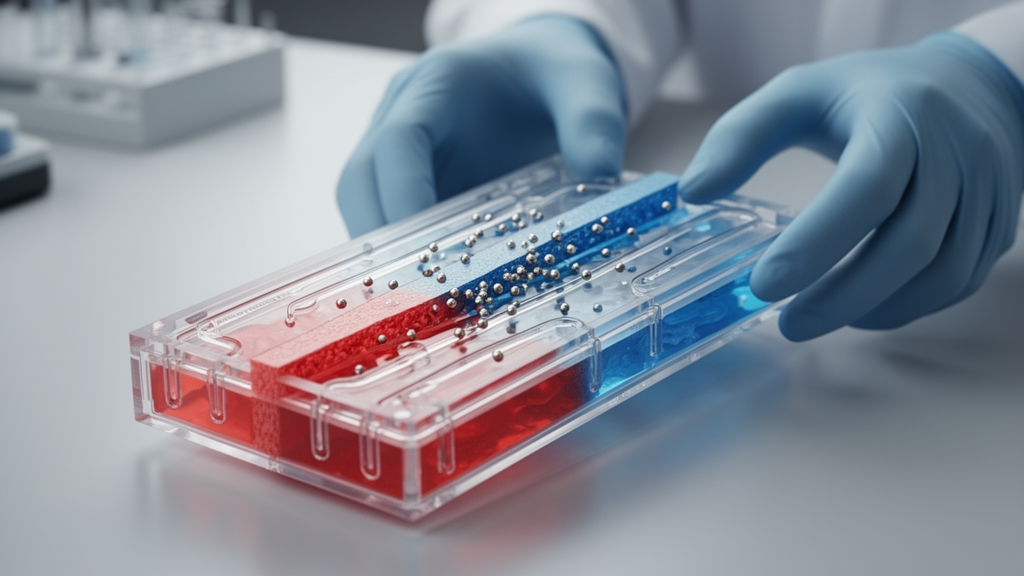
In a laboratory at the University of Pennsylvania, a sliver of living human placenta no larger than a pencil eraser is quietly rewriting what scientists know about one of pregnancy’s most troubling exposures. A team led by bioengineer Dan Dongeun Huh has built a microfluidic device that recreates the maternal–fetal interface of the human placenta using primary cells isolated from real, full-term placentas. Published in Nature Biomedical Engineering, the study uses this bioengineered tissue to simulate how toxic metals circulating in maternal blood interact with the placental barrier, and it delivers a series of findings that conventional cell cultures have never been able to capture. The work arrives at a moment of growing alarm: epidemiological studies have linked prenatal exposure to metals such as lead, mercury, arsenic and cadmium to miscarriage, preterm birth and low birth weight, with consequences that can echo into adulthood as cardiovascular, neurological and metabolic disease.
The scientific obstacle the team faced is as much ethical as it is technical. Directly studying how environmental toxicants affect pregnant women and their developing fetuses is largely off-limits, and the alternatives have serious shortcomings. Whole placentas and villous explants preserve the organ’s biological complexity but require fresh clinical specimens and are notoriously difficult to perfuse in a controlled way. Standard cultures of placental cell lines, meanwhile, flatten the placenta’s intricate three-dimensional architecture into something too simple to reflect its real-world responses. The Penn team’s answer was to build the missing middle ground: a microphysiological system in which clinically sourced primary cells assemble themselves into a vascularized, functioning placental barrier.
The device itself is a marvel of microscale engineering. Fabricated from poly(dimethylsiloxane), it consists of an upper maternal chamber and a lower fetal chamber, separated by a thin semipermeable membrane pierced with one-micrometer pores. Into the fetal chamber the researchers injected a fibrin hydrogel seeded with placental endothelial cells and fibroblasts. Over roughly a week, the endothelial cells self-organized into a three-dimensional network of open blood vessels—a process mimicking vasculogenesis in the womb—that could be perfused with flowing media through side channels. The vessels stabilized at an average diameter of about 19.9 micrometers, closely matching the 20.3 micrometers measured in real placental villi. On the upper side of the membrane, primary cytotrophoblasts were seeded and grown into a confluent monolayer studded with microvilli, the fingerlike projections that maximize exchange surface in the native organ.
What happened next is the kind of detail that makes developmental biologists sit up. Maintained at 5 percent oxygen—matching the genuinely low-oxygen environment of the human placenta rather than the 20 percent of a standard incubator—and bathed in continuous flow, the trophoblasts spontaneously fused into a syncytium, the multinucleated cell layer that performs most of the placenta’s work in vivo. The cells shed their intercellular junctions, ramped up production of the pregnancy hormone beta-hCG, and upregulated genes associated with syncytiotrophoblast maturation, including syncytin and placental growth factor. Barrier function, measured by transepithelial electrical resistance, was significantly stronger under flow than in static conditions, and the engineered tissue transferred glucose from the maternal to the fetal compartment at a rate of 33.4 percent—squarely within the physiological range documented for perfused human placental explants.
With a validated model in hand, the researchers turned to cadmium, a metal flagged as a high-priority toxicant by environmental agencies. Humans encounter cadmium through food, contaminated water, mining, fertilizer production, fossil fuel combustion and cigarette smoke, and a recent systematic review found that cadmium exposure raises the risk of low birth weight by 21 percent and preterm birth by 32 percent. When cadmium chloride was added to the maternal flow, the engineered barrier proved markedly more resilient than a conventional Transwell culture built from the same batches of primary cells. At environmentally relevant doses between 0.1 and 10 micromolar, the trophoblast layer remained largely intact, whereas the Transwell model showed substantial cell injury even at 1 micromolar. The difference, the authors argue, reflects the protective influence of physiological flow and the hydrogel stroma, which together make the microengineered system a more faithful stand-in for the real organ.
The subtler findings may prove the most consequential. Even at 5 micromolar—a dose that caused no detectable cell death—the barrier became measurably leakier, production of beta-hCG dropped, and the tissue released elevated levels of the pro-inflammatory cytokines IL-8, IL-6, IL-1β and TNF. At just 1 micromolar, expression of the glucose transporter GLUT1 fell and maternal-to-fetal glucose transfer dropped below the physiological range, even though the barrier looked structurally pristine. In other words, cadmium can sabotage placental function long before it kills a single cell, a mode of toxicity that static cultures, which register injury at far lower doses, would misread entirely. When the team added donor-matched primary Hofbauer cells—the fetal macrophages that patrol the villous stroma—the inflammatory response intensified dramatically, with IL-1β rising 3.75-fold in the fetal compartment, and the stroma showed signs of fibroblast activation and collagen deposition reminiscent of fibrosis in pre-eclamptic placentas.
Perhaps the study’s most striking mechanistic discovery concerns the placenta’s own molecular bouncers. Gene analysis revealed that cadmium exposure upregulates a family of ATP-binding cassette transporters, including BCRP, MDR1 and MRP1, which sit on the maternal-facing surface of trophoblasts and actively pump foreign substances back into the maternal circulation. When the researchers chemically inhibited BCRP, cadmium-induced cell injury roughly doubled on the maternal side and inflammatory cytokines surged in both compartments at doses that were otherwise harmless. Genetic knockdown of BCRP told the same story: the barrier began to fail at 1 micromolar instead of 5, cytotoxicity increased, and the fetal vasculature became inflamed and leaky, even recruiting adherent neutrophils when those cells were perfused through the vessels. BCRP, one of the two most abundant efflux transporters in the human placenta, appears to be a first line of defense against cadmium—a finding that could eventually inspire strategies to bolster the placenta’s natural detoxification machinery.
The team then pushed the platform into a new application: biomarker discovery. Using untargeted metabolomics on fluid collected separately from the maternal and fetal chambers, they mapped how cadmium rewires placental metabolism in a dose-dependent fashion. Higher exposures elevated pyrimidine, asparagine and serine metabolism while suppressing folate and energy-related pathways, and the fetal compartment showed a distinctive signature of disrupted fatty acid metabolism, with drops in arachidonic acid, oleic acid and glutamate—molecules essential for fetal neural development and energy supply. Notably, several of these metabolic changes mirror signatures previously reported in human placentas from pregnancies complicated by preterm birth, gestational diabetes and fetal growth restriction, suggesting that disrupted placental metabolism may be one route by which cadmium contributes to adverse outcomes. Receiver operating characteristic analysis yielded distinct sets of candidate biomarkers for low and high exposure levels, offering a potential roadmap toward clinical tests that do not yet exist.
To guard against the possibility that their findings were artifacts of the chip, the researchers ran a parallel validation using living villous explants from term placentas, perfused in a 3D-printed chamber. The explants reproduced the key responses: dose-dependent cell injury, a surge of inflammatory cytokines at high cadmium doses, and metabolic shifts that overlapped substantially with the microengineered model—roughly 48 percent of the top altered pathways matched those seen in the maternal compartment. The convergence between a fully reconstructed tissue and the native organ lends considerable weight to the platform’s predictions. Limitations remain, as the authors candidly note: the model is a simplified snapshot that cannot capture how the placenta changes across gestation, nor the direct effects of cadmium on the developing fetus itself, and the PDMS used to build the device can absorb hydrophobic compounds, restricting its use to water-soluble toxicants.
Even so, the implications are hard to overstate. For decades, the placenta has been called the forgotten organ—remarkably complex, ethically inaccessible and poorly understood. A perfusable, primary-cell model that reproduces its barrier, vasculature, immune residents and metabolic activity gives toxicologists, clinicians and regulators a human-relevant test bed for a class of exposures that touches every pregnancy on the planet. Cadmium’s prevalence is highest in developing countries, making this as much a global health equity issue as a basic science one. If follow-up work can validate the metabolite biomarkers in real patients and identify drugs or nutrients that strengthen BCRP-mediated efflux, the tiny placenta on a chip may end up protecting pregnancies far larger than itself.
Subject of Research: A microphysiological model of the human placental barrier used to study fetal exposure to environmental metals such as cadmium during pregnancy
Article Title: A bioengineered model of human placental exposure to environmental metals during pregnancy
Article References: Fattahi, P., Younesi, M., Lee, W. D., Whang, K., Kim, S.-J., Kang, T., Aleksunes, L. M., & Huh, D. D. (2026). A bioengineered model of human placental exposure to environmental metals during pregnancy. Nature Biomedical Engineering. https://doi.org/10.1038/s41551-026-01801-9
Image Credits: AI Generated
DOI: 10.1038/s41551-026-01801-9
Keywords: placenta-on-a-chip, cadmium, microfluidics, trophoblast, BCRP transporter, maternal-fetal interface, environmental toxicology, pregnancy, metabolomics, organ-on-a-chip, Hofbauer cells, prenatal exposure
Cite Scienmag News
Ophelia Keating. (October 9, 2026). Placenta-on-a-chip reveals how toxic metals cross from mother to fetus. Scienmag. https://scienmag.com/placenta-on-a-chip-reveals-how-toxic-metals-cross-from-mother-to-fetus/
Ophelia Keating. "Placenta-on-a-chip reveals how toxic metals cross from mother to fetus." Scienmag, 9 October 2026, https://scienmag.com/placenta-on-a-chip-reveals-how-toxic-metals-cross-from-mother-to-fetus/. Accessed 9 October 2026.
Ophelia Keating. "Placenta-on-a-chip reveals how toxic metals cross from mother to fetus." Scienmag. October 9, 2026. https://scienmag.com/placenta-on-a-chip-reveals-how-toxic-metals-cross-from-mother-to-fetus/


