


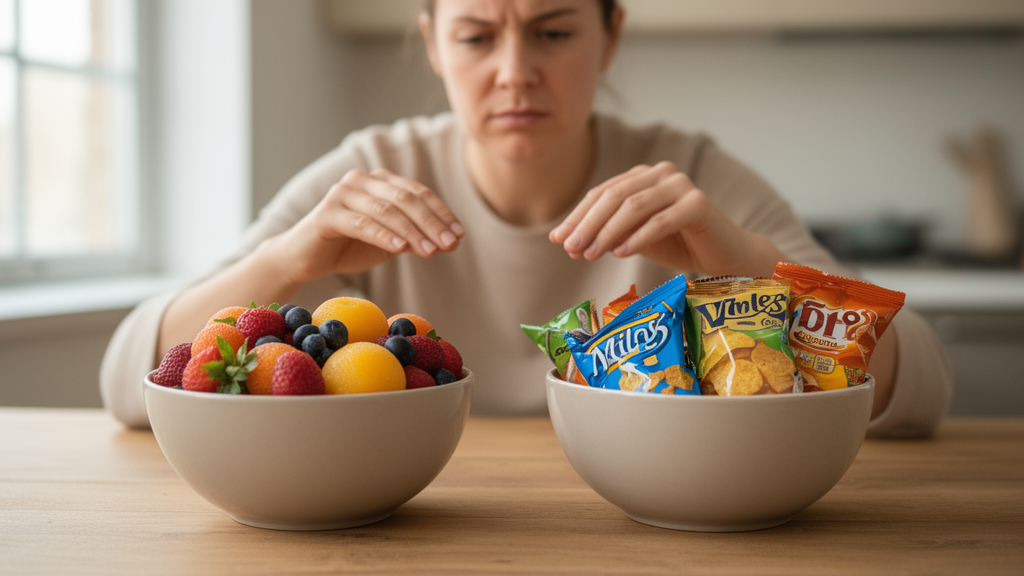
Why is it so hard to swap a beloved snack for a healthier alternative? A new study suggests the answer lies in how our long-standing food preferences actively interfere with the brain’s learning machinery. Researchers at Yale University report that when people try to learn new value associations for foods they already love or loathe, their prior preferences distort the learning process itself—and that the very first experiences in a learning sequence can leave a lasting imprint on how flexible that learning becomes. The findings, published in Communications Psychology, carry striking implications for dietary interventions, which routinely ask people to overturn deeply held food values.
The research team, led by Alexandra Rich and Ifat Levy, recruited 415 participants online through the Prolific platform across two independent cohorts, with 279 participants ultimately included in the final analysis. Rather than using neutral shapes or abstract symbols, as most value-learning studies do, the researchers personalized the experiment to each individual. Participants first rated 65 snack images from the Food Folio database, ranging from granola bars to croissants, on a four-point scale from strongly dislike to strongly like. From these ratings, the researchers built a personalized set of four foods for each participant: one strongly liked, one liked, one disliked, and one strongly disliked. Importantly, the team verified that these preference ratings did not track the foods’ caloric or nutritional content, confirming that the experiment captured genuinely subjective values rather than objective properties of the snacks.
Participants then completed a probabilistic reversal-learning task. On each trial, one of their four personal foods appeared on screen, and they had three seconds to predict whether it would be followed by a positive outcome of plus five points or a negative outcome of minus five points. The task unfolded in six blocks of 32 to 36 trials each. In Congruent blocks, the outcomes aligned with participants’ existing preferences 90 percent of the time: liked foods usually predicted rewards and disliked foods usually predicted punishments. In Incongruent blocks, the relationship flipped, forcing participants to learn associations that ran directly against their priors. Crucially, participants knew the task involved switching relationships, but they were never told when reversals would occur or that the block structure was tied to their own ratings.
The results revealed a surprising order effect. Participants who began the task with a Congruent block—meaning their priors were initially reinforced—showed greater overall accuracy than those who began with an Incongruent block. More tellingly, the Congruent-start group achieved exceptionally high accuracy on later Congruent blocks, averaging 0.73, while performing far worse on Incongruent blocks, averaging 0.59. In contrast, participants who started with a block that challenged their priors performed similarly across both block types, around 0.62. This interaction between starting condition and block type was replicated in both independent cohorts. In other words, the first reinforcement of one’s food preferences appeared to potentiate rigidity: once the brain’s existing associations were validated, they became harder to overturn later, even though participants explicitly knew the rules would change.
The researchers propose several cognitive mechanisms that could explain this anchoring-like effect. Participants likely entered the experiment with the plausible hypothesis that outcomes would follow their personal preferences. For those who started with a Congruent block, that hypothesis was immediately confirmed, strengthening the anchor linking liked foods to rewards and disliked foods to punishments. Associative priming, confirmation bias, increased confidence, and egocentric discounting may all have compounded the effect. Conversely, participants whose initial evidence contradicted their priors may have been less biased in subsequent judgments, which is consistent with their more uniform performance across block types.
An equally important finding concerned an asymmetry between liked and disliked foods. For liked items, prediction accuracy was consistently higher in Congruent blocks than in Incongruent blocks, regardless of which block type participants started with—positive priors made these associations stubbornly inflexible. Disliked foods behaved differently: participants performed better in whichever condition they started in, suggesting that associations with non-preferred foods were far more suggestible to the surrounding task environment. The authors interpret this as an asymmetry in food-value plasticity. It may be considerably easier to add a disliked food to one’s diet than to remove a liked one, a conclusion that challenges the optimism of earlier training studies that modestly devalued highly preferred foods through cued-approach paradigms.
The study also uncovered a robust positivity bias. Across all conditions, participants predicted reward-associated outcomes more accurately than punishment-associated outcomes, with average accuracy of 0.69 for rewards versus 0.61 for punishments. This held regardless of block type, food preference, or starting condition—even though the point outcomes were arbitrary and carried no real-world value beyond a bonus payment tied to overall accuracy. Translated to the dinner table, the finding hints that emphasizing the rewarding aspects of healthy foods, such as their benefits, may influence associative learning more effectively than warnings about negative health consequences. Carrots, in this sense, may genuinely work better than sticks.
Behavioral measures collected before and after the task reinforced the plasticity story. Participants who began with an Incongruent block showed significant increases in their willingness to pay, enjoyment, and expected satisfaction for disliked foods after the task, along with a decrease in satisfaction for liked foods. Congruent-start participants showed almost no such changes. This suggests that beginning with experiences that challenge one’s priors may promote broader updating of item value rather than mere trial-by-trial adaptation—a cumulative shift in valuation that could be harnessed in interventions aimed at reshaping eating habits.
Exploratory analyses added a clinical dimension. Among Congruent-start participants, higher scores on the Binge Eating Scale were associated with lower accuracy when learning that disliked foods predicted rewards, a relationship that remained significant in a regression controlling for age, gender, and body mass index. This finding aligns with prior evidence that reward processing and cognitive flexibility are altered in binge eating, and it hints that impaired updating of non-preferred stimuli’s values may be a cognitive feature of obesity with comorbid binge eating—a population for whom dietary interventions already show reduced efficacy. The authors caution, however, that this effect was weak and emerged from multiple comparisons, warranting further study.
The study’s limitations invite follow-up work. The outcomes were arbitrary points rather than motivationally salient rewards, and the researchers cannot yet say whether the findings generalize to other valued items, such as sports teams or politicians, or how neutral stimuli would perform in the same paradigm. Still, the central message is clear and ecologically important: we rarely learn about value in a naive environment, and our prior preferences confound the process from the very first trial. For public health, that means the sequencing of experiences matters. Interventions that begin by challenging existing food preferences, rather than reinforcing them, may stand a better chance of building the flexible food-value learning that healthier eating requires.
Subject of Research: How prior food preferences interfere with the flexible associative learning of food values in humans
Article Title: Prior preferences interfere with the associative learning of food values
Article References: Rich, A., Kapadia, S., Henry, R., Dan, O. J., & Levy, I. (2026). Prior preferences interfere with the associative learning of food values. Communications Psychology, 4(1), Article 132. https://doi.org/10.1038/s44271-026-00533-5
Image Credits: AI Generated
DOI: 10.1038/s44271-026-00533-5
Keywords: food value learning, associative learning, reversal learning, prior preferences, reinforcement learning, positivity bias, dietary interventions, binge eating, cognitive flexibility, decision making, reward processing, behavioral neuroscience
Cite Scienmag News
Cassandra Pierce. (October 9, 2026). Your Food Preferences Sabotage How You Learn New Food Values. Scienmag. https://scienmag.com/your-food-preferences-sabotage-how-you-learn-new-food-values/
Cassandra Pierce. "Your Food Preferences Sabotage How You Learn New Food Values." Scienmag, 9 October 2026, https://scienmag.com/your-food-preferences-sabotage-how-you-learn-new-food-values/. Accessed 9 October 2026.
Cassandra Pierce. "Your Food Preferences Sabotage How You Learn New Food Values." Scienmag. October 9, 2026. https://scienmag.com/your-food-preferences-sabotage-how-you-learn-new-food-values/


