


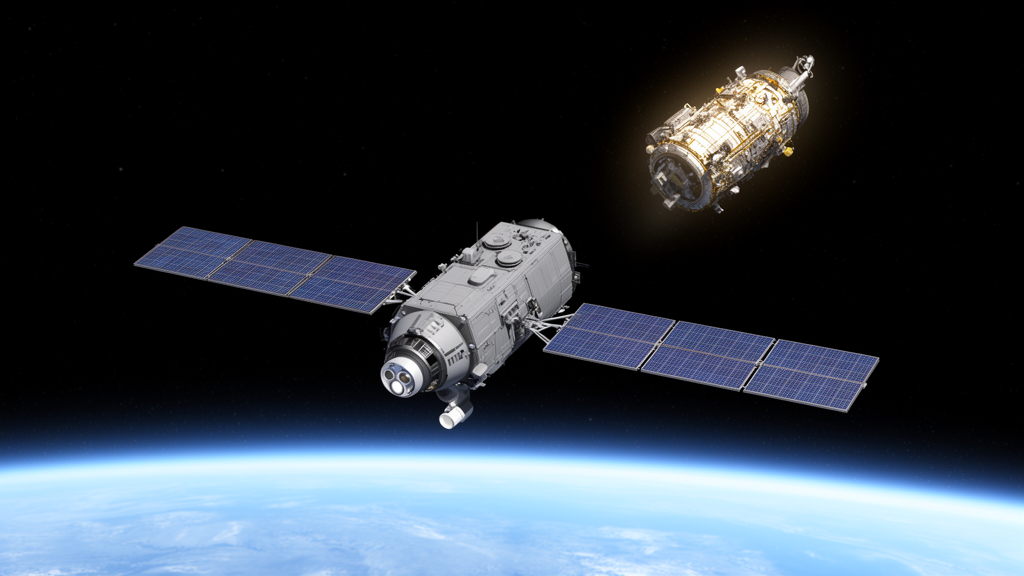
In the crowded and increasingly contested environment of geostationary orbit, some 35,786 kilometers above Earth, knowing precisely what a neighboring satellite is doing has become a central concern of space security. A new peer-reviewed study published in Space: Science & Technology, led by Meng Yunhe of the School of Artificial Intelligence at Sun Yat-sen University, presents a systematic strategy design method that allows an observing spacecraft to plan a fuel-minimal, multi-stage sequence of close-range maneuvers around a non-cooperative target. The approach, grounded in sequential coalition game theory, addresses a bottleneck that has long limited space situational awareness: how to gather multi-aspect payload information about an uncooperative object without exhausting the finite propellant aboard the observer.
The strategic stakes are considerable. The geostationary belt hosts a large number of missile early warning and military communication satellites, making it a core strategic resource in orbital operations. In recent years, the United States Geosynchronous Space Situational Awareness Program, known as GSSAP, has conducted hundreds of close-range observation operations on dozens of on-orbit satellites in the vicinity of GEO. These activities have underscored that acquiring multi-aspect information from non-cooperative targets is now a critical component of space security assessment. By observing a target from multiple geometries and ranges, analysts can infer its functions and mission status, turning raw imagery and payload signatures into actionable assessments of what an unknown or suspicious spacecraft is actually built to do.
Close-range spacecraft operations provide the technical means for such observation. Using relative motion configurations such as fly-around, hovering, and drifting flight, an observer can approach and circle a target to collect multi-aspect payload information. Yet existing research has predominantly focused on the control design of a single relative motion configuration, which cannot satisfy the complex requirements of a full multi-aspect observation campaign. Combining multiple observation models introduces a cluster of intertwined challenges: achieving smooth switching between modes, optimizing fuel consumption across the whole sequence, designing tractable strategy algorithms, and analyzing how payload parameters such as camera field of view affect the quality of the resulting data. The new work tackles all of these problems within a single unified framework.
The mathematical foundation of the study rests on the Clohessy–Wiltshire relative dynamics equations, the classical linearized description of relative motion between two spacecraft in near-circular orbits. From the analytical solutions of unforced relative motion, the researchers constructed four typical close-range operation models: the droplet model, the coplanar fly-around model, the non-coplanar fly-around model, and the drifting flight model. For each configuration, the team derived solution functions for the initial motion states that produce stable relative motion trajectories, parameterized by relative distance and phase angle. The droplet model, characterized by its symmetry and revisit capability, enables fine, repeated observation of the target. The coplanar and non-coplanar fly-around models facilitate circling observations in different orbital planes, while the drifting flight model achieves close-range observation through multi-impulse control.
Switching cleanly between these configurations is a nontrivial problem in its own right, because an abrupt transition would waste propellant and could destabilize the relative trajectory. To solve it, the researchers designed a waypoint trajectory planning scheme based on minimum integral squared control theory, a formulation that seeks the control input minimizing the accumulated squared control effort over the transfer. Combined with a multi-impulse maneuver strategy, this scheme allows the observing spacecraft to move smoothly from the terminal state of one observation model to the initial state of the next, stitching the four configurations into a continuous, fuel-conscious observation campaign rather than a set of disconnected maneuvers.
The most novel element of the study is its introduction of sequential coalition game theory into the multi-model combined observation problem, an application the authors describe as the first of its kind. By constructing a game tree whose branches represent the available initial motion points and close-range operation models at each stage, the algorithm searches for the optimal combination at every decision point under minimum fuel constraints. The result is an optimal observation strategy sequence: a staged plan that tells the observing spacecraft which configuration to adopt, where to begin it, and how to transition to the next, all while keeping total propellant expenditure as low as possible. Framing the problem as a sequential game transforms an otherwise combinatorial trajectory planning task into a structured search over well-defined strategic choices.
Simulation results validate the framework end to end. The generated strategy set shows a clear staged progression: the first stage selects an initial point and the droplet model, the second stage selects the drifting flight model, and the third and fourth stages sequentially select the coplanar and non-coplanar fly-around models. The three-dimensional relative trajectories of this four-model combined observation confirm that the algorithm can successfully produce an optimal combined sequence under minimum fuel constraints. In other words, the game-theoretic planner does not merely find a feasible path through the space of possible maneuvers; it finds one that respects the hard propellant budget that ultimately governs how long an observing satellite can remain useful on orbit.
Beyond trajectory planning, the study delivers a quantitative analysis of effective observation time, defined as the total duration during which the target remains observable within prescribed constraints on observation distance and camera field-of-view angle. Because the observation cameras are fixedly installed on the spacecraft, frequent large-angle attitude maneuvers would be both time-consuming and fuel-intensive, making the choice of relative motion geometry the primary lever for maximizing observability. The statistical analysis reveals two practical design rules. First, under the same close-range operation model configuration, increasing the observation distance and the field-of-view angle significantly enhances target observability and yields longer effective observation time. Second, for fixed distance and field of view, reducing the model configuration size also improves observation performance.
These findings carry substantial engineering reference value for space security assessment and on-orbit situational awareness. For mission planners, the work offers a systematic, computable method to design multi-aspect information acquisition campaigns against non-cooperative targets, replacing ad hoc maneuver selection with a principled game-theoretic optimization. For the broader space community, the study arrives at a moment when close-range operations near GEO are no longer hypothetical but routine, and when the ability to characterize an unknown object quickly and cheaply may determine how confidently operators can protect their own assets. By unifying relative orbital dynamics, minimum-fuel trajectory planning, and sequential game theory into one framework, the Sun Yat-sen University team has outlined a template for the next generation of autonomous inspection missions, in which a single observer can adaptively choose how, where, and when to look at a target that will never cooperate.
Subject of Research: Game-theoretic strategy design for multi-model spacecraft proximity observation of non-cooperative satellites
Article Title: Spacecraft proximity operation model-based sequential coalitional observation game strategy design
Article References: Spacecraft proximity operation model-based sequential coalitional observation game strategy design. (n.d.). Original publication
Image Credits: AI Generated
DOI: Not provided
Keywords: space situational awareness, geostationary orbit, spacecraft proximity operations, sequential coalition game theory, Clohessy–Wiltshire dynamics, non-cooperative targets, fuel optimization, fly-around maneuvers, trajectory planning, GSSAP, space security, relative orbital motion
Cite Scienmag News
Bruce Campbell. (October 9, 2026). Game Theory Steers Spacecraft Through Multi-Model Observation of Non-Cooperative Targets. Scienmag. https://scienmag.com/game-theory-steers-spacecraft-through-multi-model-observation-of-non-cooperative-targets/
Bruce Campbell. "Game Theory Steers Spacecraft Through Multi-Model Observation of Non-Cooperative Targets." Scienmag, 9 October 2026, https://scienmag.com/game-theory-steers-spacecraft-through-multi-model-observation-of-non-cooperative-targets/. Accessed 9 October 2026.
Bruce Campbell. "Game Theory Steers Spacecraft Through Multi-Model Observation of Non-Cooperative Targets." Scienmag. October 9, 2026. https://scienmag.com/game-theory-steers-spacecraft-through-multi-model-observation-of-non-cooperative-targets/


