


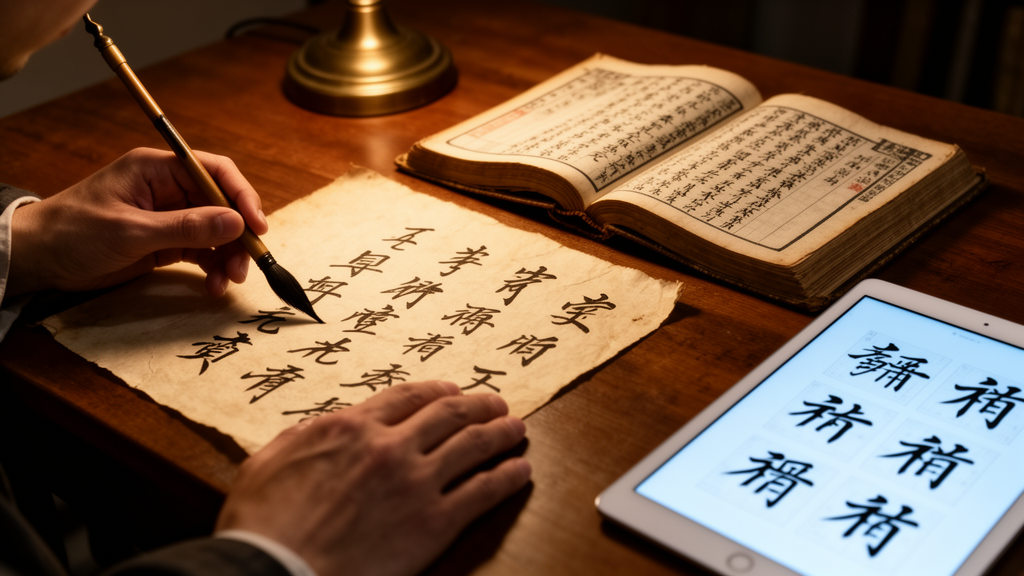
For centuries, the Yi script of southwestern China has carried linguistic knowledge and cultural memory across generations, inscribed in manuscripts, ritual texts, and dictionaries that scholars still consult today. Yet anyone who has tried to use a traditional Yi dictionary knows the frustration: the script contains thousands of visually intricate glyphs, and looking one up typically requires knowing its pronunciation, its digital encoding, or its position in a fixed index. A reader who can recognize or copy a character by hand but cannot name it has historically been locked out of the very reference works that could explain it. A new study published in npj Heritage Science presents a practical answer to this problem, using modern artificial intelligence to let users find dictionary entries simply by drawing the glyph they see.
The research, led by Xiaoyu Zhou and colleagues at Chuxiong Normal University in Yunnan, China, describes a handwriting-based retrieval framework designed specifically for Yi script lexicographic resources. Rather than attempting to fully recognize and transcribe handwritten characters, a task made difficult by the sheer size and visual complexity of the Yi repertoire, the system treats the problem as one of retrieval: given a handwritten query, it searches a database of 2,572 dictionary-linked glyph identities and returns a ranked list of the closest matches. The user then confirms the correct entry from the shortlist, keeping the original dictionary and human interpretation as the final authority.
At the technical core of the framework is SigLIP-B/16, a vision-language model pretrained on large-scale image and text data, which the researchers adapted to the specific demands of Yi handwriting. Pretrained models of this kind learn general-purpose visual representations, but they are not natively tuned to the stroke conventions, stylistic variation, and idiosyncrasies of handwritten Yi characters. To bridge that gap, the team attached a lightweight residual adapter to the model. This adapter is a small trainable module inserted into the network that learns to adjust the pretrained representations for the target domain, while the residual connection preserves the original model’s knowledge. The design keeps the number of trainable parameters modest, which matters for a heritage project that may need to run on modest hardware and be retrained as new handwriting samples become available.
The evaluation design reflects a realistic and demanding use case. The researchers conducted a one-shot, glyph-disjoint test, meaning that the 350 held-out glyph identities used for evaluation had never been seen during the adapter’s training phase, and each was represented by only a single reference exemplar in the gallery. In practical terms, the system had to match a handwritten query against characters it had never been trained on, using just one canonical image per character. This setup mirrors what a real user would encounter: a dictionary contains many characters, and no system can assume it has seen abundant handwritten examples of every one of them.
The results quantify how much the adaptation mattered. Across 417 handwritten queries covering the 350 held-out identities, the adapted system achieved a Recall@30 of 88.7 percent, meaning that for nearly nine out of ten queries the correct glyph appeared somewhere within the top thirty ranked candidates. Without adaptation, the same backbone managed only 64.7 percent. The improvement at stricter cutoffs was equally striking: Recall@10 rose from 53.0 percent to 75.1 percent, and the median rank of the correct answer dropped from eighth place to third. For a user scanning a shortlist of candidate characters on screen, those numbers translate directly into less searching and faster lookup.
Why does a residual adapter deliver such a large gain on a task that a powerful pretrained model already performs reasonably well? The authors’ framework suggests an answer rooted in the nature of the domain gap. SigLIP’s pretraining exposes it to an enormous variety of printed and natural images, giving it a strong sense of shape and structure, but handwritten Yi glyphs occupy a narrow visual niche with its own conventions of stroke order, slant, and proportion. The adapter effectively learns a compact transformation that reorients the pretrained feature space so that handwritten queries land closer to their printed reference counterparts. Because the transformation is residual, it refines rather than replaces the base representations, avoiding the catastrophic forgetting that can occur when small datasets are used to fine-tune large models end to end.
The choice of retrieval over full recognition is also a deliberate design decision with cultural and practical implications. Yi script, in its traditional form, encompasses thousands of characters, and building a recognizer that must commit to a single output label risks confidently returning the wrong character, which would silently mislead a user consulting a dictionary. A ranked-list interface instead surfaces several plausible candidates and lets the human make the final judgment. The authors are explicit that the prototype is intended as an entry point to difficult-to-index lexicographic resources, with the original dictionary and human interpretation retained as the basis for further consultation. In other words, the machine narrows the search; the scholar still reads the entry.
The work sits within a growing body of computational research on Yi script heritage. Related efforts include a repository of ancient Yi handwriting samples published in 2024, a dual-branch transformer approach for detecting Yi characters in ancient manuscripts, and methods that integrate path signature and pen-tip trajectory features for online handwriting recognition of Yi text. Together, these projects sketch a pipeline for digital humanities work on the script: datasets are being assembled, detection and recognition models are being refined, and now retrieval tools are emerging that connect raw handwriting to structured lexical knowledge. Each component addresses a different stage of the same underlying challenge, which is that a script of great historical significance can become inaccessible when its reference infrastructure assumes knowledge that many users do not have.
The practical significance extends beyond Yi studies. Many of the world’s scripts, particularly those used in manuscript traditions rather than mass printing, face the same indexing problem: large character inventories, multiple historical variants, and dictionaries organized by principles that presuppose familiarity with the writing system. A handwriting-based retrieval layer offers a general pattern for making such resources navigable, and the demonstrated recipe, a strong pretrained vision model plus a small domain adapter evaluated under glyph-disjoint conditions, is one that other script communities could adapt. The one-shot, disjoint evaluation protocol is especially relevant, because it tests the scenario that matters most for endangered or minority scripts, where annotated handwriting data is scarce and new characters will always lie outside the training set.
The study, supported by the Chuxiong Normal University Research Fund, arrives as an open-access article under a Creative Commons Attribution license, making the framework’s details available to researchers and heritage practitioners worldwide. Its authors report no competing interests, and the published version documents a system that moved a difficult retrieval task from roughly two-thirds success within thirty candidates to nearly ninety percent, while cutting the typical search depth from eight candidates to three. Those are not headline-grabbing superhuman benchmarks, and that is precisely the point: the system is built to assist rather than replace human expertise, giving anyone who can draw a Yi character a working path into the dictionaries that preserve the language’s accumulated knowledge. For a script whose manuscripts encode centuries of cultural memory, a tool that turns a hand-drawn stroke into a dictionary lookup is a quiet but meaningful act of digital preservation.
Subject of Research: Handwriting-based retrieval of Yi script dictionary entries using an adapted vision-language model
Article Title: Handwritten Dictionary Retrieval for Digital Access to Yi Script Heritage
Article References: Zhou, X., Xu, L., Zheng, Z., Jian, Z., & Kui, Z. (2026). Handwritten Dictionary Retrieval for Digital Access to Yi Script Heritage. npj Heritage Science. https://doi.org/10.1038/s40494-026-03017-1
Image Credits: AI Generated
DOI: 10.1038/s40494-026-03017-1
Keywords: Yi script, handwriting retrieval, SigLIP, residual adapter, digital heritage, dictionary access, glyph recognition, npj Heritage Science, cultural preservation, deep learning, one-shot learning, lexicography
Cite Scienmag News
Courtney Benton. (October 9, 2026). Handwriting Meets AI: New Tool Unlocks Ancient Yi Script Dictionaries. Scienmag. https://scienmag.com/handwriting-meets-ai-new-tool-unlocks-ancient-yi-script-dictionaries/
Courtney Benton. "Handwriting Meets AI: New Tool Unlocks Ancient Yi Script Dictionaries." Scienmag, 9 October 2026, https://scienmag.com/handwriting-meets-ai-new-tool-unlocks-ancient-yi-script-dictionaries/. Accessed 9 October 2026.
Courtney Benton. "Handwriting Meets AI: New Tool Unlocks Ancient Yi Script Dictionaries." Scienmag. October 9, 2026. https://scienmag.com/handwriting-meets-ai-new-tool-unlocks-ancient-yi-script-dictionaries/


