


For more than half a century, the defining story of human settlement has been one of concentration: people flooding into cities, and ecologists racing to document the consequences. But a quieter, counterintuitive trend is gathering force alongside it. Across much of the Global North, and increasingly beyond, substantial numbers of people are moving down the settlement hierarchy, from large urban centres to smaller towns, suburbs and the countryside. This process, known as counter-urbanisation, was thrust into the spotlight by the COVID-19 pandemic, when lockdowns, fear of infection and the normalisation of remote work prompted many households to seek greener, more spacious living environments. Now, a comprehensive review published in PLOS Ecosystems by Qianwen Duan and colleagues at the University of Southampton, together with Alessandro Sorichetta of the University of Milan, argues that this population redistribution is reshaping human-ecological relations in ways that science has largely failed to capture, and that the effects are neither uniformly good nor uniformly bad for nature.
The core problem the researchers identify is fragmentation of evidence. The ecological impacts of urban expansion are well documented, typically tied to the direct conversion of land into built-up surfaces. Counter-urbanisation is harder to pin down. It is fundamentally a demographic concept, describing relocation to less densely populated places, and it does not automatically entail landscape change. When people leave cities, buildings and roads remain behind, and ecological recovery is gradual. Meanwhile, in the rural areas receiving newcomers, growth may raise land consumption and habitat loss, or it may instead inspire conservation. To untangle these contradictory signals, the team developed a unified framework built on two complementary mechanisms: a landscape footprint, arising from physical modification of land use and land cover, and a lifestyle footprint, arising from changes in human presence, mobility, recreation and consumption that leave land cover intact.
The landscape pathway begins with built development. An influx of new residents into rural areas typically produces low-density, diffuse settlement, with roads, housing and infrastructure expanding at the expense of natural or semi-natural vegetation. Because habitat loss remains a primary driver of biodiversity decline globally, this expansion carries familiar risks. Mammals that need large contiguous habitats, amphibians dependent on connected aquatic and terrestrial sites, and reptiles relying on structurally complex vegetation are especially sensitive, while disturbance-tolerant generalists and non-native species may thrive, pushing communities toward biotic homogenisation. Roads outside cities are particularly consequential, acting as physical barriers that subdivide populations, restrict movement between feeding and breeding grounds, alter hydrology and increase erosion.
Yet the review emphasises that low-density rural development is not simply sprawl in miniature. Exurban housing often retains a patchwork of gardens, hedgerows and green spaces, and urban-rural gradient studies show that species richness can be relatively high at low or moderate development intensities. These mixed habitats create structural heterogeneity, offer microclimatic refugia during environmental perturbations, and supply water, food and nest sites, sometimes supporting more species than surrounding monocultural farmland or even intensive forest plantations. Context is decisive. In intensively farmed European landscapes, settlement-associated hedgerows can boost habitat heterogeneity, and dryland built patches have supported higher bird richness than natural desert sites. By contrast, similar low-density development at the fringes of Australian woodlands can reduce biodiversity by fragmenting native vegetation and simplifying habitat structure.
Agricultural restructuring adds a second, subtler layer of landscape change. In amenity and retirement destinations, demand may shift away from traditional farming toward tourism services and high-value cultivation, as seen in Spain’s Alicante region, where retirement migration has pushed agriculture toward irrigated fruits and vineyards. Where such systems retain natural vegetation, field margins or vegetated inter-rows, they can support local biodiversity. Elsewhere, the shift of land and labour into the service economy can accelerate agricultural abandonment, enabling rewilding on marginal land and contributing to forest transition, the shift from net forest loss to net gain, which benefits many forest-associated birds and mammals. Return migrants may invest in commercial agriculture or sustain traditional smallholdings that preserve agro-biodiversity. But the review cautions that local gains can be offset by leakage: reduced farming on productive receiving land can displace food production elsewhere, triggering cropland expansion and habitat loss in other regions.
Newcomers can also become environmental stewards. Drawn by the scenery that attracted them in the first place, amenity migrants frequently oppose damaging development and engage in land stewardship. In a village near Shanghai, newcomers resisted the full hardening of riverbanks; in Canada, new ranch owners have restored native riparian vegetation and reallocated irrigation water to sustain trout populations. Yet landscaping preferences cut both ways. Motivated by aesthetics or tourism, new residents often plant ornamental species, and in rural tourism villages of tropical China ornamental cultivation was the principal source of non-native garden plants. An Australian survey found that over 60 percent of new residents planted non-native or mixed gardens. Some introduced plants become invasive, as Norway maple has in eastern North American forests, outcompeting native maples and beeches, disrupting pollinator networks through phenological mismatches, and even sharing generalist soil pathogens with native vegetation.
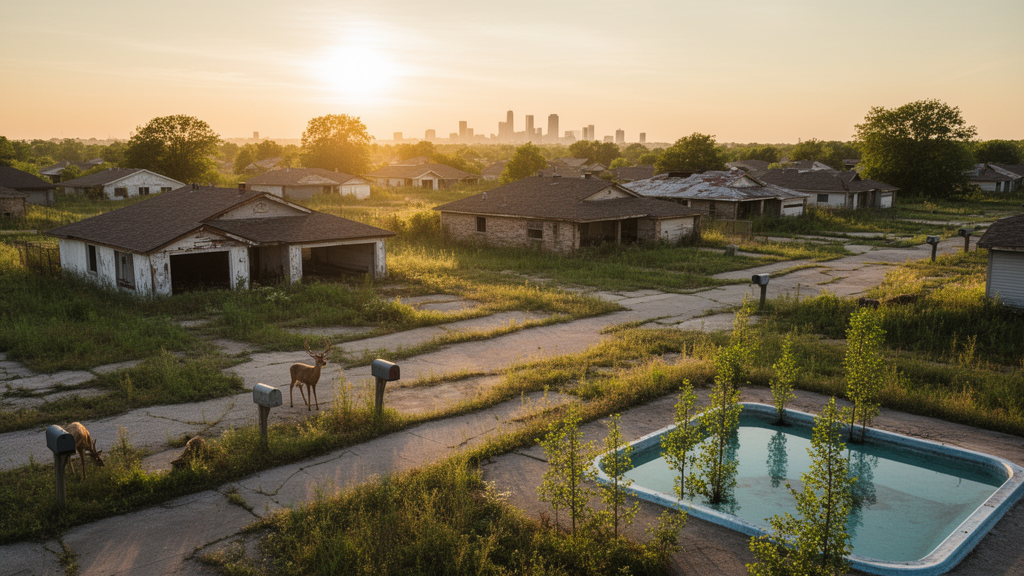
The review’s most striking findings concern the places people leave behind. Sustained urban depopulation produces vacant land, and these abandoned lots can become unexpected biodiversity sanctuaries. In the Hauts-de-Seine department near Paris, plant richness in urban wastelands accounted for 58 percent of the total recorded for the entire area. In Detroit, vacant lots hosting wildflowers supported bumblebee diversity and abundance comparable to rural nature reserves. Even non-native vegetation on vacant land delivers services: in Cleveland, trees on vacant lots provided roughly triple the ecosystem-service value per hectare of occupied residential lots, with exotic species such as tree-of-heaven contributing about half of that value. The ecological character of these sites depends on land-use legacy, surrounding landscape, site size and age, making generalisation difficult but management potentially powerful.
The lifestyle footprint may matter even more than the landscape one, because it operates immediately and invisibly. Low-density living fundamentally alters household metabolism. Life-cycle assessments in the United States indicate that suburban neighbourhoods dominated by detached homes consume up to 320 percent more embodied energy, 150 percent more operational energy and roughly 160 percent more total life-cycle energy per capita than dense neighbourhoods of apartments and duplexes. Lawn and garden irrigation raises water demand, straining supplies in dry regions. Car dependence intensifies: in England, only about 5 percent of rural village households have no car, compared with 33 percent in urban conurbations, and car travel accounted for 75 percent of trips in the most rural areas in 2021 versus 51 percent in cities. Rising traffic on traditionally quiet rural roads increases wildlife roadkill, triggers avoidance behaviour that subdivides animal populations, and can spread invasive plants such as common ragweed along road networks. Free-roaming pets compound the pressure; one estimate attributes 1.3 to 4.0 billion bird deaths and 6.3 to 22.3 billion mammal deaths annually in the United States to free-ranging domestic cats, with impacts most severe in rural settings.
What makes the framework genuinely useful is its insistence that outcomes depend on who moves, why, and where. Affordability-driven movers settling in peri-urban areas while keeping urban jobs reinforce energy-intensive housing, car-dependent commuting and habitat fragmentation. Tourism entrepreneurs in traditional agricultural landscapes can trigger passive rewilding while simultaneously introducing invasive ornamentals and seasonal visitor disturbance that degrades feeding and breeding habitats, as documented for piping plover chicks on recreational beaches. Amenity seekers and remote workers in high-nature-value landscapes may support conservation and low-intensity organic farming that benefits soil organisms and pollinators, yet their dog-walking, running and gardening still disturb wildlife and trample sensitive vegetation. The authors propose measuring these dynamics with household surveys, mobility data, high-resolution land-cover products, building footprints and AI-driven geospatial models, always against clearly defined counterfactual baselines, such as comparing peri-urban growth against a continued urban-densification trajectory. In an era when remote work has decoupled livelihoods from location, the review’s central message is that planning for nature recovery must anticipate not only where cities grow, but also, and perhaps more urgently, where people go when they leave them.
Subject of Research: Ecological consequences of counter-urbanisation, the redistribution of populations from higher- to lower-density settlements
Article Title: A review of ecological consequences of emerging counter-urbanisation
Article References: Duan, Q., Lai, S., Sorichetta, A., & Eigenbrod, F. (2026). A review of ecological consequences of emerging counter-urbanisation. PLOS Ecosystems, 1(2), e0000030. https://doi.org/10.1371/journal.pesy.0000030
Image Credits: AI Generated
DOI: 10.1371/journal.pesy.0000030
Keywords: counter-urbanisation, biodiversity, land-use change, habitat fragmentation, rural migration, forest transition, urban vacancy, ecosystem services, invasive species, commuting emissions, rewilding, human-wildlife interaction
Cite Scienmag News
Margaret Porter. (October 9, 2026). When People Leave Cities: The Hidden Ecological Costs and Surprises of Counter-Urbanisation. Scienmag. https://scienmag.com/when-people-leave-cities-the-hidden-ecological-costs-and-surprises-of-counter-urbanisation/
Margaret Porter. "When People Leave Cities: The Hidden Ecological Costs and Surprises of Counter-Urbanisation." Scienmag, 9 October 2026, https://scienmag.com/when-people-leave-cities-the-hidden-ecological-costs-and-surprises-of-counter-urbanisation/. Accessed 9 October 2026.
Margaret Porter. "When People Leave Cities: The Hidden Ecological Costs and Surprises of Counter-Urbanisation." Scienmag. October 9, 2026. https://scienmag.com/when-people-leave-cities-the-hidden-ecological-costs-and-surprises-of-counter-urbanisation/


