


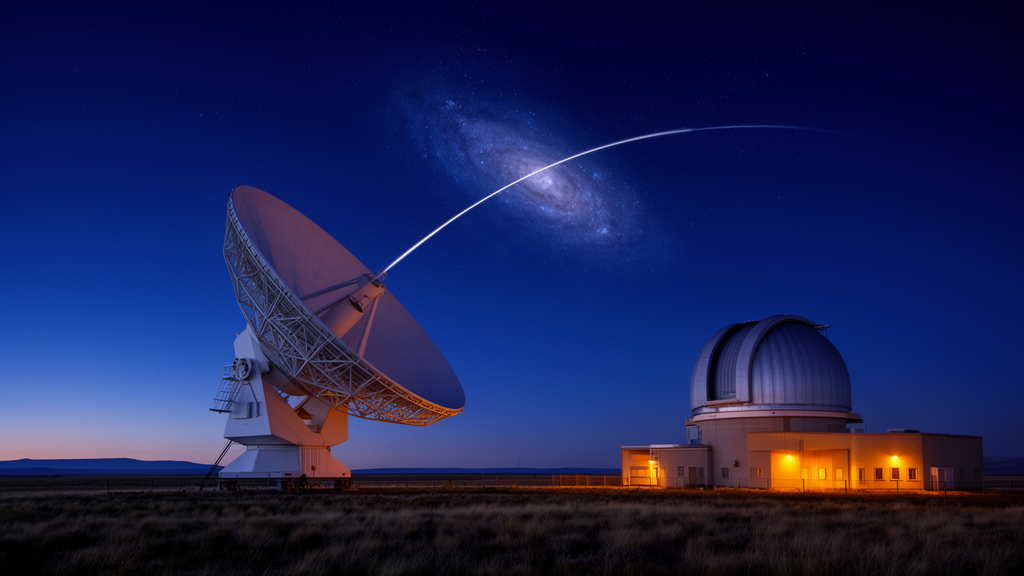
Astronomers have detected and precisely located the most distant fast radio burst ever recorded, a colossal flash of radio energy that journeyed for more than ten billion years before sweeping across Earth. The burst, designated FRB 20240304B, was emitted when the Universe was only about three billion years old, a time when the first generations of stars and galaxies were still assembling the cosmic structures we see today. The discovery, led by Dr Manisha Caleb and Dr Themiya Nanayakkara of the University of Sydney and published in the journal Science, more than doubles the previous distance record for these enigmatic events and opens a new window onto both the early evolution of galaxies and the diffuse matter that fills the space between them.
Fast radio bursts are among the most perplexing phenomena in modern astronomy. Each burst lasts only a few milliseconds, yet in that fleeting instant it can release as much energy as the Sun emits over days, all in the radio part of the spectrum. Since their accidental discovery in archival data in 2007, hundreds have been catalogued, but their physical origins remain contested. Proposed engines range from highly magnetised neutron stars called magnetars to more exotic scenarios involving collisions of compact stellar remnants. What makes FRBs especially valuable to scientists is not only their violence but their utility: because radio waves are slowed, very slightly and measurably, by the ionised gas they traverse on their way to Earth, each burst encodes a census of the matter it has passed through.
The new record-breaking burst was captured by the MeerTRAP project using South Africa’s MeerKAT radio telescope, one of the most sensitive radio astronomy facilities in the world and a precursor to the Square Kilometre Array Observatory now under construction in South Africa and Australia. MeerKAT’s combination of wide field of view and high sensitivity makes it exceptionally well suited to catching transient events that appear without warning and vanish almost immediately. Once the burst was detected in real time, the team faced the far harder task of determining where in the sky, and therefore when in cosmic history, it had originated.
Pinpointing the host galaxy required the unique infrared capabilities of NASA’s James Webb Space Telescope. The galaxy that produced the burst turned out to be invisible to the largest ground-based optical telescopes, a testament to how faint and distant it is. By combining Webb’s infrared imaging and spectroscopy with the radio localisation from MeerKAT, the researchers were able to identify the galaxy and measure its distance, confirming that the light left its source when the Universe was roughly a quarter of its current age. The measurement places the burst at a redshift of about 2, a milestone in transient astronomy.
The host galaxy itself proved to be an unexpected and scientifically rich find. Dr Laura Driessen, a co-author at the University of Sydney, described it as surprisingly small, metal-poor and undergoing a very active episode of star formation. Such characteristics are significant because they offer clues about the environments in which fast radio bursts are born. The galaxy’s youth and vigorous star formation are more consistent with theories in which FRBs arise from young magnetars, the collapsed cores of massive stars that exploded as supernovae, than with alternative models invoking the merger of much older neutron stars. In effect, the burst’s cosmic address strengthens the case that at least some of these flashes trace the deaths of the most massive stars.
Beyond what it reveals about its birthplace, the burst served as a cosmic beacon illuminating the otherwise invisible matter strung between galaxies. As the radio signal travelled across most of cosmic history, it accumulated information about every cloud of ionised gas it crossed. Astronomers can read this information from the burst’s dispersion measure, a quantity describing how much the radio signal was delayed as a function of frequency. Because the host galaxy’s distance is now precisely known, the team can separate the contribution of the intergalactic medium from that of the burst’s own galaxy, mapping reservoirs of matter that conventional telescopes struggle to detect directly.
This technique addresses one of the enduring puzzles of cosmology: the whereabouts of ordinary, baryonic matter. Observations of the cosmic microwave background indicate how much normal matter the Universe contains, yet surveys of stars, gas and galaxies have historically accounted for only a fraction of it. The remainder is thought to lie in a tenuous web of ionised gas between galaxies. Fast radio bursts, because they are brief, bright and spread across a wide range of radio frequencies, are emerging as the sharpest tools available for weighing that missing matter, and a burst from such an early epoch extends this accounting across an unprecedented span of cosmic time.
The achievement also demonstrates how far observational capability has advanced. Dr Caleb, of the Sydney Institute for Astronomy in the School of Physics, said the result shows that astronomers can now identify and study a fast radio burst from a time when the Universe was young, calling it an extraordinary glimpse into the distant Universe. Kavya Shaji, a co-author and PhD student in the School of Physics, noted that in principle sufficiently powerful bursts could be detectable from the very early Universe. Professor Ben Stappers of the University of Manchester, Principal Investigator of the MeerTRAP project, said the next step is to push this frontier further and see how close astronomers can get to the first generations of stars.
The discovery continues a remarkable run for Australian-led radio astronomy. In 2023, University of Sydney researchers were involved in identifying what was then the most distant fast radio burst known, a record now surpassed by FRB 20240304B. The trajectory reflects the growing power of instruments such as MeerKAT and the anticipation surrounding the SKA Observatory, whose unprecedented sensitivity is expected to transform the study of transient radio phenomena. Dr Nanayakkara, who recently joined the University of Sydney, said the results further show the amazing capability of the Webb Space Telescope, where boundaries can be pushed beyond what was previously possible.
For now, FRB 20240304B stands as both a record and a demonstration. It confirms that millisecond flashes from the early Universe can be caught, localised and dissected with present-day facilities, turning what was once a curiosity of archival data into a precision probe of cosmic history. Each additional distant burst will refine the map of matter between galaxies, tighten constraints on how galaxies like our own assembled their stars, and test whether young magnetars truly are the engines behind these extraordinary explosions of radio energy. The research was supported by the Australian Research Council, the European Research Council, the UK Science and Technology Facilities Council and the US National Science Foundation, and the authors declare no competing interests.
Subject of Research: Detection and localisation of the most distant fast radio burst, from a galaxy observed three billion years after the Big Bang
Article Title: Sydney astronomers pinpoint the most distant fast radio burst ever detected
Article References: Sydney astronomers pinpoint the most distant fast radio burst ever detected. (n.d.). Original publication
Image Credits: AI Generated
DOI: Not provided
Keywords: fast radio bursts, FRB 20240304B, MeerKAT, James Webb Space Telescope, magnetars, University of Sydney, MeerTRAP, early Universe, host galaxy, intergalactic medium, radio astronomy, cosmology
Cite Scienmag News
Grant Pearson. (October 9, 2026). Cosmic Flash From a Young Universe: Astronomers Trace Record-Breaking Fast Radio Burst Across 10 Billion Years. Scienmag. https://scienmag.com/cosmic-flash-from-a-young-universe-astronomers-trace-record-breaking-fast-radio-burst-across-10-billion-years/
Grant Pearson. "Cosmic Flash From a Young Universe: Astronomers Trace Record-Breaking Fast Radio Burst Across 10 Billion Years." Scienmag, 9 October 2026, https://scienmag.com/cosmic-flash-from-a-young-universe-astronomers-trace-record-breaking-fast-radio-burst-across-10-billion-years/. Accessed 9 October 2026.
Grant Pearson. "Cosmic Flash From a Young Universe: Astronomers Trace Record-Breaking Fast Radio Burst Across 10 Billion Years." Scienmag. October 9, 2026. https://scienmag.com/cosmic-flash-from-a-young-universe-astronomers-trace-record-breaking-fast-radio-burst-across-10-billion-years/


