

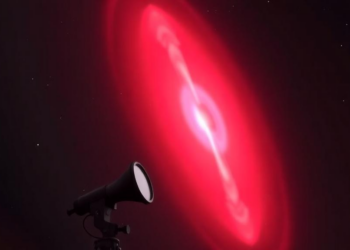
MeerKAT telescope catches faint hydrogen whisper from billions of light years away
Astronomers using South Africa's MeerKAT telescope have directly detected the faint 21-centimetre radio signal of neutral hydrogen from billions of ...
Astronomers using South Africa's MeerKAT telescope have directly detected the faint 21-centimetre radio signal of neutral hydrogen from billions of ...

A detailed radio map of molecular gas in Stephan's Quintet shows that turbulent gas motions suppress star formation even where ...
Astronomers led by the University of Sydney have traced the most distant fast radio burst ever detected, a millisecond flash ...
A decade of workshops with San-descended communities around South Africa's SKA telescope site shows that Indigenous sky knowledge is a ...
Curtin University astrophysicist Dr Adelle Goodwin and colleagues have discovered that black holes of vastly different masses launch jets at ...
On-sky tests of the AAVS3 prototype confirmed a predicted sensitivity loss in the sunflower-inspired antenna layout, prompting a modified design ...
A patent-pending SUNY invention pairs time-domain and frequency-domain signal representations with a cosine similarity loss function to improve detection of ...
A new study finds that black holes from stellar to supermassive scales launch jets at the same universal critical accretion ...
Ultra-wideband observations with the Parkes 64-m Radio Telescope have revealed that the radio spectra of nine pulsars change systematically across ...
Astronomers, during their quest to unravel the mysteries surrounding fast radio bursts (FRBs)—enigmatic flashes of energy from the cosmos—have achieved ...

Embark on a thrilling journey of discovery with Scienmag.com—your ultimate source for cutting-edge breakthroughs. Immerse yourself in a world where curiosity knows no limits and tomorrow’s possibilities become today’s reality!