


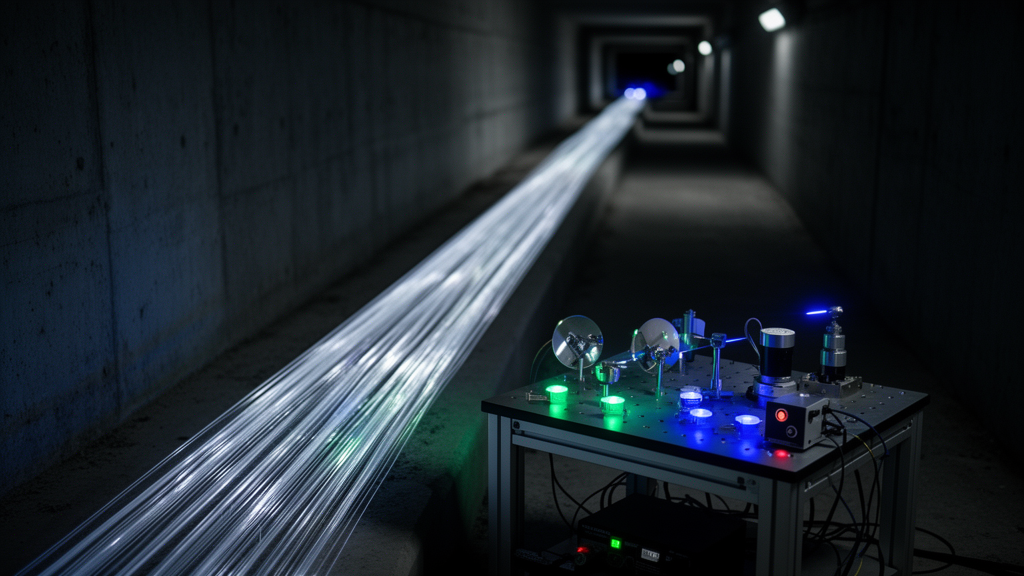
For decades, quantum physicists have dreamed of shipping delicate entangled states through the same fiber-optic cables that carry the internet. Now a team at Leibniz University Hannover has done something no one had managed before: transmitting a four-qubit cluster state—a genuinely multi-partite entangled quantum resource—over 29.5 kilometers of optical fiber, part of which runs through a real, deployed campus link. The achievement, published in Light: Science & Applications, removes one of the most stubborn bottlenecks on the road to a practical quantum internet, because cluster states are the raw fuel for measurement-based quantum computing, blind quantum computing, and quantum key agreement protocols.
The problem that has stymied previous efforts is brutally simple: loss. When a multi-qubit state is spread across several photons, with one qubit per photon as in conventional polarization encoding, the probability that all photons survive the journey falls exponentially with both photon number and distance. Lose a single photon and the entire encoded state is gone. For four-qubit states, this exponential penalty has made fiber transmission over application-relevant distances effectively impossible without loss-tolerant architectures such as all-photonic quantum repeaters, which remain far from deployment.
The Hannover team, led by Philip Rübeling, Robert Johanning, and Michael Kues, sidestepped the exponential scaling by packing multiple qubits into single photons. In their scheme, each of two photons carries two qubits, encoded in multi-level time bins—discrete temporal slots in which the photon can arrive. Because the number of photons stays fixed at two regardless of how many qubits are encoded, the transmission rate no longer collapses exponentially as the quantum state grows. The researchers compared their multi-level encoding directly against a four-qubit multi-photon encoding and confirmed the predicted advantage: a fundamentally different, more forgiving loss scaling that enables longer transmission distances.
Generating the cluster state itself was made dramatically more efficient by a clever trick at the source. Conventionally, cluster states are carved out of hyper-entangled photon pairs using a controlled-phase gate, an operation that introduces additional optical loss and experimental complexity. Instead, the team exploited coherent control of the parametric generation process itself. They carved four coherent excitation pulses from a continuous-wave laser using an electro-optic amplitude modulator, with irregular spacings of 100, 200, and 100 picoseconds, and applied a phase shift of π/2 to the fourth pulse using an electro-optic phase modulator. When these pulses drove cascaded second-harmonic generation and spontaneous parametric down-conversion in a periodically poled lithium niobate waveguide, the photon pairs emerged already in the cluster state—no gate required. Shifting the phase manipulation from the fragile photon pairs to the robust classical excitation pulses cuts both loss and complexity, two currencies that quantum networks cannot afford to waste.
Once generated, the signal and idler photons were separated by a wavelength-selective switch into distinct 15-gigahertz channels centered at 193.7 and 193.1 terahertz, distributing two qubits of the cluster state to each of two processing nodes. The idler photon then faced the gauntlet: a 4.5-kilometer deployed fiber link running in a round trip across the Leibniz University Hannover campus between the Institute of Photonics and the Institute of Solid State Physics—buildings only 600 meters apart linearly—followed by an additional 25 kilometers of fiber on a spool. A dispersion compensation module corrected the distortion introduced by the fiber, and an active stabilization system using a motorized optical delay line tamed thermal drifts. Without this feedback, applied every 15 minutes from the photons’ time-of-flight, the fiber length wandered by roughly 100 picoseconds; with it, jitter was squeezed down to just 2.8 picoseconds, keeping the time bins crisply distinguishable over a 90-hour acquisition.
Verifying that the transmitted state was still genuinely entangled posed its own challenge. Certification required projective measurements on each qubit in two mutually unbiased bases, which for time-bin qubits normally means imbalanced fiber interferometers—rigid devices matched to a single time-bin spacing, operating at only 50 percent efficiency, and, for this multi-level encoding, requiring four separately stabilized interferometers. The team’s answer is perhaps the experiment’s most transferable innovation: chirped pulse modulation, a reconfigurable Fourier-domain pulse-shaping technique. An electro-optic phase modulator sits between two chirped fiber Bragg gratings of opposite dispersion, each of about 10 nanoseconds per nanometer. The first grating stretches the pulse so that its spectrum maps onto time, the modulator imprints a radio-frequency phase pattern, and the second grating recompresses everything back into the time domain—producing coherent copies of the time bins that act as a tunable beam splitter for temporal quantum states.
The elegance of chirped pulse modulation lies in its flexibility. By driving the modulator with an arbitrary waveform generator at 1.25 gigahertz, the team superimposed the 100-picosecond time bins of one qubit level; at 3.75 gigahertz, they addressed the 300-picosecond bins of the other level, all while leaving the orthogonal qubit untouched. A single segmented waveform, repeated every 180 nanoseconds, cycled through nine different beam-splitter settings, allowing 48 projective measurements across three basis settings to be acquired in parallel. This parallelism made the measurement robust against count-rate fluctuations from polarization drifts and pump power noise, and the entire beam splitter could be reconfigured in under 2.5 nanoseconds by changing the radio-frequency waveform.
The results were emphatic. From the stabilizer values computed across all 48 measurements, the team derived an entanglement witness of −0.57 ± 0.03, certifying genuine four-qubit entanglement after transmission with a confidence of 19 standard deviations—a threshold crossed far beyond any reasonable statistical doubt. The witness implies a lower bound on the fidelity with the ideal cluster state of 78.5 percent. To demonstrate that the state is not merely a curiosity but a working computational resource, the researchers executed primitives of one-way quantum computing on the transmitted cluster state, performing partial projective measurements and observing two-qubit interference visibilities between 89.7 and 96.8 percent. All four measured configurations clearly violated the CHSH inequality, whose threshold sits at 70.7 percent, proving that residual bipartite entanglement survives even after parts of the cluster state have been measured away.
The implications ripple outward. Because the entire scheme operates at telecommunication wavelengths in standard single-mode fiber, it is natively compatible with the existing global fiber infrastructure—unlike spatial encodings such as orbital angular momentum, which cannot propagate in single-mode fiber at all. The two-node topology demonstrated here is already sufficient for compelling applications, including blind quantum computing, where a client delegates computation to a server without revealing the computation itself, and quantum key agreement. The authors note that the main distance limitation is currently optical loss in the processing setup itself, which could be alleviated with integrated photonic components, optimized source phase-matching, and spectral multiplexing. Scaling to around ten qubits appears feasible with state-of-the-art technology, which would open the door to distributed blind Grover algorithms and multi-qubit quantum communication. The demonstration stops short of a fault-tolerant, directly scalable architecture, and the beam splitter’s cross-talk and spectral walk-off currently cap the observed visibilities. But the conceptual barrier has fallen: complex, multi-qubit entangled states can now travel the same glass arteries that carry today’s internet, and the quantum networks long sketched on whiteboards have moved measurably closer to the fiber in the ground.
Subject of Research: Fiber transmission of multi-level time-bin encoded photonic cluster states for quantum networking
Article Title: Transmission of multi-level time-bin encoded cluster states over 29 km of partially deployed optical fiber
Article References: Rübeling, P., Johanning, R., Heine, J., Marchukov, O. V., & Kues, M. (2026). Transmission of multi-level time-bin encoded cluster states over 29 km of partially deployed optical fiber. Light: Science & Applications, 15(1), Article 384. https://doi.org/10.1038/s41377-026-02465-5
Image Credits: AI Generated
DOI: 10.1038/s41377-026-02465-5
Keywords: cluster states, quantum entanglement, time-bin encoding, optical fiber, quantum networks, photonic quantum computing, blind quantum computing, chirped pulse modulation, spontaneous parametric down-conversion, entanglement witness, quantum communication, telecom infrastructure
Cite Scienmag News
Katie Riggs. (October 9, 2026). Quantum Cluster States Survive a 29 km Trip Through Real-World Fiber. Scienmag. https://scienmag.com/quantum-cluster-states-survive-a-29-km-trip-through-real-world-fiber/
Katie Riggs. "Quantum Cluster States Survive a 29 km Trip Through Real-World Fiber." Scienmag, 9 October 2026, https://scienmag.com/quantum-cluster-states-survive-a-29-km-trip-through-real-world-fiber/. Accessed 9 October 2026.
Katie Riggs. "Quantum Cluster States Survive a 29 km Trip Through Real-World Fiber." Scienmag. October 9, 2026. https://scienmag.com/quantum-cluster-states-survive-a-29-km-trip-through-real-world-fiber/


