


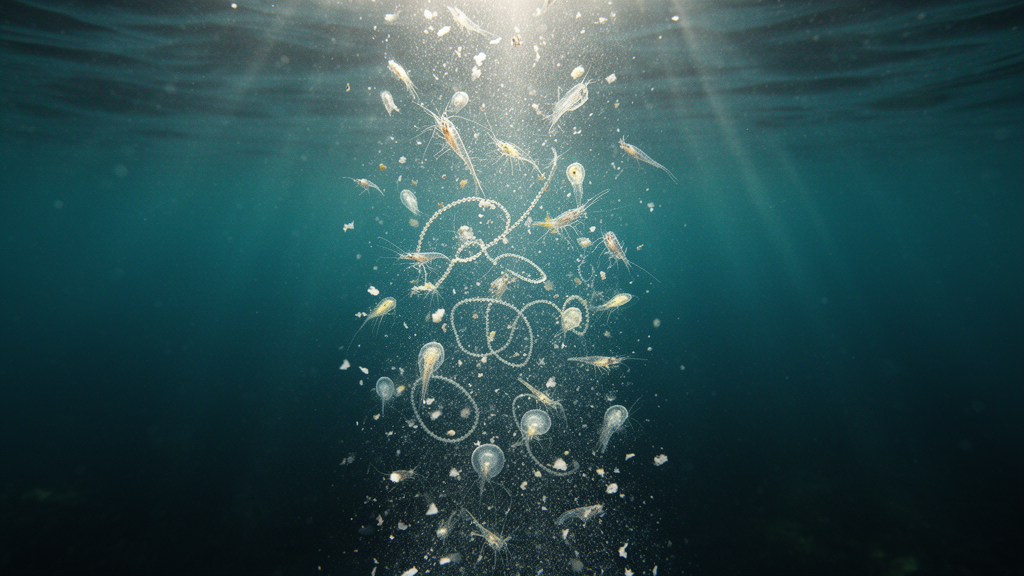
Beneath the surface of every ocean, an invisible drama unfolds: trillions of microscopic organisms drift, feed, reproduce, and die, while the remains of their lives sink slowly toward the seafloor as flakes of organic debris known as marine snow. This ceaseless activity underpins the ocean’s capacity to store carbon and regulate Earth’s climate, yet scientists have struggled for decades to observe it consistently across the planet. Now, a team of more than two dozen researchers from institutions spanning Argentina, France, Canada, Germany, Norway, and the United States has released an unprecedented global archive of roughly eight million underwater images, offering the most comprehensive standardized picture yet of ocean life and detritus as it actually exists in the water column.
The dataset, published in the journal Earth System Science Data, compiles observations made between 2008 and 2018 by the Underwater Vision Profiler 5, an underwater camera system that photographs particles and plankton as it descends through the sea. In total, the archive spans 3,114 vertical profiles collected across all major ocean basins, drawn from 62 separate research projects and validated by 71 different human annotators. Every image has been sorted into one of 33 standardized categories, from copepods and colonial radiolarians to salps, siphonophores, and amorphous detritus, and each object comes with 42 morphological measurements describing its size, shape, brightness, and texture.
The instrument behind the dataset is itself a triumph of ocean engineering. The UVP5 images roughly one liter of water per flash at frequencies of 5 to 20 hertz and can operate down to 6,000 meters, typically mounted on the rosette of water samplers deployed from research vessels. Because it photographs organisms in place, it avoids the crushing, tangling, and outright destruction that plankton nets inflict on fragile creatures like gelatinous zooplankton and delicate rhizarian protists. All particles larger than about 100 micrometers are counted and sized automatically, while the larger and more recognizable objects, those exceeding roughly 600 micrometers in the high-definition version and one millimeter in the standard-definition version, are cropped into individual vignettes for expert classification.
Perhaps the most striking finding is how lopsided the ocean’s visible particle world really is. Detritus, the non-living organic matter that includes marine snow, fecal pellets, and aggregates of dead organisms, accounts for 90.5 percent of all imaged objects and fully 95 percent of the total biovolume. Among living organisms, copepods, the tiny crustaceans that graze on phytoplankton, dominate the counts, followed by colonies of the nitrogen-fixing cyanobacterium Trichodesmium. Gelatinous filter-feeders and carnivores appear far less frequently but contribute disproportionately to total biomass because of their large body sizes, a reminder that abundance and ecological importance are very different things in the open ocean.
The spatial patterns captured in the archive tell a story about ocean fertility. Plankton and detritus concentrations peak in eastern boundary current systems, particularly the upwelling zones off California and Senegal, where nutrient-rich deep water fertilizes surface productivity, reaching up to five plankton and sixty detritus particles per cubic meter in the top 100 meters. The lowest concentrations occur in the centers of the great subtropical gyres, notably the South Pacific and Indian Ocean, where nutrient-starved waters support sparse communities. Concentrations decline steadily with depth, mirroring the rain of organic material from the sunlit surface toward the abyss.
Assembling a globally consistent dataset from a decade of work by dozens of independent teams posed formidable technical challenges. Different annotators classify images at different taxonomic depths, and human perception is vulnerable to fatigue, boredom, and bias toward familiar groups. To counter this, the team merged more than 250 original categories into 33 broad groups that could be applied consistently across all projects, each backed by at least 50 validated images. Quality control was rigorous: 200 images from each category, and ten percent of all detritus images, were independently re-reviewed, yielding error rates below eight percent for taxonomic classification and under 0.1 percent contamination of the detritus category by living plankton.
The researchers also confronted subtle instrumental differences. The standard-definition and high-definition versions of the UVP5 use different cameras, which changes the smallest objects each can resolve and alters morphological measurements such as grey levels. The two versions were inter-calibrated using concurrent particle size spectra measured in natural conditions, so sizes remain comparable between instruments, but the team cautions users that brightness and opacity measurements may not be directly comparable. One individual instrument, serial number 000, famously used during the Tara Oceans expeditions of 2009 to 2012, produced feature distributions that differ from all other units, and the authors provide a quantile-to-quantile transformation in the R programming language so users can correct for this before pooling data.
The scientific payoff could be enormous. Because plankton and detritus drive the biological carbon pump, the mechanism by which the ocean sequesters atmospheric carbon dioxide in its depths, models of climate and biogeochemistry depend critically on accurate data about these organisms and particles. Recent studies have shown that zooplankton grazing is one of the largest sources of uncertainty in marine carbon cycling within the latest generation of climate models, and that the morphology of marine snow particles strongly influences how fast they sink and how much carbon reaches the deep sea. A globally consistent, image-based record of both living plankton and sinking detritus gives modelers exactly the kind of ground truth they have lacked.
The dataset is also poised to become a training goldmine for artificial intelligence. Machine learning has already transformed plankton image analysis, with random forest classifiers and convolutional neural networks predicting object identities that humans then validate. The seven million detritus images in this release, most of which have never been sorted by morphology, represent an ideal challenge for next-generation algorithms, and the authors explicitly hope the community will use the archive to develop new classification tools. Successors of the UVP5, including the UVP6 now deployed on autonomous floats and ships, are generating roughly 5,000 new profiles and 87 million images in just the last four years, and embedded AI classifiers will be essential for platforms like biogeochemical Argo floats that are never recovered from the sea.
For all its scope, the archive has honest gaps. Two-thirds of the profiles come from the northern hemisphere, the equatorial band between 30 degrees south and 30 degrees north is best represented, and the Southern Ocean and deep sea remain conspicuously undersampled. Small sampled volumes make rare taxa easy to miss, and apparent zeros in the data may reflect detection limits rather than true absence. The authors frame this first release as a starting point rather than a finished product: roughly 10,000 additional profiles await full validation, and future work will focus on subdividing the sprawling detritus category into morphotypes such as fecal pellets, whose sinking behavior differs in ways that matter for carbon flux calculations. In an era when climate change is rapidly reshaping ocean temperature, acidity, and circulation, a shared, standardized, and openly available window into the ocean’s microscopic engine room could not have arrived at a better time.
Subject of Research: A global standardized image database of plankton and detritus from Underwater Vision Profiler 5 deployments
Article Title: A global consistent database of plankton and detritus from in situ imaging by the Underwater Vision Profiler 5
Article References: Nocera, A. C., Stemmann, L., Babin, M., Biard, T., Coustenoble, J., Carlotti, F., Coppola, L., Courchet, L., Drago, L., Elineau, A., Guidi, L., Hauss, H., Jalabert, L., Karp-Boss, L., Kiko, R., Laget, M., Lombard, F., McDonnell, A., Merland, C., … Irisson, J.-O. (2026). A global consistent database of plankton and detritus from in situ imaging by the Underwater Vision Profiler 5. Earth System Science Data, 18(10), 7345-7366. https://doi.org/10.5194/essd-18-7345-2026
Image Credits: AI Generated
DOI: 10.5194/essd-18-7345-2026
Keywords: plankton, detritus, marine snow, Underwater Vision Profiler, ocean imaging, carbon cycle, zooplankton, machine learning, biogeochemistry, ocean observation, copepods, Earth System Science Data
Cite Scienmag News
Violet Maxwell. (October 9, 2026). Eight Million Ocean Images Reveal a Hidden World of Plankton and Marine Snow. Scienmag. https://scienmag.com/eight-million-ocean-images-reveal-a-hidden-world-of-plankton-and-marine-snow/
Violet Maxwell. "Eight Million Ocean Images Reveal a Hidden World of Plankton and Marine Snow." Scienmag, 9 October 2026, https://scienmag.com/eight-million-ocean-images-reveal-a-hidden-world-of-plankton-and-marine-snow/. Accessed 9 October 2026.
Violet Maxwell. "Eight Million Ocean Images Reveal a Hidden World of Plankton and Marine Snow." Scienmag. October 9, 2026. https://scienmag.com/eight-million-ocean-images-reveal-a-hidden-world-of-plankton-and-marine-snow/


