


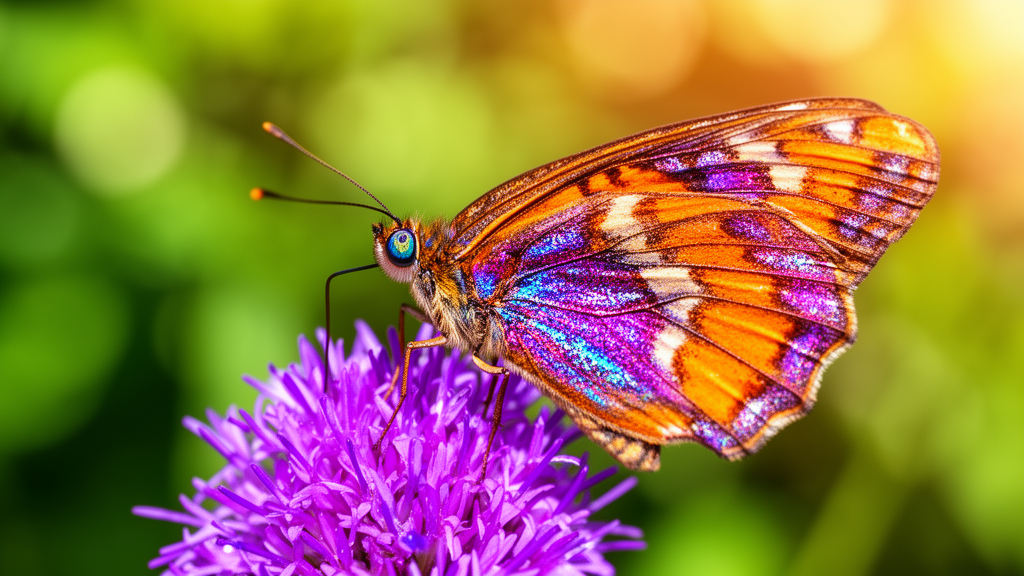
In a discovery that reshapes how scientists think about the evolution of sight, biologists at the University of California San Diego have identified the precise genetic modification that gave butterflies their extraordinary sense of color. The research, published in the journal Science Advances, reveals how these insects broke away from an eye design that has remained essentially unchanged across the insect world for hundreds of millions of years. By adding a single extra light-detecting cell to every unit of their compound eyes, butterflies gained the ability to perceive a far richer palette of colors than their relatives, an advantage that helps them find nectar-rich flowers and recognize potential mates in a visually complex environment.
Most insects, including flies, see the world through compound eyes composed of hundreds of tiny lenses. Behind each lens sits a cluster of eight light-detecting cells, called photoreceptors, arranged in a pattern so fundamental that scientists believe it has been conserved since before the diversification of the major insect groups. Butterflies are the rare exception to this rule. They carry nine photoreceptors per eye unit, an addition that fundamentally changes how much color information their visual systems can gather. According to Michael Perry, an associate professor in the Department of Cell and Developmental Biology at UC San Diego’s School of Biological Sciences, butterflies see far more color than flies because at some point in their evolution they added a photoreceptor to every unit of their compound eye, a rare break from an eye design otherwise conserved across insects for hundreds of millions of years. His team, he said, found the genetic switch that did it.
The study focused on the painted lady butterfly, one of the most widespread butterfly species on Earth and a familiar visitor to gardens across multiple continents. In flies, the light-sensing cells are known as photoreceptors R1 through R8. The researchers discovered that butterflies expanded their color vision by adding a second R7 photoreceptor to each unit of the eye. This duplication is not merely a matter of having more cells; it means that every single sampling unit of the butterfly’s compound eye carries an additional channel of color information, effectively upgrading the resolution of the insect’s perception of the visual world at every point where light is captured.
To determine whether this genetic change was sufficient on its own to produce the butterfly eye plan, the team performed a striking experiment. They recreated the modification in a fruit fly, an insect that normally follows the standard eight-cell design. By switching on a gene in cells where it is normally kept silent, and timing that activation to the brief developmental window during which the eye is being built, they produced what the researchers describe as a butterfly fly. This engineered insect grows its eyes according to the butterfly blueprint, with nine cells per eye unit instead of the usual eight. The result demonstrates that a single, targeted genetic change can redirect the construction of an entire sensory organ toward a fundamentally different architecture.
An additional light detector, however, would be useless without a brain capable of interpreting its signals. The prevailing assumption in sensory biology has been that when a new sensory input evolves, the brain must gradually evolve a matching neural partner to receive the information on the other end. Evolution, in this view, would need to coordinate changes on both sides of the connection: the eye producing new signals and the brain developing new circuitry to process them. The UC San Diego team expected to find evidence of such a slow, coupled adaptation in butterflies. What they found instead surprised them. No adaptive change in the brain was needed at all.
The explanation lies in a remarkable feature of how insect brains develop. The fly brain routinely overproduces neurons during development, and those surplus cells die off if they fail to find a connection. This built-in redundancy creates a population of standby neurons that normally have no function and are pruned away. In the butterfly fly, the researchers found that the brain knew precisely how to handle the new photoreceptor. It simply recruited its extra standby neurons and put them to work. Perry explained that when the team gave those spare neurons something to connect to, they survived and wired up correctly, immediately, with no further genetic change. In his words, the brain was ready before the eye asked, a rare and concrete case of evolution making use of neurons that were otherwise going to die.
This finding carries significant implications for understanding how major sensory innovations arise. Rather than requiring perfectly synchronized mutations in both the eye and the brain, the evolution of a new photoreceptor could proceed because the developing nervous system already possessed the flexibility to accommodate novel inputs. The brain’s habit of generating excess neurons and keeping them available until connections are established provided a pre-existing substrate for the new visual channel. In effect, the neural infrastructure for enhanced color vision was already in place, waiting for the eye to supply it with something to do. This mechanism allowed insects with a flexible brain framework to adapt to an emerging ecological need: the elevated ability to visualize flowering plants as they became prominent features of the environment.
The coevolution of flowering plants and their insect pollinators is one of the most celebrated stories in evolutionary biology, and the new study adds a mechanistic chapter to it. Butterflies depend on flowers for nectar, and flowers depend on butterflies and other pollinators for reproduction. The ability to distinguish subtle differences in color would confer a direct foraging advantage, guiding butterflies toward rewarding blossoms and helping them avoid flowers that have already been depleted. Enhanced color vision may also play a role in mate recognition, as butterflies often use visual signals to identify conspecifics. The addition of a ninth photoreceptor to every eye unit would have amplified all of these capabilities at once, making it a powerful adaptation with consequences across multiple aspects of the butterfly’s life.
The researchers also found evidence that this evolutionary transition is not confined to the distant past. They identified a hawkmoth species that appears to be partway through the same change. The lower half of its eye is butterfly-like, containing two of these R7-type cells per unit, while the upper half remains fly-like, with only one. This mosaic pattern is roughly what would be expected if the genetic change began in one region of the eye and is spreading across the organ over evolutionary time. The hawkmoth thus offers a living snapshot of an intermediate stage, a rare opportunity to observe a major sensory transition in progress rather than inferring it solely from comparisons between finished endpoints.
Questions remain, and the team is actively pursuing them. The most difficult to study is whether the engineered butterfly fly can actually see more vivid color with its additional photoreceptor, as natural butterflies do. Behavioral and physiological tests will be needed to confirm that the new cell contributes functional color discrimination rather than simply existing as an anatomical novelty. Still, the study stands as a compelling demonstration of how a single genetic switch, acting at the right moment in development, can rebuild a sensory organ, and how a brain pre-adapted with spare neural capacity can absorb the change without further modification. It offers a concrete, experimentally verified account of one of the most consequential upgrades in the visual history of insects, and a vivid illustration of evolution’s capacity to repurpose existing biological material in service of new ways of seeing the world.
Subject of Research: Genetic basis of photoreceptor expansion and neural accommodation in butterfly color vision
Article Title: The story behind the butterfly’s enhanced visual world of color
Article References: The story behind the butterfly’s enhanced visual world of color. (n.d.). Original publication
Image Credits: AI Generated
DOI: Not provided
Keywords: butterflies, color vision, photoreceptors, compound eye, genetics, evolution, neuroscience, Science Advances, painted lady butterfly, fruit fly, hawkmoth, sensory biology
Cite Scienmag News
Juliet Wilcox. (October 9, 2026). Genetic Switch That Gave Butterflies Extra Color Vision Revealed. Scienmag. https://scienmag.com/genetic-switch-that-gave-butterflies-extra-color-vision-revealed/
Juliet Wilcox. "Genetic Switch That Gave Butterflies Extra Color Vision Revealed." Scienmag, 9 October 2026, https://scienmag.com/genetic-switch-that-gave-butterflies-extra-color-vision-revealed/. Accessed 9 October 2026.
Juliet Wilcox. "Genetic Switch That Gave Butterflies Extra Color Vision Revealed." Scienmag. October 9, 2026. https://scienmag.com/genetic-switch-that-gave-butterflies-extra-color-vision-revealed/


