


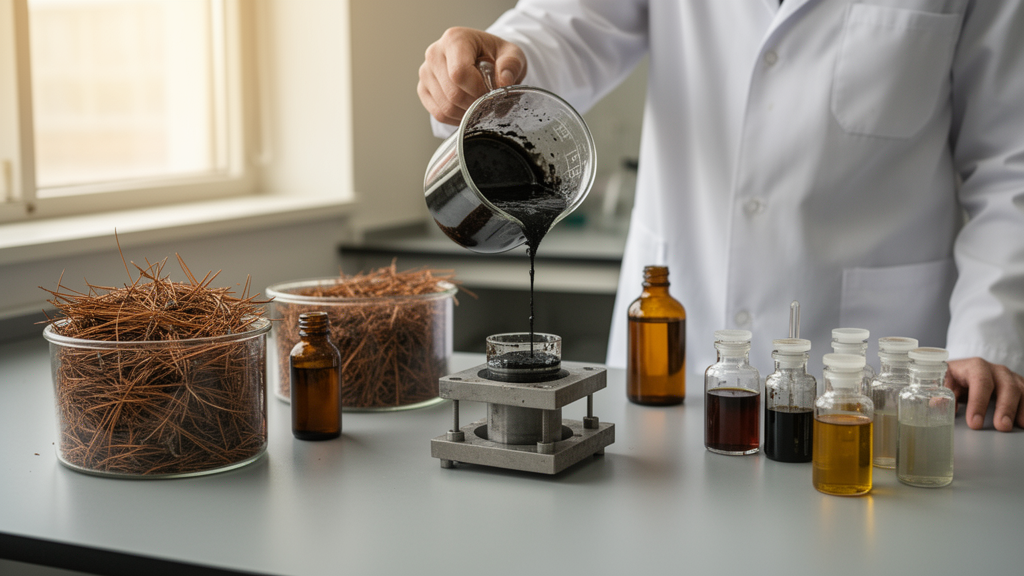
Every year, the world’s roads consume billions of tonnes of bitumen, the sticky, black petroleum residue that binds asphalt pavements together. Producing it is carbon-intensive, with conventional bitumen typically generating around 450 to 500 kilograms of carbon dioxide equivalent per tonne. As governments push toward greener infrastructure, researchers have been hunting for sustainable substitutes, and a new study suggests the answer may lie in an unlikely place: pine needles, sawdust, rice straw, and even household garbage, all transformed into oil through pyrolysis.
A research team led by Bhaswati Bora of the University of Padua, working with colleagues at the Indian Institute of Technology Roorkee, has carried out one of the most systematic comparisons to date of pyrolysis oils as bitumen modifiers. Their work, published in Environmental Science and Pollution Research, evaluated oils derived from three lignocellulosic biomass sources and one municipal solid waste (MSW) stream, all produced under identical conditions and blended into a viscosity-graded VG 40 base bitumen at a fixed 5 percent replacement rate. The goal was to isolate a single variable: the feedstock itself.
Pyrolysis is a thermochemical conversion process that heats organic material to between 300 and 600 degrees Celsius in the absence of oxygen, breaking it down into oil, char, and gas. The resulting oil is chemically similar to petroleum-derived products, which makes it a plausible candidate for binder modification. In the study, dried and crushed feedstocks were heated at 500 degrees Celsius for 30 minutes in a fixed-bed reactor under a nitrogen atmosphere, then the condensed oils were blended into bitumen at 135 degrees Celsius for 20 minutes.
The first clue to performance came from the feedstocks themselves. Proximate and ultimate analyses revealed that pine needles had the lowest ash content at 3.11 percent, the highest carbon and hydrogen fractions, and the most favorable atomic ratios, with a hydrogen-to-carbon ratio of 1.541 and an oxygen-to-carbon ratio of just 0.677. Lower oxygenation means lower polarity, and lower polarity means better compatibility with the hydrophobic, hydrocarbon-dominated world of petroleum bitumen. Rice straw and sawdust, by contrast, showed oxygen-to-carbon ratios approaching 1.0 and ash contents above 10 percent, signaling high acidity and moisture sensitivity. Municipal solid waste fell in between, with decent carbon content but elevated ash and a trace of sulfur absent from the biomass oils.
Fourier transform infrared spectroscopy painted a molecular picture that matched. Pine needle oil displayed a balanced profile: moderate hydroxyl intensity, clear aliphatic carbon-hydrogen stretches, visible carbonyl peaks, and distinct aromatic bands from its lignin-rich origin. Rice straw oil was dominated by oxygen-hydrogen, carbonyl, and carbon-oxygen bands, confirming it as the most polar and oxygenated of the four. The MSW oil showed stronger aliphatic bands, reflecting plastic-derived hydrocarbons, though the authors caution that heteroatoms and chlorine-containing species from PVC in waste streams demand careful pretreatment.
When the oils were blended into bitumen, the modification turned out to be primarily physical rather than chemical. No major new bonds formed, but the modified binders carried substantially higher polarity, with pronounced ester carbonyl absorption near 1740 wavenumbers. Intriguingly, the carbonyl signal in modified binders is intrinsic to their composition, whereas in unmodified asphalt it signals oxidative aging, a distinction that matters when interpreting aging tests. Gel permeation chromatography showed that pine needle and MSW binders had molecular weight distributions and intrinsic viscosities closest to the base binder, while rice straw bio-bitumen exhibited an unusual quad-modal distribution, a sign of molecular heterogeneity.
Thermal and storage tests reinforced the compatibility story. All bio-bitumens except the MSW variant showed single-step decomposition profiles like the base binder, and mass losses stayed within one percent of the reference. Segregation testing after 48 hours at 140 degrees Celsius produced softening point differences below 2.5 degrees Celsius and segregation ratios at or below 1.2 for every modified binder, confirming that the oils did not separate from the bitumen during storage.
Rheology, however, revealed trade-offs. All modified binders were softer than the base bitumen, with complex shear modulus reductions ranging from 11 percent for pine needle blends to 49 percent for MSW at 70 degrees Celsius, accompanied by phase angle increases that indicate a shift toward viscous behavior. Softer binders may improve workability and low-temperature flexibility, but they risk rutting under heavy traffic and high pavement temperatures. Pine needle bio-bitumen consistently stayed closest to the base binder’s viscoelastic balance, while MSW-bitumen was the softest and most deformation-prone.
Aging resistance proved equally decisive. After standard short-term and long-term laboratory aging procedures simulating plant production and years of field service, pine needle bio-bitumen showed moderate carbonyl growth and, remarkably, a lower long-term sulfoxide index than the base binder itself, suggesting suppressed oxidative hardening. Rice straw bio-bitumen fared worst, with carbonyl and sulfoxide indices far exceeding all other samples, while sawdust and MSW variants accumulated roughly two to two and a half times the base binder’s long-term carbonyl growth.
The verdict is clear: feedstock selection is everything. Pine needle-derived pyrolysis oil emerged as the most promising modifier, combining low polarity, high energy density, favorable molecular structure, and the best aging profile. The authors recommend advancing it to mixture-level testing and exploring higher replacement rates, while rice straw and sawdust oils would need upgrading steps such as de-ashing, esterification, or mild hydrodeoxygenation before practical use. MSW oil remains viable but requires contaminant screening for heavy metals and chlorine before any field deployment. With bio-based and waste-derived binders previously reported to cut greenhouse gas emissions by up to 80 percent, and some life cycle assessments showing net-negative emissions for certain biomass sources, the humble pine needle may soon play a role in building the carbon-conscious roads of the future.
Subject of Research: Comparative evaluation of pyrolysis oils from lignocellulosic biomass and municipal solid waste as sustainable bitumen modifiers
Article Title: Comparative evaluation of pyrolysis oils derived from lignocellulosic biomass and municipal solid waste as potential bitumen modifiers
Article References: Bora, B., Saboo, N., Kumar, P., & Thengane, S. K. (2026). Comparative evaluation of pyrolysis oils derived from lignocellulosic biomass and municipal solid waste as potential bitumen modifiers. Environmental Science and Pollution Research. https://doi.org/10.1007/s11356-026-38286-7
Image Credits: AI Generated
DOI: 10.1007/s11356-026-38286-7
Keywords: bio-bitumen, pyrolysis oil, bitumen modification, lignocellulosic biomass, municipal solid waste, pine needles, rheology, oxidative aging, sustainable roads, FTIR spectroscopy, thermal stability, asphalt binder
Cite Scienmag News
Violet Maxwell. (October 9, 2026). Pine Needles Outperform Other Waste Oils as Sustainable Bitumen Modifiers. Scienmag. https://scienmag.com/pine-needles-outperform-other-waste-oils-as-sustainable-bitumen-modifiers/
Violet Maxwell. "Pine Needles Outperform Other Waste Oils as Sustainable Bitumen Modifiers." Scienmag, 9 October 2026, https://scienmag.com/pine-needles-outperform-other-waste-oils-as-sustainable-bitumen-modifiers/. Accessed 9 October 2026.
Violet Maxwell. "Pine Needles Outperform Other Waste Oils as Sustainable Bitumen Modifiers." Scienmag. October 9, 2026. https://scienmag.com/pine-needles-outperform-other-waste-oils-as-sustainable-bitumen-modifiers/


