


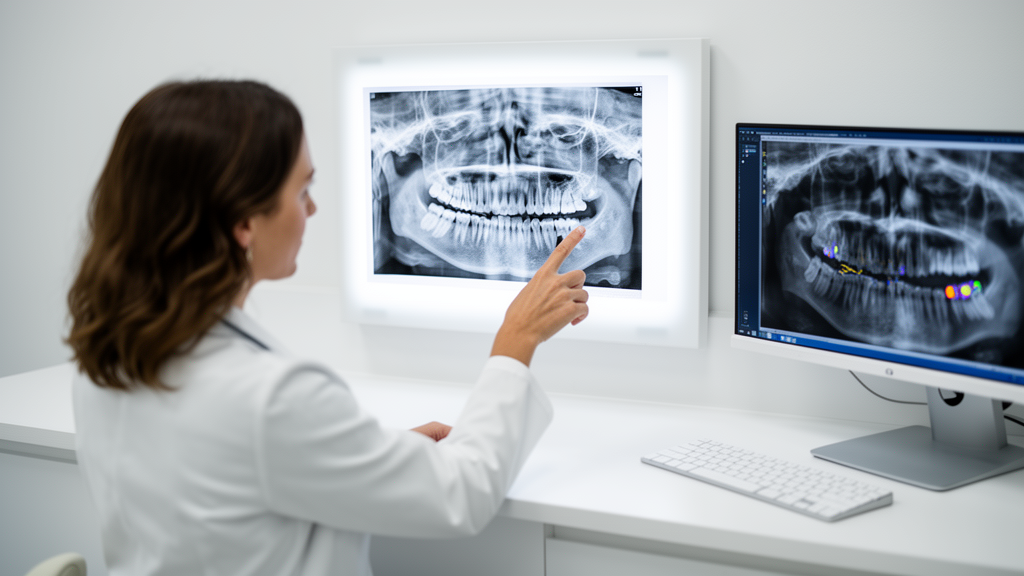
Dental panoramic radiographs are among the most widely used imaging tools in dentistry, offering a sweeping view of the teeth, jaws, and surrounding structures in a single exposure. Yet reading them well is notoriously difficult. Lesions can be tiny, anatomical boundaries often blur into one another, and complex structures such as impacted teeth or root anomalies can hide in plain sight. A research team led by Jiayi Peng and colleagues now reports a new artificial intelligence framework, called RCTE, that tackles these challenges head-on, delivering measurably better detection of dental structures and lesions while still running fast enough for real-time clinical use.
The study, published in PLOS One, addresses a long-standing bottleneck in computer-aided dental diagnosis. Modern object detectors excel at finding large, well-defined objects in natural images, but dental radiographs are a different beast. A small periapical lesion may occupy only a handful of pixels, its edges dissolving into the surrounding bone. Teeth overlap in the projection, implants mimic natural roots, and the same anatomical feature can appear at wildly different scales depending on the patient’s anatomy and positioning. Detectors trained on generic imagery tend to miss these subtle targets, and missed detections in a clinical setting can mean overlooked pathology.
The researchers built their framework on YOLOv8n, a lightweight member of the widely used You Only Look Once family of detectors. YOLO models are prized for speed, processing an entire image in a single pass through a neural network, which makes them attractive for clinical workflows where results must appear in seconds. The baseline YOLOv8n, however, was not designed with the peculiar demands of dental radiography in mind. The team’s contribution lies in three carefully engineered modules that retrofit the detector for exactly those demands, each targeting a distinct failure mode of the original architecture.
The first component is a Cross-Scale Channel Transformer, or CSCT, module. In feature pyramid architectures like YOLO’s, the network extracts features at multiple resolutions, conventionally labeled P3, P4, and P5, with P3 capturing fine, high-resolution detail and P5 capturing coarse, high-level context. Small lesions live mostly in the P3 layer, but interpreting them correctly requires context from the broader scene, such as the position of neighboring teeth or the outline of the jaw. The CSCT module lets these three levels talk to each other, using a transformer-style attention mechanism to exchange channel-wise information across scales. The result is that a faint, ambiguous patch of bone loss can be evaluated in light of its anatomical surroundings rather than in isolation.
The second component, a Re-parameterized Feature Pyramid Fusion structure built on a RepNCSPELAN4 block, tackles the problem of aggregating multi-scale features efficiently. Re-parameterization is a clever training trick: the network uses a richer, multi-branch structure while learning, which gives it more expressive capacity to blend features from different levels, and then the branches are mathematically collapsed into a single streamlined path for inference. The model effectively gets the accuracy benefits of a heavier architecture at the computational cost of a light one. For dental detection, where both subtle multi-scale patterns and clinical speed matter, this trade-off is precisely the right one.
The third innovation, a Multi-Scale EMA mechanism, refines features just before they reach the detection head. EMA stands for Efficient Multi-scale Attention, a mechanism that recalibrates features by emphasizing the spatial positions and channels most relevant to the target while suppressing background noise. By applying this recalibration across multiple scales, MS-EMA ensures that the final detection decisions rest on the clearest possible representation of each candidate object. In panoramic radiographs, where anatomical clutter is the norm rather than the exception, this last-stage cleanup proved especially valuable for reducing missed detections of complex dental structures.
To test the framework, the team used a publicly available dataset of dental panoramic radiographs covering eleven categories of dental structures and lesions, ranging from individual teeth and restorations to pathological findings. Performance was measured with standard object detection metrics: precision, which tracks how many detections are actually correct; recall, which tracks how many true targets are found; the F1-score, which balances the two; and mean average precision at several intersection-over-union thresholds, including mAP50, mAP75, and the stricter mAP50-95 average. These thresholds reward not just finding an object but drawing a tight, accurate box around it, which matters when a bounding box may later guide a clinician’s eye.
The results showed consistent gains over the baseline. Compared with the original YOLOv8n, RCTE improved mAP50 by 2.55 percentage points, mAP75 by 3.88 points, mAP50-95 by 2.40 points, and recall by 5.10 points. The recall improvement is arguably the headline number, because recall measures detection completeness, and in a screening context a missed lesion is usually more costly than a false alarm. The especially large gain at the stricter mAP75 threshold also indicates that the framework localizes targets more precisely, drawing boundaries that hug the true extent of each structure. Head-to-head comparisons against other YOLO-based detectors confirmed that RCTE offered better detection completeness and localization accuracy than its competitors, and crucially, the model retained real-time inference capability, preserving the speed advantage that makes YOLO-family detectors clinically practical.
What makes this work notable beyond its benchmark numbers is the way it illustrates a broader trend in medical imaging AI. Rather than inventing detection from scratch, the researchers identified the specific ways a general-purpose detector fails on dental images, such as weak multi-scale interaction, shallow feature fusion, and noisy final features, and designed targeted, composable fixes for each. This modular philosophy means the individual components, the cross-scale transformer, the re-parameterized fusion structure, and the multi-scale attention recalibration, could plausibly be ported to other radiographic domains with similar pathologies of scale and contrast, from cephalometric analysis to general skeletal imaging. The framework thus serves as both a practical tool and a design template.
The authors position RCTE as a potential solution for computer-aided dental image analysis, and the clinical implications are straightforward. A detector that finds more lesions, localizes them more tightly, and answers in real time could serve as a second pair of eyes for dentists, flagging findings that might otherwise slip through a busy clinic’s workflow and helping standardize the quality of radiographic screening across practitioners. The work also underscores the value of public datasets and rigorous multi-metric evaluation in pushing medical AI forward. As dental practices increasingly adopt digital imaging pipelines, frameworks like RCTE suggest a future in which the humble panoramic X-ray, read with the aid of a fast and attentive neural network, catches more disease earlier and with fewer oversights.
Subject of Research: Multi-class object detection in dental panoramic radiographs using an enhanced YOLOv8n-based deep learning framework
Article Title: RCTE: A multi-class object detection framework for dental panoramic radiographs
Article References: Peng, J., Liu, J., Shen, Y., Yin, M., Liu, C., Zhou, J., Liu, J., Zhang, R., & Hong, Q. (2026). RCTE: A multi-class object detection framework for dental panoramic radiographs. PLOS One, 21(10), e0359630. https://doi.org/10.1371/journal.pone.0359630
Image Credits: AI Generated
DOI: 10.1371/journal.pone.0359630
Keywords: dental panoramic radiographs, object detection, YOLOv8n, deep learning, computer-aided diagnosis, feature pyramid, attention mechanism, transformer, medical imaging, recall, mAP, real-time inference
Cite Scienmag News
Blake Davidson. (October 9, 2026). Smarter AI Spots Hidden Dental Problems in Panoramic X-Rays. Scienmag. https://scienmag.com/smarter-ai-spots-hidden-dental-problems-in-panoramic-x-rays/
Blake Davidson. "Smarter AI Spots Hidden Dental Problems in Panoramic X-Rays." Scienmag, 9 October 2026, https://scienmag.com/smarter-ai-spots-hidden-dental-problems-in-panoramic-x-rays/. Accessed 9 October 2026.
Blake Davidson. "Smarter AI Spots Hidden Dental Problems in Panoramic X-Rays." Scienmag. October 9, 2026. https://scienmag.com/smarter-ai-spots-hidden-dental-problems-in-panoramic-x-rays/


