


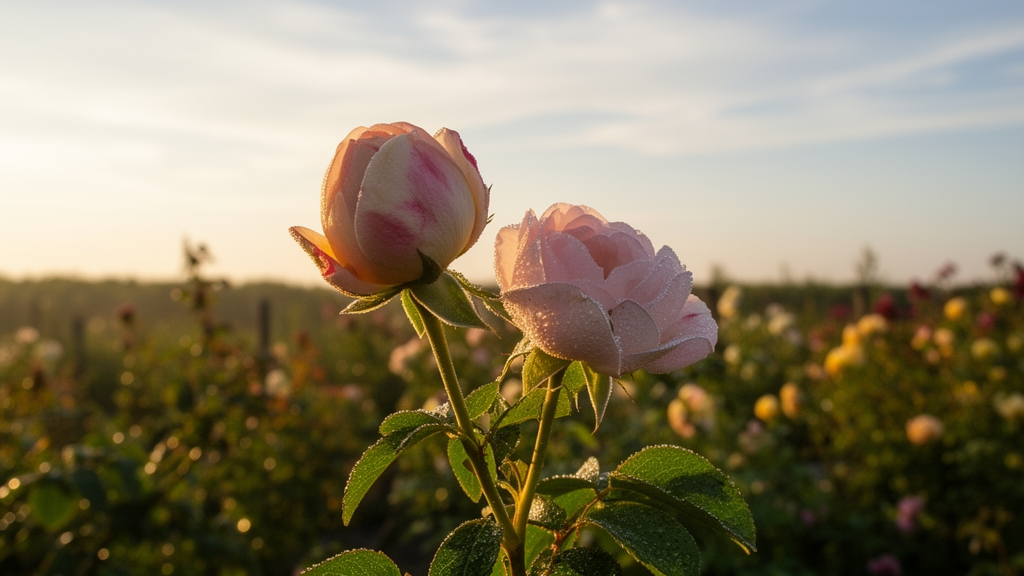
Every flower that opens in a spring meadow is the end point of an astonishingly complex molecular conversation. A new open-access review published in Discover Plants synthesizes decades of research into how flowering plants build their reproductive organs, decide when to bloom, and determine whether their flowers will be male, female, or both. The work, led by Sabir Iqbal and Jinggui Fang of Nanjing Agricultural University together with an international team, weaves together genetics, hormone biology, epigenetics and environmental physiology into a single framework that explains why a plant flowers when it does, and why its flowers look and function the way they do.
At the heart of floral architecture lies the famous ABCDE model, first sketched out in the early 1990s from studies of Arabidopsis thaliana and snapdragon. According to this framework, five classes of homeotic genes act in overlapping combinations across the concentric whorls of a flower. A-class genes specify sepals, A plus B specifies petals, B plus C specifies stamens, C alone specifies carpels, D-class genes govern ovule identity, and E-class SEPALLATA proteins act as essential partners that allow the other classes to function at all. Nearly all of these genes encode MADS-box transcription factors, proteins carrying a conserved 58 to 60 amino acid DNA-binding domain that recognizes specific regulatory sequences called CArG boxes. When any class is lost, the flower transforms dramatically: Arabidopsis plants lacking C-class AGAMOUS function produce double flowers, a trait breeders have deliberately induced in ornamental species such as morning glory and chrysanthemum.
The review emphasizes that the classical model is now only the skeleton of a much richer regulatory body. Revised interpretations, including the so-called (A)BC framework, assign APETALA2 a broader, more context-dependent role than the original model predicted. Beyond the ABCDE genes, an expanding cast of regulators refines floral patterning. AGL6-type MADS-box proteins interact with B-class factors in orchids to form complexes that determine whether a sepal, petal or lip develops, a finding that has reshaped understanding of orchid floral evolution. In tomato, silencing the SlAGL6 gene causes fused sepals and pale, shrunken petals. Other families contribute too: NAC-type NAP genes affect petal and stamen elongation, SPL proteins accelerate the transition to flowering, TGA factors with their glutaredoxin partners ROXY1 and ROXY2 are required for proper anther development, and WOX genes influence everything from gynoecium structure to flowering time, with rice OsWOX13 overexpression triggering flowering seven to ten days early.
Deciding when to flower is an equally intricate calculation. Plants integrate photoperiod, temperature, vernalization, age, hormones and metabolic status through interconnected genetic pathways. In the photoperiod pathway, circadian regulation of GIGANTEA and CDF1 activates CONSTANS, which in turn induces the floral integrator FLOWERING LOCUS T, the mobile signal that travels from leaf to shoot apex. Vernalization works through epigenetic silencing of the floral repressor FLOWERING LOCUS C: weeks of cold trigger chromatin changes, including Polycomb-mediated histone methylation, that lock FLC into a repressed state and release the brake on flowering. The FRIGIDA protein, recognizing H3K4me3 marks at the FLC locus, does the opposite, keeping FLC active and delaying bloom in winter annuals. Temperature responses also flow through FCA, FLM and SVP, which modulate FT expression depending on ambient conditions, a mechanism illustrated in osmanthus, where OfFCA expression rises at 19 degrees Celsius and flowering is advanced.
A particularly elegant layer of control involves microRNAs that track a plant’s age. miR156, abundant in seedlings, represses SPL transcription factors and keeps the plant vegetative. As the plant matures, miR156 declines and miR172 rises, together flipping the developmental switch toward reproduction. This miR156-miR172 module is conserved from Arabidopsis to maize, and the review highlights how long non-coding RNAs and circular RNAs add further post-transcriptional regulation that is only now being mapped through transcriptome-wide sequencing.
Hormones and metabolites complete the picture. Gibberellin promotes flowering by degrading DELLA repressor proteins, and in Arabidopsis the active gibberellin GA4 accumulates at the shoot apex alongside sucrose under short days, driving expression of the meristem identity gene LEAFY. Cytokinins and gibberellin jointly activate MADS-box genes that promote bud formation, while auxin’s polar transport is essential for flower bud initiation, with AUXIN RESPONSE FACTOR 3 helping establish the ovary boundary. Even gaseous and nutritional signals matter: nitric oxide delays flowering by inhibiting GI and CO, sucrose antagonizes this effect by reducing S-nitrosylation of those same proteins, and sulfur can reverse NO-induced late flowering. The carbon-nitrogen balance thus acts as a metabolic gauge, ensuring that a plant only commits to the costly business of reproduction when resources permit.
Sex differentiation adds a further dimension of complexity. Although most angiosperms are hermaphroditic, roughly seven percent of species are dioecious, bearing male and female flowers on separate plants, and this breeding system has evolved repeatedly from hermaphroditic or monoecious ancestors. Unlike animals, plants rarely possess well-defined XY or WZ sex chromosome systems, but where they do occur, sex-linked genes accumulate in recombination-suppressed genomic regions. In the white campion Silene latifolia, the Y-linked SlAP3 gene encodes a B-class MADS-box protein expressed in developing male buds, while X-linked genes such as MROS3X and SlMF1 show elevated expression in female flowers. In persimmon, the HD-Zip gene MeGI acts as a key regulator of anther fertility, and in melon, a C2H2 zinc finger protein called CmWIP1 promotes stamens while suppressing carpels, a system famously traced to a transposon insertion that rewired hormone signaling.
Methodological advances are transforming the field. Early candidate-gene approaches have given way to RNA sequencing, which in cucumber identified roughly 200 differentially expressed genes linked to sex determination, and in melon revealed 1,259 genes associated with male fertility. Long-read platforms from PacBio and Oxford Nanopore now resolve full-length transcripts and complex splice isoforms, while single-cell and single-nucleus transcriptomics can distinguish developmental trajectories within floral meristems, stamens, ovules and other reproductive tissues. Spatial transcriptomics preserves the positional context of gene expression, allowing researchers to connect transcriptional states to specific floral domains rather than averaging across whole organs. The review argues that combining these approaches will finally reveal when, where and in which cell types the key regulatory genes act.
The stakes extend well beyond basic biology. Flowering time and sex expression directly determine crop yield, and climate change is making these traits less predictable, as drought, salinity and heat increasingly stress plants during reproduction. Studies in rice show that OsWOX13 enhances drought tolerance while promoting early flowering, hinting that stress adaptation and flowering control are mechanistically entangled. The authors call for integrating genomics, epigenomics, machine learning and CRISPR-based functional validation to build predictive models of reproductive development. If that integration succeeds, breeders could engineer flowering stability and climate resilience into the crops that feed the world, turning the molecular secrets of the flower into agricultural insurance.
Subject of Research: Molecular and environmental regulation of floral development, flowering time and sex differentiation in angiosperms
Article Title: Molecular and environmental regulation of floral development, flowering, and sex differentiation in angiosperms
Article References: Iqbal, S., Tariq, K., Elatafi, E., Yu, H., Ali, S., Elhendawy, B., Aziz, R. B., Khan, I. A., Baz, N. M., Hussain, A., & Fang, J. (2026). Molecular and environmental regulation of floral development, flowering, and sex differentiation in angiosperms. Discover Plants, 3(1), Article 450. https://doi.org/10.1007/s44372-026-00925-1
Image Credits: AI Generated
DOI: 10.1007/s44372-026-00925-1
Keywords: flowering, MADS-box transcription factors, ABCDE model, floral organ identity, sex differentiation, vernalization, photoperiod, microRNA, phytohormones, epigenetics, single-cell transcriptomics, crop improvement
Cite Scienmag News
Juliet Wilcox. (October 9, 2026). How Genes, Hormones and Weather Decide When a Flower Blooms. Scienmag. https://scienmag.com/how-genes-hormones-and-weather-decide-when-a-flower-blooms/
Juliet Wilcox. "How Genes, Hormones and Weather Decide When a Flower Blooms." Scienmag, 9 October 2026, https://scienmag.com/how-genes-hormones-and-weather-decide-when-a-flower-blooms/. Accessed 9 October 2026.
Juliet Wilcox. "How Genes, Hormones and Weather Decide When a Flower Blooms." Scienmag. October 9, 2026. https://scienmag.com/how-genes-hormones-and-weather-decide-when-a-flower-blooms/


