


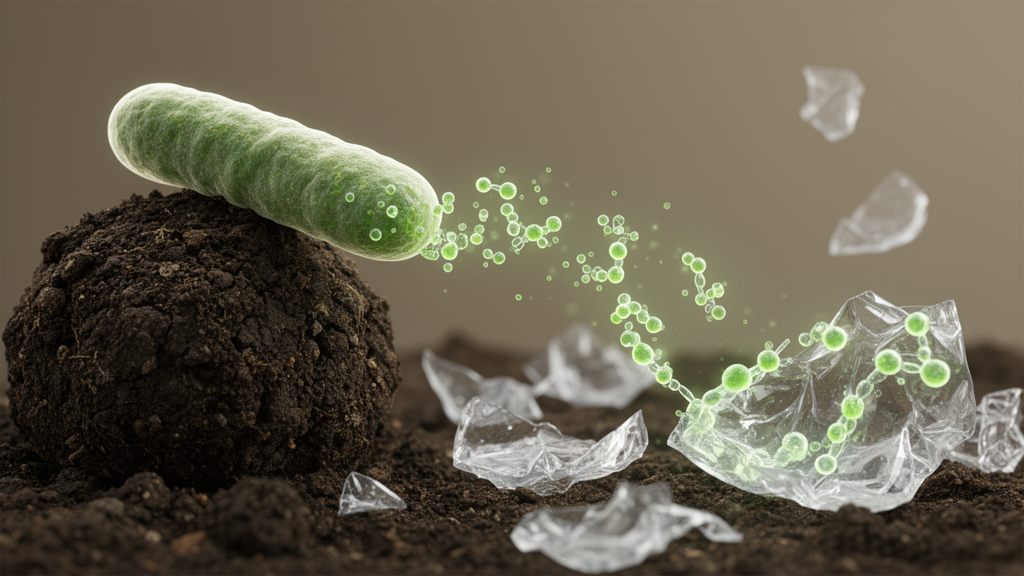
Plastic pollution has pushed scientists to search every corner of the microbial world for enzymes capable of dismantling one of the world’s most ubiquitous polymers: polyethylene terephthalate, better known as PET. While celebrated enzymes such as the PETase from the bacterium Ideonella sakaiensis and the leaf-compost cutinase known as LCC have grabbed headlines for their ability to attack the plastic polymer itself, a quieter bottleneck has persisted further down the recycling pipeline. Once PET is partially broken down, it yields soluble intermediates—chiefly bis(2-hydroxyethyl) terephthalate, or BHET, and mono(2-hydroxyethyl) terephthalate, or MHET—that must still be converted into terephthalic acid before the material can truly be recycled into new plastic. A newly characterized enzyme from a hardy soil bacterium now promises to close that gap with remarkable efficiency, and its discovery is reshaping how researchers think about the enzymatic toolkit for plastic degradation.
The enzyme, named BhEstB, was isolated and characterized by a team of researchers working at the University of Hamburg in Germany in collaboration with partners in Algeria and at Heinrich-Heine-University Düsseldorf and Forschungszentrum Jülich. Its source is Bacillus halotolerans, a salt-tolerant member of a bacterial genus famous for its metabolic versatility and resilience in harsh environments. Writing in the journal Applied Microbiology and Biotechnology, lead author Hadjira Bounabi and colleagues, including corresponding author Wolfgang R. Streit, describe BhEstB as a versatile carboxylesterase whose behavior defies easy categorization within the established families of PET-degrading enzymes. Structurally, it is closely related to an esterase from Bacillus subtilis, yet it diverges markedly from canonical PETases and from most well-characterized MHETases, including the MHETase of Ideonella sakaiensis. Instead, it clusters more closely with carboxylesterases such as TfCa, placing it in a distinct branch of the hydrolase family tree.
That phylogenetic distance turns out to matter enormously for function. When the team measured BhEstB’s activity across a panel of artificial substrates—p-nitrophenyl esters of varying chain lengths—the enzyme displayed broad esterase activity, with optimal performance at a mildly alkaline pH of 8 and at temperatures between 20 and 30 degrees Celsius. Those are gentle, ambient conditions, a striking contrast to the elevated temperatures often required by PET-active enzymes that must approach the polymer’s glass transition temperature to gain access to its chains. The modest thermal optimum initially suggested BhEstB might be a niche player, but the kinetic data told a very different story when the researchers turned to the soluble intermediates of PET breakdown.
Against BHET, BhEstB delivered results that place it among the most efficient BHET-hydrolyzing enzymes characterized to date. The enzyme achieved complete conversion of 50 millimolar BHET within just one hour at 30 degrees Celsius. The underlying kinetics are equally impressive: a turnover number, or kcat, of 15.57 plus or minus 1.25 per second, a Michaelis constant, or Km, of 6.54 plus or minus 1.01 millimolar, and a corresponding catalytic efficiency of 2.38 times ten to the third per molar per second. In practical terms, this means each enzyme molecule processes roughly fifteen BHET molecules every second under saturating conditions, with a substrate affinity that allows meaningful conversion even at moderate concentrations. For a bioprocess engineer, those numbers translate directly into smaller reactors, shorter residence times, and lower costs.
The enzyme’s performance on MHET, the other major soluble intermediate of PET hydrolysis, was nearly as striking. BhEstB converted 39.8 millimolar MHET into terephthalic acid with a yield of 77 percent, plus or minus 0.7 percent, within 24 hours. Terephthalic acid is the prize at the end of this enzymatic relay: it is the monomer from which virgin PET is made, and recovering it in pure form from waste plastic is the central goal of enzymatic recycling. By efficiently finishing the job that depolymerizing enzymes begin, BhEstB functions as a second-stage catalyst that could be paired with PETases or cutinases in a two-step biocatalytic cascade, converting plastic waste all the way back to its building blocks.
Perhaps the most telling comparison came from head-to-head benchmarking. BhEstB significantly outperformed not only the engineered LCC variant known as LCC ICCG—one of the most intensively optimized PET-depolymerizing enzymes in the field—but also PET46, a recently published archaeal feruloyl esterase that had itself drawn attention for its PET-intermediate activity. That a naturally occurring Bacillus enzyme, without the benefit of directed evolution or rational engineering, could surpass these heavily studied catalysts on BHET and MHET underscores how much unexplored enzymatic diversity remains hidden in soil microorganisms. It also validates the authors’ framing of BhEstB as a blueprint: a structural and mechanistic template from which future engineered variants could be derived.
The blueprint idea carries real weight because BhEstB’s sequence and structure differ from the canonical PETase fold that has dominated the literature since Ideonella sakaiensis was described in 2016. Carboxylesterases of this type appear to have evolved for hydrolyzing ordinary ester bonds in plant and soil chemistry, yet their active-site architecture accommodates the aromatic diesters of PET breakdown with unexpected ease. Understanding which structural features grant BhEstB its extraordinary BHET turnover—features that canonical PETases and MHETases lack—could guide protein engineers in designing hybrid enzymes that combine polymer attack with rapid intermediate processing, eliminating the accumulation of BHET and MHET that can limit the throughput of current enzymatic recycling schemes.
On the bulk polymer itself, the team was careful to keep expectations measured. BhEstB showed modest overall activity on commercial semi-crystalline PET powder, with some activity observed at elevated temperatures, but it is clearly not a polymer-depolymerizing specialist on the order of LCC or the best engineered PETases. The authors frame this honestly: BhEstB is a versatile BHET- and MHET-active carboxylesterase with modest activity toward the bulk polymer, contributing to the expanding diversity of PET-intermediate-degrading enzymes rather than replacing the depolymerization workhorses. In a multi-enzyme recycling process, that division of labor is not a weakness but a design principle—each catalyst doing what it does best under conditions that favor the overall reaction.
The broader significance of the work lies in what it reveals about the ecology and evolution of plastic-degrading chemistry. PET has existed for less than a century, far too short a time for enzymes to have evolved specifically for it, so the catalysts being discovered today are almost certainly repurposed from older metabolic functions such as cutin degradation, ferulate ester hydrolysis, or general ester scavenging. BhEstB, with its carboxylesterase scaffold and ambient-temperature optimum, fits this pattern perfectly and suggests that the search space for PET-intermediate enzymes extends well beyond the known PETase lineages into the vast and poorly sampled diversity of bacterial esterases. Metagenomic and activity-based screening of soil and marine microbiomes, the approach exemplified by the Hamburg group’s broader research program, is likely to yield many more such catalysts.
For a world drowning in PET waste—hundreds of millions of tonnes produced annually, with only a small fraction chemically recycled—enzymes like BhEstB represent a practical step toward genuine circularity. A complete enzymatic recycling process would combine a depolymerase that shreds the polymer into soluble fragments with an intermediate-processing enzyme that finishes the conversion to terephthalic acid and ethylene glycol, both of which can feed back into virgin-quality PET production. By demonstrating complete BHET conversion in an hour and efficient MHET turnover at 30 degrees Celsius, BhEstB shows that the second stage of that process can be fast, mild, and economical. The study, funded in part by Algeria’s Directorate-General for Scientific Research and Technological Development and Germany’s Federal Ministry of Education and Research, and published open access, adds a powerful new name to the growing roster of plastic-eating enzymes—and a reminder that some of biotechnology’s best tools are still waiting quietly in the soil.
Subject of Research: Enzymatic degradation of PET plastic intermediates by a Bacillus carboxylesterase
Article Title: A versatile Bacillus esterase reveals a carboxylesterase blueprint for PET intermediate degradation
Article References: A versatile Bacillus esterase reveals a carboxylesterase blueprint for PET intermediate degradation. (n.d.). https://doi.org/10.1007/s00253-026-14056-w
Image Credits: AI Generated
DOI: 10.1007/s00253-026-14056-w
Keywords: PET biodegradation, Bacillus halotolerans, carboxylesterase, BHET, MHET, terephthalic acid, enzyme kinetics, plastic recycling, biocatalysis, hydrolases, PETase, microbial enzymes
Cite Scienmag News
Morgan Morrow. (October 9, 2026). Soil Bacterium Yields a Surprisingly Powerful Enzyme for Breaking Down PET Plastic Intermediates. Scienmag. https://scienmag.com/soil-bacterium-yields-a-surprisingly-powerful-enzyme-for-breaking-down-pet-plastic-intermediates/
Morgan Morrow. "Soil Bacterium Yields a Surprisingly Powerful Enzyme for Breaking Down PET Plastic Intermediates." Scienmag, 9 October 2026, https://scienmag.com/soil-bacterium-yields-a-surprisingly-powerful-enzyme-for-breaking-down-pet-plastic-intermediates/. Accessed 9 October 2026.
Morgan Morrow. "Soil Bacterium Yields a Surprisingly Powerful Enzyme for Breaking Down PET Plastic Intermediates." Scienmag. October 9, 2026. https://scienmag.com/soil-bacterium-yields-a-surprisingly-powerful-enzyme-for-breaking-down-pet-plastic-intermediates/


