


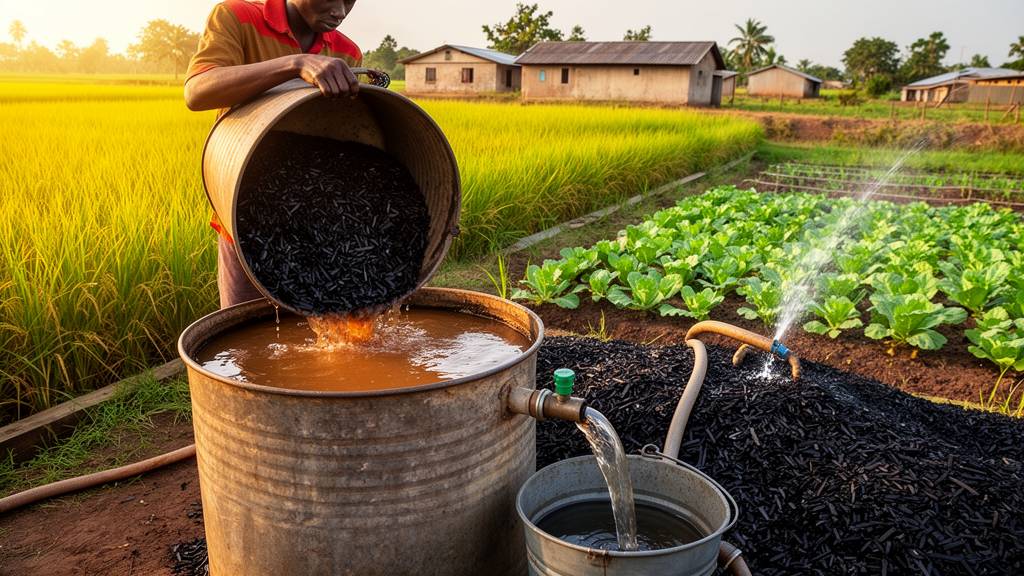
In the farming community of Diewuoso-Obuasi in Ghana’s Ashanti Region, a simple question has been driving a quietly ambitious experiment: can the waste products of local agriculture be turned into the technology that makes local wastewater safe enough to grow food? A new study published in PLOS Water suggests the answer is a qualified but encouraging yes. Researchers built a decentralized, on-farm treatment system packed with biochar made from rice husks, a plentiful agro-residue that would otherwise be burned or discarded, and ran raw municipal wastewater through it for ten days. The results offer a compelling glimpse of how low-cost, locally sourced materials could reshape water reuse in rural communities that sit far from conventional treatment infrastructure.
The system itself is elegantly straightforward. Rather than relying on energy-intensive mechanical plants, the team designed a two-stage downflow filtration arrangement in which wastewater cascades through columns of rice husk biochar. Biochar, the charcoal-like material produced by heating biomass in low-oxygen conditions, is prized for its enormous internal surface area and its capacity to adsorb contaminants, buffer pH, and host microbial communities that break down organic pollutants. Because the feedstock in this case came from residues generated within the same agricultural landscape that needs the treated water, the approach embodies a circular economy in miniature: farm waste cleans farm water, which then returns to irrigate crops.
Over the ten-day trial, the filter demonstrated substantial physical and chemical polishing of the incoming wastewater. Turbidity, the cloudiness caused by suspended particles, dropped by 66.92 percent, a critical outcome since suspended solids shield pathogens from disinfection and clog soil pores. Total dissolved solids fell by 38.19 percent, and salinity declined by 22.03 percent. Both of the latter measures matter enormously for irrigation, because accumulated salts can degrade soil structure and damage crops over successive growing seasons. Importantly, the treated water met the irrigation quality limits set by the Food and Agriculture Organization of the United Nations on these parameters, meaning that from a crop and soil protection standpoint, the effluent was fit for purpose.
One counterintuitive finding, however, complicates the picture. Electrical conductivity, a proxy for the total ionic content of water, actually rose by 26.58 percent during treatment. The researchers attribute this increase to the leaching of ash minerals from the biochar itself. When rice husks are pyrolyzed, potassium, calcium, magnesium, and other soluble compounds remain concentrated in the resulting char, and fresh biochar can release these ions into water passing through it. While this mineral release is not necessarily harmful to soils and may even supply plant nutrients, it signals a practical consideration for anyone deploying biochar filters in the field: the material may benefit from pre-washing or conditioning before it enters service, particularly where irrigation water salinity is already a concern.
The microbial results tell a more dramatic story. The biochar filter achieved log-scale reductions in the indicator organisms that public health engineers use to track fecal contamination. Escherichia coli concentrations fell by 90.42 percent, fecal coliforms by 98.39 percent, and total coliforms by 99.99 percent. These are remarkable figures for a passive, unpowered filter built from agricultural waste. The removal likely reflects a combination of mechanisms: physical straining of bacteria within the biochar’s porous matrix, adsorption of cells onto charged surfaces, and possibly the antimicrobial properties that some biochars exhibit due to residual phenolic compounds and reactive mineral phases.
Yet here lies the study’s most important caveat. Despite reductions approaching or exceeding 99 percent, the final effluent concentrations of these indicator bacteria still exceeded the thresholds established by the World Health Organization and Ghana’s Environmental Protection Agency for unrestricted irrigation, meaning water that can safely be applied to any crop, including those eaten raw. The arithmetic of pathogen removal is unforgiving: when raw municipal wastewater carries bacterial loads in the millions per 100 milliliters, even a three-log reduction can leave behind counts in the thousands. The authors conclude that the rice husk biochar filter is best understood as an efficient pre-treatment component within a treatment train, one that would still require a secondary disinfection step, such as chlorination, solar exposure, or slow sand filtration, to eliminate residual public health risk.
This framing is not a weakness of the research but arguably its greatest strength. Too often, discussions of water reuse in low-resource settings swing between two unhelpful extremes: either expensive centralized plants that never get built, or unregulated direct reuse that exposes farmers and consumers to genuine hazards. The Obuasi study charts a middle path, demonstrating that locally produced biochar can shoulder a large share of the treatment burden affordably, while honestly documenting the gap that remains. That gap, bridged by an appropriate post-treatment technology, defines a scalable engineering blueprint rather than a dead end.
The choice of Obuasi as a study site adds another layer of significance. The town is historically Ghana’s gold mining heartland, a landscape where water resources face pressure from both mining legacy contamination and untreated municipal discharge. Smallholder farmers in such peri-urban areas frequently irrigate with polluted streams out of necessity, a practice the WHO acknowledges is widespread and better managed than prohibited. Technologies like the biochar filter tested here directly address that reality, offering farmers a way to reduce the pathogen and solids load in the water they already use, rather than demanding they abandon irrigation altogether.
Rice husk availability makes the model particularly attractive for scale-up. Ghana’s rice production generates substantial quantities of husk as a milling byproduct, and similar residues are abundant across West Africa. Converting them into biochar requires only simple pyrolysis kilns that can be fabricated locally, and the spent char, after its filtration service ends, retains value as a soil amendment that can improve water retention and carbon sequestration on the very fields it serves. Few treatment technologies can claim such a complete lifecycle: grown on the farm, deployed on the farm, and returned to the farm.
The broader implications extend well beyond one Ghanaian community. As climate variability intensifies and urban populations grow across sub-Saharan Africa, the pressure to reuse wastewater in agriculture will only increase, and the FAO estimates that vast volumes of urban wastewater are already used for irrigation worldwide, most of it untreated. Studies like this one provide the evidence base needed to make that practice safer through incremental, affordable engineering rather than aspirational infrastructure. The Obuasi biochar filter may not yet deliver water clean enough for unrestricted use on its own, but as a rigorously tested building block in a circular, community-scale treatment system, it points toward a future in which the solution to water pollution grows in the same fields it protects.
Subject of Research: On-farm wastewater treatment using rice husk biochar filtration for agricultural irrigation reuse in Ghana
Article Title: On-farm wastewater treatment for irrigation using biochar from local agro-residues in Obuasi, Ghana
Article References: Amponsah, L. O., Obemah, D. N., Quayson, B. L., Banunle, A., Asamoah, D. K. O., & Mwema, M. F. (2026). On-farm wastewater treatment for irrigation using biochar from local agro-residues in Obuasi, Ghana. PLOS Water, 5(9), e0000612. https://doi.org/10.1371/journal.pwat.0000612
Image Credits: AI Generated
DOI: 10.1371/journal.pwat.0000612
Keywords: biochar, wastewater treatment, rice husk, irrigation, Ghana, water reuse, E. coli, coliforms, circular economy, decentralized treatment, PLOS Water, agro-residues
Cite Scienmag News
Alan Morgan. (October 9, 2026). Rice Husk Biochar Filters Wastewater for Farm Irrigation in Ghana. Scienmag. https://scienmag.com/rice-husk-biochar-filters-wastewater-for-farm-irrigation-in-ghana/
Alan Morgan. "Rice Husk Biochar Filters Wastewater for Farm Irrigation in Ghana." Scienmag, 9 October 2026, https://scienmag.com/rice-husk-biochar-filters-wastewater-for-farm-irrigation-in-ghana/. Accessed 9 October 2026.
Alan Morgan. "Rice Husk Biochar Filters Wastewater for Farm Irrigation in Ghana." Scienmag. October 9, 2026. https://scienmag.com/rice-husk-biochar-filters-wastewater-for-farm-irrigation-in-ghana/


