


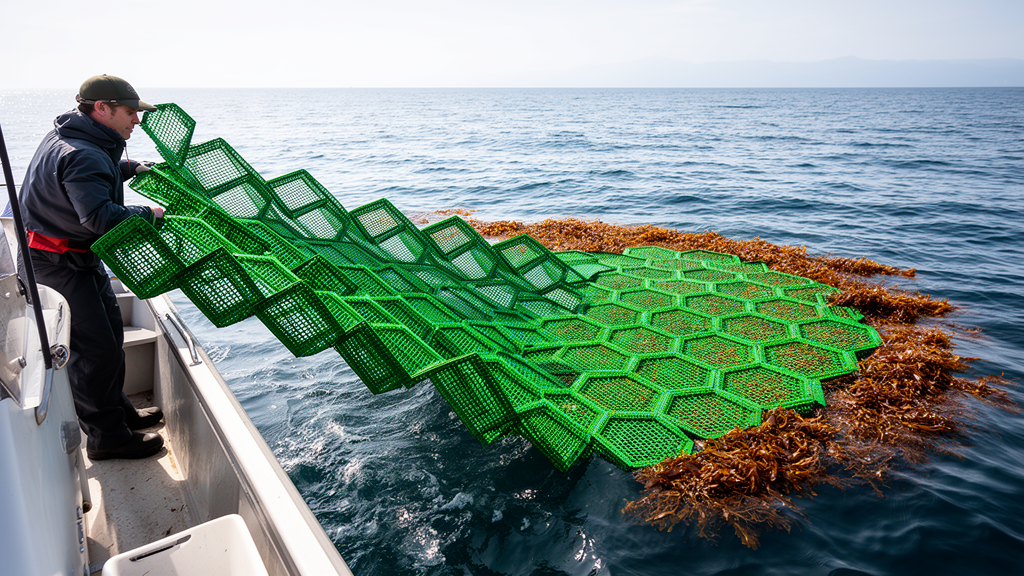
Seaweed has long been touted as one of nature’s most promising tools against climate change, but the open ocean has stubbornly refused to cooperate. Strong currents rip young fronds from their moorings, nutrients drift away before plants can absorb them, and offshore infrastructure is scarce and expensive. Now a team of Chinese researchers believes the answer may lie in an art form that is centuries old: origami. In a study published online on 28 September 2026 in Environmental Science and Ecotechnology, researchers at Zhejiang University, working with collaborators at Guizhou University and the Ningbo Innovation Center, unveiled the Seaweed Origami-inspired Aquaculture System, or Seaweed OAS, a modular structure that folds from flat panels into a protective, dodecahedron-like shell designed to tame the ocean’s flow.
The case for moving seaweed farming offshore is compelling. Macroalgae contribute roughly 1.5 petagrams of carbon to global annual net primary production, and sediments beneath seaweed farms can bury about 1.87 plus or minus 0.73 tons of carbon dioxide equivalent per hectare per year, roughly twice the burial rate of adjacent non-farmed areas. Yet existing aquaculture is concentrated in sheltered coastal waters, where space is limited and competition with other uses is intense. Expanding into the open ocean would multiply the available area enormously, but only if cultivation systems can survive currents that would tear apart conventional rigs and still deliver the calm, nutrient-rich microenvironments that seaweed needs to grow.
The core problem is hydrodynamic. Seaweed attaches to hard surfaces and grows best when water movement around it is slow enough to avoid physical damage but fast enough to replenish gases and nutrients. In the open ocean, currents routinely exceed the thresholds that young plants can tolerate, and the dissolved nitrogen, phosphorus, and iron that seaweed requires are far too dilute for large-scale cultivation. Previous offshore platforms have either depended on scarce offshore infrastructure or offered no way to regulate the local flow field around the plants themselves. The Zhejiang-led team set out to build a low-cost structure that could do three things at once: slow the water, store and release nutrients, and provide surfaces for attachment.
The geometry is the breakthrough. Inspired by the traditional Chinese huiwen, or fret pattern, the researchers designed flat panels that fold into a 25-sided variant pentagonal unit. Twelve of these units assemble into a dodecahedron-like shell, creating a shell-core architecture in which an origami-inspired outer surface surrounds an internal nutrient space, a central buoyancy ball, and connection seats for linking modules together. The folding behavior is governed by a dimensionless scaling ratio, defined as the auxiliary-circle radius divided by the base-circle radius. The team simulated values of this ratio from 0.28 to 0.56 and found that 0.36 was optimal for a single unit, a parameter choice that shaped how the folded shell deflects and slows incoming water.
Using computational fluid dynamics, the researchers quantified how much of the interior volume experienced conditions suitable for growth, defined as a streamwise velocity of no more than 0.5 meters per second. Under an inflow of 2.0 meters per second, a demanding current by aquaculture standards, the optimal single-unit design produced 2,607.7 cubic centimeters of suitable growth volume, and the best single-unit result reached 2,791.6 cubic centimeters, 17 times that of a spherical reference structure of the kind commonly used in conceptual offshore designs. The folded shell essentially wraps the seaweed in a pocket of slowed water, creating what the authors describe as quiet microhabitats where plants can attach and grow while the same module stores slow-release nutrients.
Single modules, however, are not the whole story. When the researchers arranged six units in a hexagonal layout with 0.35-meter spacing, cooperative wake interactions amplified performance. Upstream modules shielded downstream ones, so the total suitable volume reached 33,210.3 cubic centimeters at 2.0 meters per second, or 5,535.1 cubic centimeters per unit, 2.1 times the volume of an isolated unit. This wake-sharing effect means that arrays of the modules could scale more efficiently than the sum of their parts, an important property for any technology that aspires to farm at ocean scale. The optimized six-unit configuration, labeled Hexagon 2, demonstrated that deliberate spatial arrangement can turn individual shelters into a collective one.
Structural survival was tested as rigorously as hydrodynamics. The modules were 3D-printed with polylactic acid, using water-soluble polyvinyl alcohol supports, a manufacturing approach that could in principle be replicated cheaply at scale. Compression tests yielded a minimum peak load of 11,693 newtons, compared with a predicted peak drag of only 39.9 newtons under operating conditions, a safety factor of 293. The system was then evaluated in laboratory tests, lake trials, and an open-ocean deployment in the Philippine Trench region. Across all three settings, the structure stayed afloat and stable, including during wave impacts, offering early evidence that the folded geometry is not merely a simulation artifact but a physically robust marine structure.
To gauge the global opportunity, the team mapped ocean conditions worldwide and identified 10,335 million hectares, about 28.5 percent of the global ocean, as potentially suitable for deployment. That figure is a first-order estimate, and the authors are careful to note that real siting would have to account for shipping lanes, ice cover, temperature, nutrient ratios, flow speed, and marine protected areas. Even so, the mapping suggests that if the technology performs as designed, the physical area available for open-ocean seaweed cultivation is not the limiting factor. The limiting factors, instead, will be engineering durability, nutrient logistics, and the ecological consequences of placing vast numbers of modules in pelagic waters.
The researchers frame the work as turning an ancient folding idea into a practical marine tool. By reshaping flow around each module, the system creates calm zones for growth while the same module doubles as a nutrient reservoir, they explain, and the cooperative wake interactions in optimized arrays can further amplify the suitable growth volume per unit. They also emphasize what remains unknown: long-term cultivation outcomes, the fate of carbon sunk to the deep ocean, and the ecological effects of material degradation are all unverified and require dedicated field study. The team calls for long-term offshore trials to quantify seaweed growth, structural durability, material ecotoxicity, and the persistence of sequestered carbon.
If those trials succeed, the implications extend beyond carbon. Seaweed biomass can be harvested and recycled into food, feed, and biomaterials, or, through a second pathway enabled by connection modules with controllable degradation, the system could eventually break apart so that carbon-rich biomass sinks to the deep ocean for long-term storage. Because the modular shell-core design can be deployed without existing offshore infrastructure, it could in principle be scaled in places where conventional aquaculture cannot reach. The study, funded by China’s National Key R&D Program, the National Natural Science Foundation of China, and several provincial research programs, offers a concrete, testable route toward open-ocean seaweed farming, one folded panel at a time.
Subject of Research: Origami-inspired modular aquaculture systems for open-ocean seaweed cultivation and carbon sequestration
Article Title: Origami geometry could make open-ocean seaweed farming scalable for carbon sequestration
Article References: Origami geometry could make open-ocean seaweed farming scalable for carbon sequestration. (n.d.). Original publication
Image Credits: AI Generated
DOI: Not provided
Keywords: seaweed farming, origami engineering, carbon sequestration, open-ocean aquaculture, computational fluid dynamics, macroalgae, blue carbon, Zhejiang University, dodecahedron module, ocean currents, nutrient delivery, marine climate solution
Cite Scienmag News
Violet Maxwell. (October 9, 2026). Origami-inspired modules could unlock open-ocean seaweed farming for carbon storage. Scienmag. https://scienmag.com/origami-inspired-modules-could-unlock-open-ocean-seaweed-farming-for-carbon-storage/
Violet Maxwell. "Origami-inspired modules could unlock open-ocean seaweed farming for carbon storage." Scienmag, 9 October 2026, https://scienmag.com/origami-inspired-modules-could-unlock-open-ocean-seaweed-farming-for-carbon-storage/. Accessed 9 October 2026.
Violet Maxwell. "Origami-inspired modules could unlock open-ocean seaweed farming for carbon storage." Scienmag. October 9, 2026. https://scienmag.com/origami-inspired-modules-could-unlock-open-ocean-seaweed-farming-for-carbon-storage/


