


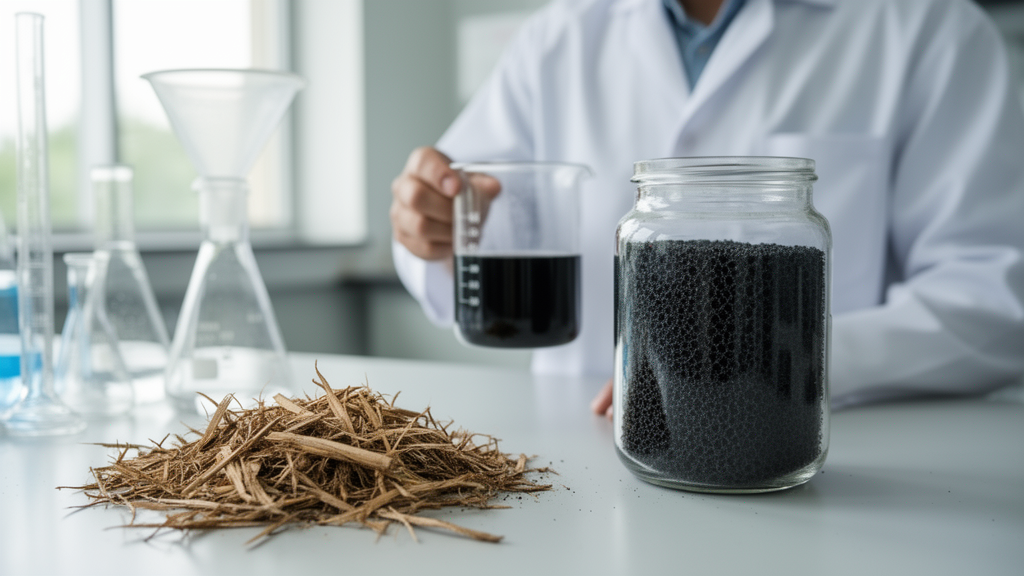
Every year, the global sugar industry leaves behind mountains of sugarcane bagasse, the fibrous residue that remains after stalks are crushed and their juice extracted. Most of this agricultural waste is burned or dumped, releasing carbon dioxide and wasting a lignocellulosic resource that chemists have long eyed as a feedstock for advanced materials. Now, a team of researchers from Morocco and France has demonstrated that this humble by-product can be transformed, using a remarkably gentle chemical process, into an activated carbon capable of stripping two of the most problematic heavy metals from contaminated water with efficiencies approaching one hundred percent. The study, published in Environmental Science and Pollution Research, also introduces a machine-learning layer that promises to change how adsorption processes are designed and scaled.
The material at the heart of the work, designated AC–SCB, is produced by treating sugarcane bagasse with sulfuric acid at low temperature. This choice matters. Conventional activated carbon production typically demands high-temperature pyrolysis or steam activation in furnaces running at several hundred degrees Celsius, an energy burden that undermines the environmental credentials of the resulting adsorbent. By contrast, the low-temperature acid activation route developed by the team, led by Mohamed Anouar and Asmaa Msaad of University Hassan I in Settat, minimizes energy consumption while avoiding the harsher chemicals often deployed in commercial carbon manufacture. The result is a mesoporous carbon with a specific surface area of 251.7 square meters per gram, a figure that, while modest compared with some engineered carbons, proved more than sufficient thanks to a second crucial feature: an abundance of oxygen-containing functional groups grafted onto the carbon surface.
Those surface functionalities are where the chemistry gets interesting. Adsorption of metal ions onto carbon is not simply a matter of pore size; it depends on the electrostatic and chemical affinity between the dissolved species and the binding sites lining the pore walls. The oxygenated groups on AC–SCB, including carboxyl and hydroxyl moieties, act as anchors for positively charged metal cations and, in the case of hexavalent chromium, create the charged interface needed to attract anionic chromate species. The researchers characterized this interplay carefully, finding that the two target pollutants, Cr(VI) and Co(II), are captured by fundamentally different mechanisms. Hexavalent chromium, which exists in water as negatively charged oxyanions, is removed primarily through electrostatic interactions that are strongly pH-dependent, while divalent cobalt, a cationic species, binds through surface complexation and chelation with the oxygen donor groups.
That mechanistic divergence made the comparative design of the study particularly valuable. Rather than optimizing conditions separately for each metal, the team ran batch adsorption experiments under identical protocols, allowing a direct head-to-head comparison. The performance figures are striking. At an optimal pH of 3.02, the material removed 99.14 percent of Cr(VI) from solution, and at pH 6.21 it captured 99.40 percent of Co(II). Equilibrium modeling with the Langmuir isotherm yielded maximum adsorption capacities of 895.2 milligrams per gram for chromium and 934.3 milligrams per gram for cobalt, capacities that place this waste-derived carbon among the most effective adsorbents reported for these contaminants. Kinetic analysis showed that uptake followed the pseudo-second-order model, indicating that the rate-limiting step involves chemical interactions between the metal ions and the binding sites rather than simple diffusion.
The pH dependence of the two systems tells a coherent mechanistic story. Under acidic conditions, the carbon surface is protonated and carries a net positive charge, which attracts the anionic forms of hexavalent chromium such as HCrO4−. As pH rises, the surface deprotonates and loses its affinity for chromate, which explains why Cr(VI) removal peaks in acid. Cobalt behaves in the opposite fashion: at low pH, hydrogen ions compete with Co2+ for the same oxygen donor sites, suppressing uptake, while at near-neutral pH the competition fades and chelation proceeds efficiently. This dual behavior means a single adsorbent could, in principle, be deployed in staged treatment trains, with one pH regime targeting chromium and another targeting cobalt, without changing the material itself.
Optimization of the process variables was handled with a combination of statistical design and artificial intelligence. The team first applied response surface methodology, or RSM, a statistical technique that models how multiple input factors, such as pH, adsorbent dose, and initial concentration, jointly influence removal efficiency. The RSM models were already highly accurate, with correlation coefficients of 0.9953 for Cr(VI) and 0.9996 for Co(II). But the researchers went further, training artificial neural networks and support vector machines on the same experimental data and comparing all three modeling approaches. The neural network emerged as the clear winner, achieving a correlation coefficient of 0.99625 for Cr(VI) and an extraordinary 0.99986 for Co(II), with correspondingly low mean squared errors. The advantage reflects the ANN’s capacity to capture nonlinear interactions among process variables that polynomial RSM models approximate only imperfectly.
The implications of that modeling result extend beyond this particular adsorbent. Adsorption is a notoriously nonlinear phenomenon, governed by competing equilibria, surface heterogeneity, and concentration-dependent effects. Traditional empirical models can miss these subtleties, leading to suboptimal operating conditions when processes are scaled from the laboratory to real treatment plants. A well-trained neural network, by contrast, learns the full response surface from data and can predict performance across the operating envelope, reducing the number of experiments needed and accelerating design cycles. The finding that ANN outperformed both RSM and SVM in capturing the nonlinear behavior of the adsorption system adds to a growing body of evidence that machine learning is becoming an indispensable companion to experimental water-treatment research.
Practical deployment also hinges on whether an adsorbent can be reused, and here the Moroccan team delivered encouraging news. After five consecutive adsorption–desorption cycles, AC–SCB retained 75 percent of its initial adsorption efficiency, a regeneration performance that supports both the economic and environmental case for the material. Durability of this kind is essential for circular-economy arguments: an adsorbent that must be replaced after every treatment run simply shifts the waste problem from contaminated water to spent carbon. The ability to regenerate and redeploy the same material across multiple cycles, combined with a feedstock that is itself an agricultural by-product, positions the technology as a genuinely closed-loop solution.
The environmental stakes are considerable. Hexavalent chromium is a recognized carcinogen associated with severe neurotoxic and organ-damaging effects, and it enters waterways from electroplating, tanning, and mining operations. Cobalt, while an essential element in small quantities, is toxic at elevated concentrations and is increasingly a concern as battery manufacturing and hydrometallurgy expand worldwide. Conventional removal technologies, including membrane filtration, ion exchange, and precipitation, often carry high capital and operating costs that put them out of reach for many polluting industries in developing economies. A low-cost adsorbent made from sugar mill waste, activated under mild conditions, and capable of near-complete removal of both metals offers a compelling alternative, particularly for small and medium-scale operations.
What makes this study resonate beyond its immediate results is the template it establishes: agricultural waste valorization, green chemistry, rigorous batch experimentation, and artificial intelligence woven into a single research pipeline. The authors, whose affiliations span University Hassan I, Sultan Moulay Slimane University, University Hassan II in Casablanca, and CNRS-affiliated laboratories at the University of Lille, carried out the work without dedicated external funding, a detail that underscores how far modest resources can go when guided by careful design. As water scarcity intensifies and industrial effluents grow more complex, the convergence of sustainable materials science and machine-learning optimization may well define the next generation of water-treatment technology, and sugarcane bagasse, of all things, has just made a strong case for a starring role.
Subject of Research: Sugarcane bagasse-derived activated carbon for Cr(VI) and Co(II) removal from wastewater using experimental and machine-learning modeling
Article Title: Sustainable sugarcane bagasse-derived activated carbon for comparative Cr(VI) and Co(II) removal: experimental and ANN modeling integration
Article References: Anouar, M., Msaad, A., El Achhab, A., Hajjaoui, H., Kadmi, Y., Bouzziri, M., & Belbahloul, M. (2026). Sustainable sugarcane bagasse-derived activated carbon for comparative Cr(VI) and Co(II) removal: experimental and ANN modeling integration. Environmental Science and Pollution Research, 33(30), 15458-15490. https://doi.org/10.1007/s11356-026-38173-1
Image Credits: AI Generated
DOI: 10.1007/s11356-026-38173-1
Keywords: activated carbon, sugarcane bagasse, Cr(VI) removal, Co(II) removal, adsorption, heavy metals, wastewater treatment, artificial neural network, response surface methodology, machine learning, circular economy, biosorbent
Cite Scienmag News
Blake Davidson. (October 9, 2026). Sugarcane Waste Turned Into Carbon Sponge That Scrubs Toxic Metals From Water. Scienmag. https://scienmag.com/sugarcane-waste-turned-into-carbon-sponge-that-scrubs-toxic-metals-from-water/
Blake Davidson. "Sugarcane Waste Turned Into Carbon Sponge That Scrubs Toxic Metals From Water." Scienmag, 9 October 2026, https://scienmag.com/sugarcane-waste-turned-into-carbon-sponge-that-scrubs-toxic-metals-from-water/. Accessed 9 October 2026.
Blake Davidson. "Sugarcane Waste Turned Into Carbon Sponge That Scrubs Toxic Metals From Water." Scienmag. October 9, 2026. https://scienmag.com/sugarcane-waste-turned-into-carbon-sponge-that-scrubs-toxic-metals-from-water/


