


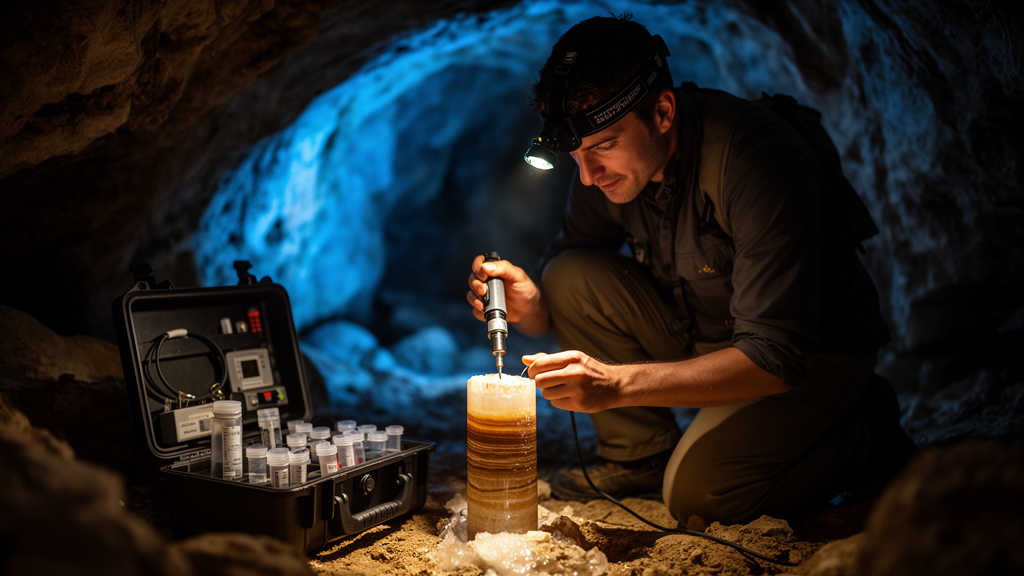
Deep beneath the scrubby limestone plain of Mexico’s Yucatán Peninsula, stalagmites have been quietly recording the region’s climate for thousands of years. These cave deposits are among the most valuable archives on Earth for reconstructing past rainfall, drought, and environmental change, largely because they can be dated with extraordinary precision using uranium-series methods. But a new study published in the journal Geochronology reveals that in tropical karst settings like the Yucatán, an invisible contaminant — initial thorium carried into caves by groundwater — can distort these atomic clocks so severely that entire age models collapse into contradiction. The research, led by Nils Schorndorf and Sophie Warken of Heidelberg University, offers both a warning and a solution: a multi-method framework that rescues chronologies even where contamination is extreme and unpredictable.
The technique at the heart of speleothem dating, uranium-thorium or 230Th/U dating, relies on a simple principle. When carbonate minerals precipitate from dripping water to form a stalagmite, they incorporate uranium but essentially no thorium. Uranium-234 then decays into thorium-230, so the amount of thorium-230 accumulated in a layer is a direct measure of its age. The method assumes the system remains closed after formation and that no thorium-230 was present at the start. In ideal conditions, age precision depends only on the accuracy of isotope measurements and well-known half-lives. Any deviation — whether from later alteration of the carbonate or from thorium that entered the crystal at the moment of growth — biases the calculated age, typically making samples appear older than they really are.
The trouble is that thorium-230 contamination almost always arrives together with thorium-232, an isotope of purely detrital origin. Geochronologists correct for the initial thorium-230 by assuming a fixed ratio of thorium-230 to thorium-232 in the contaminating material, conventionally a value of about 0.8 derived from average upper continental crust. For clean, old, uranium-rich samples, this correction works well. But in tropical karst systems, studies from Mexico, Belize, Puerto Rico, the Bahamas, Cuba, and the tropical Pacific have reported initial ratios far higher — sometimes tens of times the standard value — and highly variable even within a single cave. When contamination is strong and the assumed ratio is wrong, corrected ages can violate stratigraphy, producing the notorious ‘age inversions’ in which deeper, supposedly older layers date as younger than those above them.
Áaktun Kóopo’ Cave, located in the northeastern Yucatán Peninsula near the communities of La Estrella, Chemax, and Xcan, provided an ideal and demanding test case. The cave extends more than two kilometres through Cretaceous and Tertiary limestones and contains at least nine seasonally fluctuating water bodies. It is also an archaeological site: Maya paintings, polychrome pottery, limestone walls, and the skeletal remains of 23 individuals date to the Late Preclassic and Early Classic periods, with imported flint and obsidian suggesting ritual use by local elites. Between 2018 and 2023, the team collected samples from 15 different speleothems, including ten complete stalagmites between 6.5 and 34 centimetres long, several of which were still actively growing when extracted.
The analytical campaign was exhaustive. A total of 157 samples were dated by high-precision 230Th/U mass spectrometry at Heidelberg University, supplemented by radiocarbon measurements on stalagmite tips to confirm modern growth, X-ray diffraction and thin-section petrography to rule out mineral alteration, laser ablation ICP-MS scans to trace strontium-to-calcium ratios, and stable oxygen and carbon isotope analyses. The uranium concentrations, averaging around one part per million, allowed precise isotope measurements. Yet the results were startling: initial thorium-230 to thorium-232 activity ratios inferred for the cave ranged from 4 to as high as 68, vastly exceeding the standard bulk-earth value of roughly 0.8 and varying unsystematically in both space and time. Modern carbonate and drip water samples yielded elevated ratios of up to about 8.9, but even these did not capture the full range needed to reconcile the dates.
To tame this variability, the researchers deployed three independent approaches. First, they used local ‘isochrons’: closely spaced sub-samples from the same growth layer plot along linear mixing trends between pure carbonate and the detrital contaminant, and the slope of these trends yields a first-order estimate of the initial ratio. Five successful isochrons from three stalagmites produced values between 6.4 and 19. Second, they applied stratigraphic constraints, using samples with no detectable thorium-232 as clean anchors and requiring corrected ages to increase steadily with depth; for one stalagmite, 34 of 51 samples could be ordered this way using individual ratios between 11.5 and 49. Third, they exploited seasonal cycles in strontium-to-calcium ratios, counted with laser ablation scans, as an annual layer chronology. In stalagmite E23-3, 331 distinct minima were counted over 84 millimetres of growth, and aligning the uranium-thorium ages to this count required a ratio of about 26. For samples without specific estimates, the team applied a mean ratio of 35.5 with a large uncertainty of 32.5.
Samples with thorium-230 to thorium-232 activity ratios below 200 — 68 of the 157 dated samples — were excluded from the age models entirely, because for such heavily contaminated material the correction uncertainty swamps any useful chronological information. The remaining 89 samples were fed into six different age-depth modelling algorithms: linear interpolation, linear regression, Bchron, Bacon, COPRA, and StalAge. No single algorithm performed best everywhere; they disagreed notably on the timing and duration of growth interruptions. The team therefore constructed a composite chronology as the arithmetic mean of all successful models, with uncertainty combining both the spread between models and the average within-model uncertainty. The comparison showed that algorithm choice alone can shift the estimated onset of a hiatus by nearly four decades, a sobering illustration of how method-dependent paleoclimate timelines can be.
The validated chronologies reveal continuous carbonate deposition in Áaktun Kóopo’ Cave over the past 2,700 years, with mean growth rates of 200 to 300 micrometres per year, along with evidence of much earlier growth phases during glacial and interglacial periods extending back some 353,000 years. Crucially, the age models could be independently verified. When the stable isotope records of three stalagmites from the same chamber were plotted on their corrected timescales, they showed striking coherence in both oxygen and carbon isotopes, with correlations reaching 0.62 after minor wiggle-matching adjustments that all fell within the calculated 95 percent uncertainty ranges. This replication across independent samples demonstrates that the correction framework produces chronologies robust enough for high-resolution climate reconstruction.
The stalagmites also preserve dramatic evidence of extreme events. A centimetre-thick flooding layer appears in three stalagmites from the same cave area, dated between roughly 1350 and 1430 AD, likely marking a single catastrophic inundation. A sediment record from Cenote Muyil about 80 kilometres south documents intense hurricane activity between 1285 and 1420 AD, and historical sources report a major hurricane — the ‘hurricane of the four winds’ — in 1464 AD, though the exact match remains uncertain. A thinner interruption in two other stalagmites is precisely dated to 1624 AD, plus or minus 24 years. Such event layers, the authors suggest, could serve as stratigraphic tie-points analogous to volcanic ash layers in marine sediments, anchoring proxy records across multiple archives.
Why the thorium ratios vary so wildly remains an open question. The researchers attribute the spread to a shifting mixture of thorium reservoirs in the karst system: detrital clay particles, colloidal phases, and organic complexes mobilized by rapidly dissolving young reef limestone. Because no systematic pattern allows prediction of the initial ratio in advance, the team recommends that future studies in tropical karst combine uranium-thorium dating with radiocarbon, annual layer counting, and stratigraphic constraints rather than relying on any single correction. The payoff is substantial: the corrected Áaktun Kóopo’ records fill a conspicuous gap in high-resolution paleoclimate data from the northeastern Yucatán, where no stalagmite record has covered the last 1,600 years. With reliable timelines now in hand, researchers can begin to disentangle how droughts, floods, and hurricanes intersected with the trajectory of Maya civilization — including the profound upheavals of the Terminal Classic Period around 800 to 1000 AD, when population decline and the abandonment of urban centres reshaped the region.
Subject of Research: Uranium-thorium dating of stalagmites and correction of initial thorium contamination in tropical karst paleoclimate records
Article Title: Challenges of initial Thorium and Approaches to Robust Speleothem Age Models: A case study from the Yucatán peninsula, Mexico
Article References: Schorndorf, N., Warken, S. F., Eichstädter, R., Mielke, A. S., Avilés Olguín, J., Keppler, F., Hennhöfer, D., Tec Pool, F., Evia, C., Gómez, M. J., Stinnesbeck, W., & Frank, N. (2026). Challenges of initial Thorium and Approaches to Robust Speleothem Age Models: A case study from the Yucatán peninsula, Mexico. Geochronology, 8(3), 511-528. https://doi.org/10.5194/gchron-8-511-2026
Image Credits: AI Generated
DOI: 10.5194/gchron-8-511-2026
Keywords: speleothems, uranium-thorium dating, initial thorium, Yucatán Peninsula, paleoclimate, stalagmites, Maya civilization, geochronology, karst hydrology, age-depth models, isochron method, annual layer counting
Cite Scienmag News
Violet Maxwell. (October 8, 2026). Hidden Thorium Throws Off Cave Clocks, but a New Fix Rebuilds Maya-Era Timelines. Scienmag. https://scienmag.com/hidden-thorium-throws-off-cave-clocks-but-a-new-fix-rebuilds-maya-era-timelines/
Violet Maxwell. "Hidden Thorium Throws Off Cave Clocks, but a New Fix Rebuilds Maya-Era Timelines." Scienmag, 8 October 2026, https://scienmag.com/hidden-thorium-throws-off-cave-clocks-but-a-new-fix-rebuilds-maya-era-timelines/. Accessed 9 October 2026.
Violet Maxwell. "Hidden Thorium Throws Off Cave Clocks, but a New Fix Rebuilds Maya-Era Timelines." Scienmag. October 8, 2026. https://scienmag.com/hidden-thorium-throws-off-cave-clocks-but-a-new-fix-rebuilds-maya-era-timelines/


