


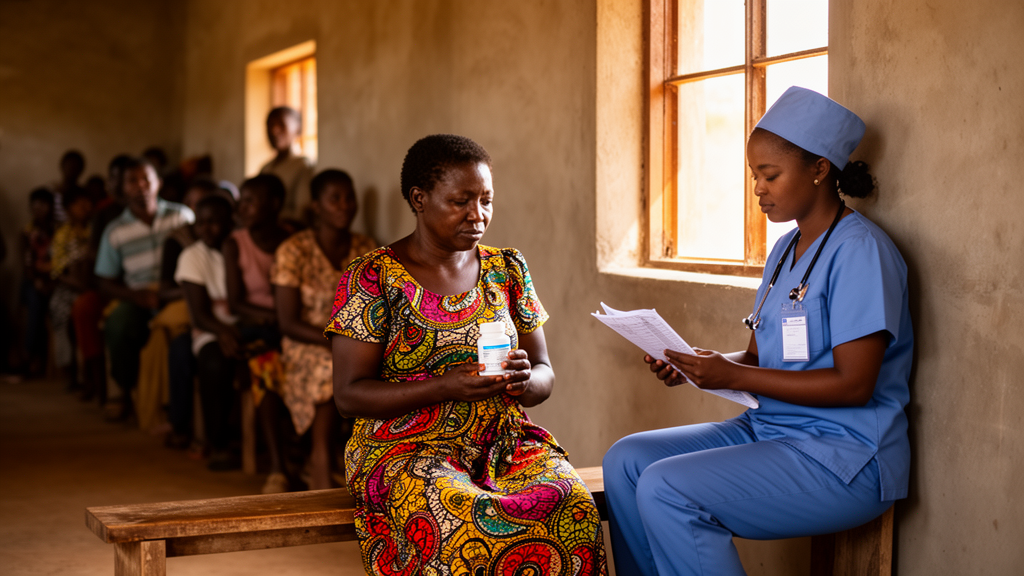
Antiretroviral therapy has transformed HIV from a uniformly fatal infection into a manageable chronic condition across much of sub-Saharan Africa, yet tens of thousands of people still die of HIV-related causes each year in Zimbabwe, Malawi, and South Africa. A new analysis published in PLOS Medicine has used seven independent mathematical simulation models to answer a deceptively simple question: where exactly in the HIV care cascade are these deaths occurring? The answer, the researchers report, is sobering and has direct consequences for how national programmes should spend their resources. In Zimbabwe and Malawi, the models consistently found that the largest share of HIV-related deaths now occurs among people who are actually receiving antiretroviral therapy, while in South Africa a strikingly high proportion of deaths occurs among people who started treatment but then dropped out of care.
The study, led by Loveleen Bansi-Matharu of University College London together with Daniel Citron, Rowan Martin-Hughes, and colleagues, adopted a multi-model comparison design rather than relying on any single simulation framework. Each of the seven participating models is an established tool in HIV policy analysis, used for years by governments and international agencies to project epidemic trajectories and evaluate intervention strategies. By running several models in parallel against the same questions, the team could distinguish findings that are robust across different modelling assumptions from findings that depend on the particular structure of one model. This approach is increasingly favoured in epidemiology because models differ in how they represent disease progression, treatment effectiveness, and the movement of patients in and out of care.
To establish that the models were grounded in reality, the researchers first asked each model to reproduce key HIV metrics for the period from 2000 to 2045 in the three countries. These metrics included total population size, HIV prevalence, annual numbers of new infections, and the proportions of people living with HIV who had been diagnosed, were on antiretroviral therapy, and were virally suppressed. The models showed strong consistency with observed population estimates and prevalence data across all three settings, which gave the team confidence that the simulations were calibrated to the actual course of the epidemics. This calibration step is essential: a model that cannot reproduce known epidemic trends cannot be trusted to describe the less visible details of who is dying and why.
With that foundation in place, the models estimated HIV-related deaths each year and sorted them into four categories reflecting the care status of the deceased individual. The first category comprised people who had never been diagnosed with HIV. The second covered those who had been diagnosed but had not yet started treatment. The third included people who were on antiretroviral therapy at the time of death, and the fourth captured those who had started treatment but had subsequently interrupted it. This classification maps directly onto the care cascade that HIV programmes monitor, and it allows policymakers to see whether deaths cluster at the entry points of the cascade, such as testing and treatment initiation, or further along, where adherence and retention become the dominant challenges.
The most technically striking result concerns the absolute numbers of deaths, which varied enormously between models. For Zimbabwe in 2025, model estimates of annual HIV-related deaths ranged from 3,666 to 17,475. In Malawi, the range was from 4,580 to 17,835, and in South Africa, the country with the largest epidemic of the three, estimates spanned from 39,470 to 114,968. Such wide ranges mean that any single model’s death count should be interpreted with caution. The authors attribute this variation to differences in model structure and assumptions, but they also point to a deeper problem: the scarcity of reliable empirical data on deaths in the region. Without national death registries that systematically record causes of death, models have little solid ground on which to anchor their mortality estimates, and uncertainty inevitably balloons.
Despite the divergence in absolute numbers, the relative distribution of deaths across care categories told a more consistent story. In Zimbabwe, all seven models agreed that people receiving antiretroviral therapy accounted for the largest proportion of HIV-related deaths, although the models disagreed about how large that share was, with estimates ranging from 35 percent to 64 percent. Deaths among people who had interrupted treatment formed the second-largest group, at between 17 percent and 29 percent. Malawi showed similar trends, with treatment recipients and treatment interrupters together dominating the mortality picture. These findings mark a profound epidemiological transition: in the early years of the African epidemic, most deaths occurred among people who had never been diagnosed or treated, whereas today the centre of gravity has shifted to people who are, at least nominally, inside the treatment system.
South Africa presented a distinctive pattern. There, a high proportion of HIV-related deaths occurred among people who had interrupted antiretroviral therapy, with model estimates ranging from 23 percent to 74 percent in 2025, alongside a substantial share among those currently receiving treatment, estimated at 23 percent to 56 percent. The very wide uncertainty around the interruption category reflects genuine difficulty in tracking patients who disengage from care and later die, often outside the health system. Even so, the direction of the finding is clear across models: treatment interruption is a leading pathway to death in South Africa, which suggests that the country’s large treatment programme is losing patients at a rate that carries a heavy mortality cost.
The implications for policy are significant. If most deaths occur among people on treatment or those who have interrupted it, then interventions focused narrowly on expanding HIV testing, while still important for the undiagnosed minority, will not by themselves eliminate the remaining mortality burden. Instead, the authors conclude that adherence counselling and programmes designed to retain people in care need to be prioritised. This could include intensified viral load monitoring to identify patients at risk of failing therapy, structured support for re-engagement among those who have dropped out, and differentiated service delivery models that make long-term treatment easier to sustain. The consistency of the multi-model findings gives national programmes in Zimbabwe, Malawi, and South Africa a firmer evidence base for such a strategic shift than any single-model analysis could provide.
The study also carries a methodological message for the global health community. Simulation models are only as good as the data that feed them, and the absence of comprehensive death registration in much of sub-Saharan Africa remains a fundamental constraint on efforts to quantify HIV mortality and evaluate progress toward epidemic control. The authors are explicit that limited data availability, particularly the lack of national death registries, is a key limitation of modelling studies in this setting. Investment in civil registration and vital statistics systems would narrow the uncertainty ranges that currently separate model estimates by factors of three or more, and would allow future analyses to pinpoint the mortality burden with far greater precision.
As the region moves toward the United Nations targets for ending AIDS as a public health threat, the remaining deaths are increasingly concentrated among people the health system has already reached. The multi-model evidence from Zimbabwe, Malawi, and South Africa indicates that the next phase of mortality reduction will be won or lost not at the testing tent or the pharmacy window, but in the long, quiet years of daily pill-taking that follow. Ensuring that people who start treatment stay on it, and that those who interrupt it are found and brought back, is now the central challenge for HIV programmes in southern Africa.
Subject of Research: HIV-related mortality across the care cascade in Zimbabwe, Malawi, and South Africa assessed through multi-model comparison
Article Title: HIV diagnosis and treatment status in individuals dying from HIV in Zimbabwe, Malawi, and South Africa: A model comparison analysis
Article References: Bansi-Matharu, L., Citron, D. T., Martin-Hughes, R., Moolla, H., Stover, J., Pickles, M., Mangal, T., Smith, J., Mugurungi, O., Kubyana, M. S., Taramusi, I., Cambiano, V., Mpofu, A., ten Brink, D., Mudimu, E., Apollo, T., Bershteyn, A., Chewere, L., Dimitrov, D., … Phillips, A. (2026). HIV diagnosis and treatment status in individuals dying from HIV in Zimbabwe, Malawi, and South Africa: A model comparison analysis. PLOS Medicine, 23(9), e1004864. https://doi.org/10.1371/journal.pmed.1004864
Image Credits: AI Generated
DOI: 10.1371/journal.pmed.1004864
Keywords: HIV, antiretroviral therapy, care cascade, mathematical modelling, Zimbabwe, Malawi, South Africa, treatment interruption, adherence, mortality, PLOS Medicine, sub-Saharan Africa
Cite Scienmag News
Ophelia Keating. (October 9, 2026). Most HIV Deaths Now Strike People on Treatment, Models Reveal in Southern Africa. Scienmag. https://scienmag.com/most-hiv-deaths-now-strike-people-on-treatment-models-reveal-in-southern-africa/
Ophelia Keating. "Most HIV Deaths Now Strike People on Treatment, Models Reveal in Southern Africa." Scienmag, 9 October 2026, https://scienmag.com/most-hiv-deaths-now-strike-people-on-treatment-models-reveal-in-southern-africa/. Accessed 9 October 2026.
Ophelia Keating. "Most HIV Deaths Now Strike People on Treatment, Models Reveal in Southern Africa." Scienmag. October 9, 2026. https://scienmag.com/most-hiv-deaths-now-strike-people-on-treatment-models-reveal-in-southern-africa/


