


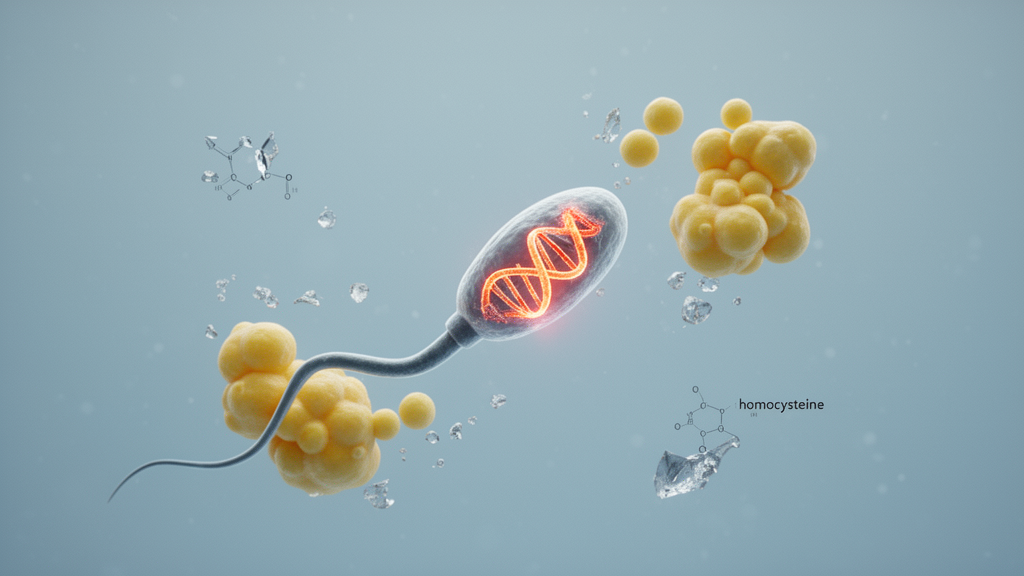
A large study of more than 5,000 men undergoing fertility evaluation has found that elevated levels of homocysteine, an amino acid intermediate best known for its role in cardiovascular medicine, are associated with increased fragmentation of the DNA inside sperm. The research, published as an open-access paper in the Journal of Translational Medicine, also reports something more provocative: body weight appears to change the strength of that association, with the link between homocysteine and sperm DNA damage being most pronounced among men living with obesity. The findings add a metabolic dimension to a question that has long been dominated by lifestyle and environmental explanations for declining male reproductive health.
Sperm DNA fragmentation, often abbreviated SDF, is a measure of breaks and other damage in the genetic material carried by sperm cells. Unlike conventional semen analysis, which counts sperm and grades their movement and shape, DNA fragmentation testing probes the integrity of the paternal genome itself. That matters because sperm with heavily fragmented DNA can still fertilize an egg, yet the resulting embryos may fail to develop, implant, or carry to term. Clinicians increasingly view SDF as a complementary indicator that captures something standard semen parameters miss, and researchers have spent years hunting for the biological drivers that push fragmentation upward.
Homocysteine sits at a fascinating biochemical crossroads. It is a sulfur-containing amino acid generated during one-carbon metabolism, the network of reactions that transfers methyl groups needed for DNA synthesis, repair, and methylation. When levels of folate, vitamin B12, or other cofactors are inadequate, or when metabolic regulation falters, homocysteine accumulates in the blood, a condition called hyperhomocysteinemia. Elevated homocysteine has been linked to oxidative stress, endothelial dysfunction, and cardiovascular risk, and because sperm are exceptionally vulnerable to oxidative damage to their DNA, the authors reasoned that homocysteine could plausibly serve as a metabolic correlate of sperm DNA integrity.
To test that idea, the team led by researchers at the Reproductive Center of the First Hospital of Jilin University enrolled 5,032 men attending their first fertility evaluation at a single reproductive center in China. Each participant provided a blood sample for serum homocysteine measurement and a semen sample for analysis, including assessment of DNA fragmentation by sperm chromatin structure assay. The investigators analyzed homocysteine three ways: as a continuous variable, against the clinical threshold for hyperhomocysteinemia, and across tertiles of the study population. Sperm DNA fragmentation was treated both as a continuous percentage and as a binary outcome, with abnormal SDF defined as 30 percent or higher. Body mass index was categorized as normal weight, overweight, or obesity, allowing the researchers to test whether weight status modified the relationship.
The raw numbers told a clear story. Median sperm DNA fragmentation climbed steadily across homocysteine tertiles, from 13.65 percent in men with the lowest homocysteine to 14.93 percent in the middle group and 17.10 percent in the highest. The prevalence of abnormal SDF, the clinically meaningful threshold of 30 percent or more, nearly doubled across the same gradient, rising from 10.53 percent to 12.12 percent and then 20.25 percent. Conventional semen parameters shifted in parallel: sperm concentration was comparable across tertiles, but total motility and the proportion of normally shaped sperm were both significantly lower in the highest homocysteine group, with P values below 0.001.
Statistical modeling reinforced the pattern after adjustment for age, sexual frequency, body mass index, and abstinence duration. Each 1 micromole per liter increase in serum homocysteine was associated with a 0.132 percentage-point rise in SDF, with a 95 percent confidence interval of 0.087 to 0.176, and with a modest but precise increase in the odds of abnormal SDF, an odds ratio of 1.026. Comparing extremes was more striking: men in the highest homocysteine tertile had SDF values 3.383 percentage points higher than those in the lowest tertile, and more than twice the odds of abnormal fragmentation, with an odds ratio of 2.184 and a confidence interval of 1.767 to 2.698. In epidemiological terms, that is a substantial effect for a single, easily measured blood analyte.
The most novel result, however, was the interaction with body size. When the researchers stratified their models by body mass index category, they found that the homocysteine-SDF association was significantly modified by weight status, with an interaction P value of 0.011, and that the association was strongest among men with obesity. In other words, high homocysteine and obesity do not simply add their risks together; the combination appears to amplify the relationship between the amino acid and sperm DNA damage. The authors suggest that serum homocysteine should be considered a candidate metabolic correlate of sperm DNA integrity, particularly among men with obesity.
Why might obesity act as an amplifier? The study itself is cross-sectional, so it cannot establish mechanism, but the biology offers plausible threads. Adipose tissue in obesity is a source of chronic low-grade inflammation and oxidative stress, both of which attack the tightly packed chromatin of sperm. Obesity also disrupts one-carbon metabolism and is frequently accompanied by lower folate status and altered insulin signaling, conditions that raise homocysteine. If elevated homocysteine reflects impaired methyl-donor availability, sperm may suffer both direct oxidative injury and compromised DNA repair capacity during spermatogenesis, a process that takes roughly two to three months and is exquisitely sensitive to the metabolic environment of the body.
The practical implications are worth weighing carefully. Homocysteine is a routine, inexpensive blood test, and the study hints that it could eventually help identify men whose sperm DNA is at risk even when conventional semen parameters look acceptable. That could matter for couples considering assisted reproduction, where sperm DNA fragmentation is increasingly recognized as a factor in embryo quality and outcomes. The findings also dovetail with a growing literature connecting metabolic health to male fertility, reinforcing the idea that weight management and nutritional status, including adequate folate and B vitamins that keep homocysteine in check, may protect not just the heart but the genome that men pass on.
Important caveats remain. The study was conducted at a single center among men already seeking fertility evaluation, so the results may not generalize to the broader population of healthy men. As a cross-sectional design, it captures one moment in time and cannot prove that homocysteine causes DNA fragmentation; reverse causation or confounding by unmeasured factors, such as diet, smoking, or underlying illness, cannot be excluded. The authors received no specific external funding for the work, and the study was approved by the ethics committee of the First Hospital of Jilin University with written informed consent from all participants. Future longitudinal studies and intervention trials, for example testing whether lowering homocysteine through supplementation or weight loss reduces sperm DNA damage, will be needed to determine whether this metabolic marker is merely a bystander or a genuine, modifiable lever for improving male reproductive health.
Subject of Research: The association between serum homocysteine and sperm DNA fragmentation in men undergoing fertility evaluation, and its modification by obesity
Article Title: Obesity modifies the association between serum homocysteine and sperm DNA fragmentation: a cross-sectional study of 5,032 men undergoing fertility evaluation
Article References: Tian, T., Liu, Q., Che, M., & Wang, Q. (2026). Obesity modifies the association between serum homocysteine and sperm DNA fragmentation: a cross-sectional study of 5,032 men undergoing fertility evaluation. Journal of Translational Medicine. https://doi.org/10.1186/s12967-026-08917-1
Image Credits: AI Generated
DOI: 10.1186/s12967-026-08917-1
Keywords: sperm DNA fragmentation, homocysteine, hyperhomocysteinemia, obesity, body mass index, male infertility, fertility evaluation, one-carbon metabolism, oxidative stress, semen parameters, cross-sectional study, reproductive medicine
Cite Scienmag News
Daisy Hatcher. (October 8, 2026). High Homocysteine Linked to Sperm DNA Damage, and Obesity Makes It Worse. Scienmag. https://scienmag.com/high-homocysteine-linked-to-sperm-dna-damage-and-obesity-makes-it-worse/
Daisy Hatcher. "High Homocysteine Linked to Sperm DNA Damage, and Obesity Makes It Worse." Scienmag, 8 October 2026, https://scienmag.com/high-homocysteine-linked-to-sperm-dna-damage-and-obesity-makes-it-worse/. Accessed 8 October 2026.
Daisy Hatcher. "High Homocysteine Linked to Sperm DNA Damage, and Obesity Makes It Worse." Scienmag. October 8, 2026. https://scienmag.com/high-homocysteine-linked-to-sperm-dna-damage-and-obesity-makes-it-worse/


