


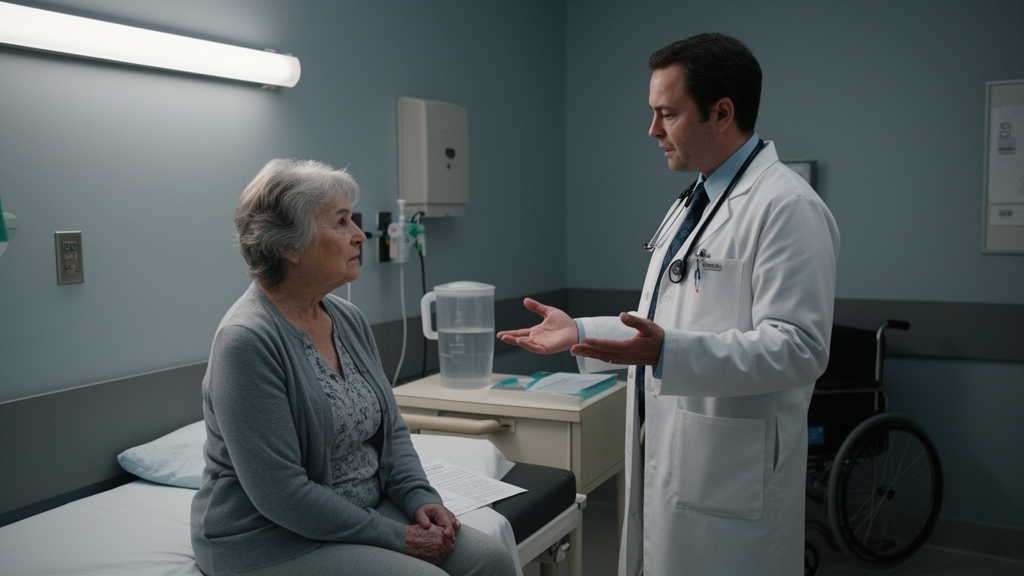
Every year, millions of older adults walk out of emergency departments across the United States clutching a printed sheet of discharge instructions that is supposed to guide their recovery. Those sheets are more than paperwork. They are the primary bridge between an acute, chaotic hospital encounter and the slower, deliberate world of primary care. When the bridge is poorly built, patients fall through it. A new study published in the Journal of General Internal Medicine by Thomas K. Hagerman and colleagues examines exactly how those bridges are constructed, and what it finds is a portrait of a communication system that routinely leaves older patients guessing about the most consequential instruction of all: follow up for what, with whom, and by when.
The research team, based at Henry Ford Hospital in Detroit, The Ohio State University, Michigan State University, and Henry Ford Health, conducted a multisite content analysis of emergency department discharge instructions given to older adults. Content analysis is a method borrowed from communication science in which researchers systematically code documents for the presence, absence, and framing of specific elements. Rather than asking patients what they remembered or surveying physicians about what they intended to communicate, the investigators went straight to the artifact itself, the written text that patients carry home. This approach has a distinct technical advantage: it captures what is actually delivered, not what clinicians believe they delivered or what patients recall receiving, two measures that decades of health communication research have shown diverge dramatically.
The stakes of this seemingly mundane document are surprisingly high. Older adults are disproportionately frequent users of emergency care, and their emergency visits are often the only point of contact with the health system for weeks at a time. Prior work cited by the authors, including a 2009 study in the Journal of the American Geriatrics Society by Hastings and colleagues, linked emergency department discharge diagnoses in older adults to subsequent adverse health outcomes, underscoring that the transition out of the emergency department is a period of genuine vulnerability. More recent evidence has sharpened the picture. A 2025 systematic review and meta-analysis in JAMA Network Open by Balasubramanian and colleagues examined the relationship between outpatient follow-up and thirty-day readmissions, while a 2020 analysis of Medicare beneficiaries by Lin and colleagues, also in JAMA Network Open, explored how ambulatory follow-up after emergency department discharge relates to downstream outcomes. Together, this literature establishes that what happens in the days and weeks after an emergency visit is not a quiet epilogue but an active determinant of whether older patients stay well or bounce back through the hospital doors.
Against that backdrop, the content of the discharge instruction becomes a kind of load-bearing wall. The researchers focused on a specific and underexamined component: the follow-up recommendation. Emergency physicians routinely write instructions telling patients to see their primary care provider, or a specialist, within some interval. But as the study’s pointed title suggests, these recommendations are frequently vague. A directive to follow up with your doctor does not specify which doctor, what the visit should accomplish, which symptoms should prompt an earlier return, or why the appointment matters. The authors’ own prior retrospective cohort study, published in Academic Emergency Medicine in 2026, had already documented a mismatch between emergency physician follow-up recommendations and actual primary care visit attendance among older adults, suggesting that whatever is being written on those instruction sheets is not reliably translating into completed appointments.
The technical logic of why vagueness matters draws on a well-established body of behavioral science. In their influential 2006 meta-analysis, Gollwitzer and Sheeran demonstrated that implementation intentions, plans that specify when, where, and how a goal will be pursued, substantially increase goal achievement across a wide range of domains. A follow-up instruction that reads see your primary care physician within one week to check your blood pressure medication is, in effect, an implementation intention. A follow-up instruction that reads follow up with doctor is not. The difference is not stylistic; it is mechanistic. Specific instructions reduce the cognitive burden on patients who may be recovering from illness, managing multiple medications, or experiencing the delirium-inducing stress of an emergency visit. They also create a checkable standard: a patient, a caregiver, or a care coordinator can verify whether the instruction was carried out.
Comprehension is the other half of the equation. A 2020 systematic review and meta-analysis in Annals of Emergency Medicine by Hoek and colleagues synthesized studies of patient discharge instructions in the emergency department and their effects on comprehension and recall, finding that the way instructions are designed and delivered measurably shapes what patients understand and remember. This matters acutely for older adults, who face higher rates of hearing and vision impairment, lower health literacy on average, and greater polypharmacy, all of which compound the difficulty of absorbing information delivered at the end of a stressful encounter. Written instructions are supposed to compensate for the well-documented forgetting curve that follows verbal discharge conversations, but only if the written text itself contains the information a patient needs. A document that omits the purpose of a follow-up visit cannot be rescued by a patient’s memory of the conversation, because the conversation may never have conveyed that purpose either.
The multisite design of the new study is what elevates it beyond a single-institution audit. Emergency departments differ enormously in their electronic health record systems, their discharge templates, their staffing models, and their patient populations. A content analysis conducted at one hospital might reflect the idiosyncrasies of one template or one group of physicians. By sampling discharge instructions across multiple sites, the investigators could ask whether the patterns they observed were local accidents or systemic features of how emergency medicine communicates with older patients. The answer, implied by the study’s framing and by the authors’ earlier work on the mismatch between recommendations and attendance, points toward a systemic problem: the follow-up information embedded in discharge documents is inconsistent, often nonspecific, and poorly aligned with what older patients and their primary care physicians need to coordinate care.
Why does this misalignment persist? The structural answer lies in the incentives and constraints of emergency care itself. Emergency physicians are trained to make disposition decisions, admit, discharge, transfer, but the follow-through after discharge belongs to a different part of the health system that the emergency department cannot directly control or even reliably see. The discharge instruction is the main instrument of that handoff, yet it is typically generated under time pressure from templates that were not designed with geriatric patients in mind. Primary care physicians, for their part, often receive little context about why an emergency visit occurred or what the emergency physician hoped a follow-up visit would achieve. The result is a communication chain with weak links at both ends, and the written instruction sheet is where those weak links become visible in black and white.
The practical implications of the study extend into several domains of health system improvement. For quality measurement, the findings suggest that follow-up recommendations in discharge instructions could be audited for specificity the way medication lists are audited for accuracy. For health information technology, they argue for smarter templates that prompt physicians to specify the type of provider, the timeframe, and the clinical rationale for follow-up, and that integrate with scheduling systems so a recommendation becomes a booked appointment rather than a suggestion. For health systems pursuing transitions-of-care programs, the study offers a concrete target: the humble instruction sheet, which is cheap to revise and sits at the exact junction where fragmented care most often fails patients. Interventions to improve patient understanding of emergency department discharge instructions, as explored by Russell, Jacobson, and Pavlic in a 2024 paper in the Western Journal of Emergency Medicine, provide a starting playbook for turning these findings into practice.
What makes this research resonate beyond the walls of emergency medicine is the way it reframes a familiar object. Nearly everyone has received a discharge instruction sheet and skimmed it, or stuffed it into a drawer. The study by Hagerman and colleagues asks readers to see that sheet as a piece of critical infrastructure, the written contract between an emergency department and an older patient’s future health. When the contract specifies what follow-up is for, who should provide it, and how soon it should happen, it functions as intended, connecting acute care to continuity of care. When it does not, older adults are left to reconstruct a care plan from fragments, and the health system loses one of its cheapest opportunities to prevent deterioration, readmission, and avoidable harm. Follow up for what is not a rhetorical question. It is a measurable design flaw in American emergency care, and this study gives clinicians, informaticists, and policymakers a precise place to start fixing it.
Subject of Research: Content analysis of emergency department discharge instructions and follow-up recommendations for older adults
Article Title: Follow Up for What? A Multisite Content Analysis of Emergency Department Discharge Instructions for Older Adults
Article References: Hagerman, T. K., Husain, A., Mowbray, F. I., Gunaga, S., Willens, D., & Miller, J. (2026). Follow Up for What? A Multisite Content Analysis of Emergency Department Discharge Instructions for Older Adults. Journal of General Internal Medicine. https://doi.org/10.1007/s11606-026-10903-8
Image Credits: AI Generated
DOI: 10.1007/s11606-026-10903-8
Keywords: emergency medicine, discharge instructions, older adults, follow-up care, care transitions, health communication, patient education, primary care, geriatrics, readmissions, content analysis, patient safety
Cite Scienmag News
Ophelia Keating. (October 8, 2026). What Emergency Departments Tell Older Adults About Follow-Up Care Often Falls Short. Scienmag. https://scienmag.com/what-emergency-departments-tell-older-adults-about-follow-up-care-often-falls-short/
Ophelia Keating. "What Emergency Departments Tell Older Adults About Follow-Up Care Often Falls Short." Scienmag, 8 October 2026, https://scienmag.com/what-emergency-departments-tell-older-adults-about-follow-up-care-often-falls-short/. Accessed 8 October 2026.
Ophelia Keating. "What Emergency Departments Tell Older Adults About Follow-Up Care Often Falls Short." Scienmag. October 8, 2026. https://scienmag.com/what-emergency-departments-tell-older-adults-about-follow-up-care-often-falls-short/


