


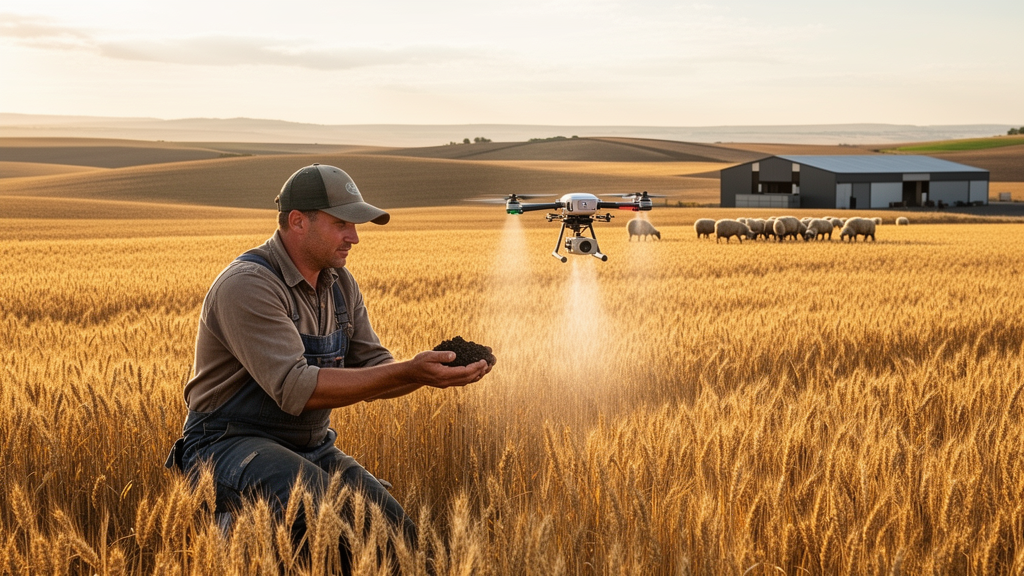
Drylands cover roughly forty percent of the planet’s land surface and are home to some 700 million people, many of whom depend on farming systems that combine crops with livestock for their survival. These mixed systems are the backbone of food security across much of the Global South, yet they are under relentless pressure from erratic rainfall, degraded soils and chronic nutrient depletion. A new review published in Discover Agriculture argues that a suite of digital technologies, from artificial intelligence and the Internet of Things to satellite remote sensing, could transform these fragile systems into productive, resilient and sustainable enterprises, provided the barriers to adoption are tackled head-on.
The review, led by Nazir Khan Mohammadi of Lanzhou University and Paktia University together with colleagues, synthesised 158 peer-reviewed publications spanning 1990 to 2025, drawn from databases including Web of Science, Scopus, Google Scholar and CAB Abstracts. The authors focused specifically on studies conducted in dryland or water-limited environments and reported outcomes on nitrogen use efficiency, yield, carbon dynamics or economic performance. Their central conclusion is striking: integrating smart agricultural tools into mixed crop-livestock systems can significantly improve nitrogen management, boost both crop and livestock productivity, and strengthen the economic resilience of farms that have historically been left behind by the technological revolution sweeping through irrigated agriculture.
At the heart of the analysis lies the problem of nitrogen. Globally, the average nitrogen use efficiency in cereal production is a mere 33 percent, meaning two-thirds of applied fertiliser never ends up in the food supply. The remainder is lost through ammonia volatilisation, nitrous oxide emissions and nitrate leaching, driving greenhouse gas emissions and water pollution. The review highlights that precision fertilisation guided by optical sensing and variable-rate application, operating at a spatial resolution of one square metre, has increased nitrogen use efficiency by more than 15 percent compared with traditional uniform application. Handheld sensors, drones and satellites such as the Copernicus Sentinel-2A/B platforms now allow farmers to tailor fertiliser inputs to the actual status and needs of their plants, rather than applying blanket rates across entire fields.
Biological nitrogen fixation offers a complementary route. Legumes such as alfalfa host symbiotic rhizobia that convert atmospheric nitrogen into biologically accessible forms, enriching the soil and reducing dependence on synthetic fertilisers. The review notes that precision agriculture techniques, including the nitrogen difference method, isotope methods and remote sensing, show great potential for diagnosing variability in symbiotic nitrogen fixation at the field level. Recent work also emphasises that below-ground nitrogen estimates must be included when quantifying fixation, otherwise the true contribution of legumes to soil fertility is systematically underestimated.
One of the most compelling farm-level strategies examined is intercropping alfalfa with silage corn. Although intercropping reduces corn yield by approximately 7 to 16 percent, it boosts alfalfa yield in the following year by 40 to 160 percent, while raising the crude protein content and improving the fermentation quality of the silage. By contrast, corn monoculture is associated with soil nitrate accumulation and inadequate ground cover. Alternative approaches, such as double cropping with rye or reseeding subterranean clover, can reduce nitrate accumulation and fertiliser requirements, though often with trade-offs in forage yield and management complexity. The review stresses that adjusting corn plant density and nitrogen application rates is essential to balance system productivity against silage quality.
The technological toolkit underpinning these gains is expanding rapidly. Internet of Things sensors deployed across fields transmit real-time data on soil moisture, temperature, pH and nutrient levels to cloud servers, where they can be integrated with geographic information systems to map soil health spatially. Field tests have validated the precision of these sensors, with R-squared values exceeding 90 percent, and some systems can trigger automated responses such as activating irrigation pumps when soil moisture falls below predetermined thresholds. Remote sensing adds another layer: the Normalized Difference Vegetation Index, combined with plant height measurements, can accurately predict biomass and nitrogen uptake in corn at different growth stages, while UAV-derived green NDVI has outperformed traditional field methods for estimating corn vigour and yield in complex smallholder systems.
Machine learning is the engine that converts this torrent of data into actionable predictions. Artificial neural networks, support vector machines and random forests integrate weather forecasts, soil sensor readings and satellite imagery to estimate crop health and forecast yields. Field-scale crop yield modelling using satellite-derived metrics alongside machine learning has accounted for over 70 percent of yield variation across different crops and agro-ecological zones, and deep neural networks have often outperformed alternative methods in comparative studies of wheat, corn and legume yield prediction. These forecasts can be generated well ahead of harvest, giving farmers and policymakers time to plan. On the livestock side, near-infrared reflectance spectroscopy can predict digestible amino acid content in animal feeds, accounting for 70 to 90 percent of variance, enabling precise feed formulation and on-farm nutritional monitoring.
Nutrient recovery closes the loop. Livestock farming generates vast quantities of nutrient-rich waste, and the review documents a growing repertoire of recovery technologies, from composting and anaerobic digestion to struvite precipitation, ammonia stripping and membrane filtration. GPS-guided manure application systems and GIS-based planning tools can optimise where and how manure nutrients are returned to fields, while the concept of manure sheds, mapping counties as sources or sinks of manure nutrients, offers a framework for recycling nutrients between animal feeding operations and nutrient-deficient cropland. Precision livestock farming, which matches nutrient supply to the requirements of individual animals through real-time sensor data, promises simultaneous gains in economic returns and reductions in environmental impact.
The economics are equally persuasive. Digital agricultural technologies have the potential to reduce fertiliser usage by up to 80 percent, cut pesticide application by 80 percent, increase crop yields by as much as 62 percent and lower labour costs by 97 percent, according to figures cited in the review. Integrated crop management systems exhibit higher net present values and cost-benefit ratios than conventional approaches, particularly in vegetable production, and intelligent platforms that combine yield data with financial analysis allow farmers to assess field profitability and negotiate land rents with confidence. Soil carbon adds a further dimension: global estimates suggest the biophysical potential for soil carbon sequestration is 4 to 5 gigatonnes of carbon dioxide per year with widespread adoption of best management practices, potentially rising to 8 gigatonnes with future technological advances.
Yet the review is candid about the obstacles. Limited internet connectivity, low digital literacy, inadequate infrastructure, high upfront costs and gender disparities all impede adoption among the smallholder farmers who stand to benefit most. A critical data gap persists: fragmented data collection and the absence of standardised protocols for integrating satellite imagery, IoT sensors, weather stations and farm records limit the development of robust, generalisable AI models, and most existing studies have been conducted under controlled conditions rather than in real-world smallholder contexts. The authors call for open-access localised datasets, long-term field trials, low-cost off-grid digital solutions and farmer-centred co-innovation, in which tools are designed collaboratively with the people who will use them. Policy support, affordable financing and digital skills training are essential complements to the technology itself. If these conditions are met, the review concludes, smart agriculture offers not merely a technological upgrade but a pathway toward resilient, efficient and equitable food systems in the world’s driest and most marginal environments.
Subject of Research: Application of smart agriculture technologies to improve nitrogen use efficiency, yield prediction and sustainability in dryland mixed crop-livestock systems
Article Title: Smart agriculture improves nitrogen use efficiency yield prediction and sustainability in dryland mixed crop livestock systems
Article References: Mohammadi, N. K., Arabzai, M. G., Inqilaabi, N. M., & Wang, Z. (2026). Smart agriculture improves nitrogen use efficiency yield prediction and sustainability in dryland mixed crop livestock systems. Discover Agriculture, 4(1), Article 316. https://doi.org/10.1007/s44279-026-00750-w
Image Credits: AI Generated
DOI: 10.1007/s44279-026-00750-w
Keywords: smart agriculture, nitrogen use efficiency, mixed crop-livestock systems, dryland farming, precision fertilisation, remote sensing, Internet of Things, artificial intelligence, yield prediction, biological nitrogen fixation, soil organic carbon, smallholder farmers
Cite Scienmag News
Alan Morgan. (October 8, 2026). Smart Farming Boosts Nitrogen Efficiency and Yields in Dryland Crop-Livestock Systems. Scienmag. https://scienmag.com/smart-farming-boosts-nitrogen-efficiency-and-yields-in-dryland-crop-livestock-systems/
Alan Morgan. "Smart Farming Boosts Nitrogen Efficiency and Yields in Dryland Crop-Livestock Systems." Scienmag, 8 October 2026, https://scienmag.com/smart-farming-boosts-nitrogen-efficiency-and-yields-in-dryland-crop-livestock-systems/. Accessed 8 October 2026.
Alan Morgan. "Smart Farming Boosts Nitrogen Efficiency and Yields in Dryland Crop-Livestock Systems." Scienmag. October 8, 2026. https://scienmag.com/smart-farming-boosts-nitrogen-efficiency-and-yields-in-dryland-crop-livestock-systems/


