


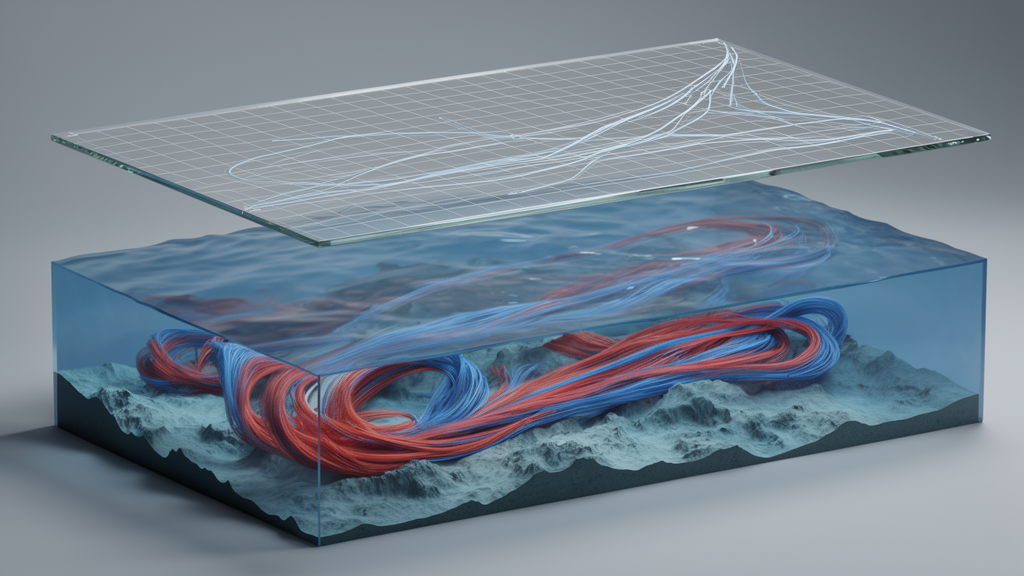
One of the most consequential questions in climate science is whether the Atlantic Meridional Overturning Circulation, the vast system of currents that carries heat northward through the Atlantic Ocean, is losing its stability and edging toward a catastrophic tipping point. A new analysis of 27 state-of-the-art climate models delivers a surprising and unsettling answer: in the simulated world, there is no sign of the destabilization that researchers have detected in real-world observations of the North Atlantic. The study, published in PLOS Climate by Maya Ben-Yami, Lana Blaschke, Sebastian Bathiany and Niklas Boers of the Potsdam Institute for Climate Impact Research and their collaborators, systematically searched for a statistical fingerprint known as critical slowing down in historical simulations spanning 1850 to 2014, and found essentially nothing.
Critical slowing down is a concept borrowed from nonlinear dynamics. When a system such as an ocean circulation sits far from a tipping point, it recovers quickly from small perturbations, and its natural fluctuations are fast and small. As the system approaches a bifurcation, the point at which it can no longer return to its current stable state, its recovery rate slows, and fluctuations become larger and more persistent. Statisticians track this process through indicators such as rising variance, rising lag-one autocorrelation, and a quantity called the restoring rate, which estimates how quickly the system snaps back toward equilibrium. In the extreme, these indicators can serve as early-warning signals of an impending transition, which is why they have become central to the debate over climate tipping points.
The AMOC is a prime candidate for such monitoring because it is thought to possess multiple stable states. The mechanism behind this bistability is the salt advection feedback: a weakening AMOC transports less salt northward, which reduces surface density in the regions where North Atlantic Deep Water forms, which in turn weakens the circulation further, potentially until an alternative, much weaker state is reached. Paleoclimate records, theoretical models and experiments with some general circulation models support the idea that such alternative states exist, although not all climate models reproduce them, and the question remains hotly debated. The Intergovernmental Panel on Climate Change concluded in its sixth assessment report, with medium confidence, that a collapse will not occur before 2100, a judgment resting heavily on the very models the new study scrutinizes.
Because continuous direct measurements of the AMOC’s strength have only existed since 2004, scientists studying longer timescales must rely on fingerprints, statistical patterns derived from observable variables that are physically connected to the circulation. The most widely used is the AMOC sea-surface temperature index, which averages sea-surface temperatures in the subpolar gyre region south of Greenland and subtracts the global mean. A landmark 2018 study used this index to argue that the AMOC has weakened over the twentieth century, and a 2021 analysis by Boers found a significant critical slowing down signal in temperature- and salinity-based fingerprints of the circulation. That signal has since been widely interpreted as evidence that the real-world AMOC is losing stability, and one 2023 study even used it to predict a tipping time, though other researchers have cautioned that the uncertainties in such predictions are enormous.
The problem is that the sea-surface temperature index is only partially correlated with the actual overturning circulation, and that correlation varies across models, time periods and scenarios. Other physical processes, such as changes in ocean mixed layer depth or atmospheric circulation, could in principle alter subpolar sea-surface temperatures in ways that mimic a stability loss without any real change in the AMOC. The researchers call this scenario a physical false positive: the statistical signal is genuinely present in the temperatures, but it says nothing about the circulation itself. Their central question was how confident we can be that the observed signal in the temperature index reflects the AMOC rather than such a confounding process.
To answer it, the team turned to the historical simulations of the sixth Climate Model Intercomparison Project, or CMIP6, in which 27 models ran the period 1850 to 2014 under realistic natural and anthropogenic forcings, with 133 ensemble members in total. For each run they computed three time series: the maximum overturning strength at 26.5 degrees north, the strength at 35 degrees north, and the sea-surface temperature index, yielding 399 AMOC time series. They then calculated three critical slowing down indicators for each, producing 1,197 indicator time series. Statistical significance was assessed conservatively, by generating 1,000 Fourier surrogates, random time series with the same variance and autocorrelation structure as the original, for each AMOC record, and asking how often a purely random process would produce an indicator trend as steep as the one observed.
The results were stark. Out of 133 ensemble members, only four showed a significant increase in the restoring rate at both streamfunction latitudes, and just one case showed coinciding significant increases in both the temperature index and a streamfunction strength. Eleven models, covering 96 ensemble members, showed no significant increases at all. Crucially, not a single model reproduced the pattern seen in the observations, where all three critical slowing down indicators rise significantly in the sea-surface temperature index. When the researchers counted all increases at the conventional 0.05 significance level, the numbers for the temperature index sat at or below what pure chance would predict for 133 random time series. In other words, the only statistically unusual thing about the model temperature indices is how few warning signals they contain.
The comparison between the temperature index and the direct circulation measure proved equally revealing. Because the models show no false warning signals in the temperature index despite the many other processes that could plausibly influence subpolar sea-surface temperatures, the researchers concluded that the index is not prone to physical false positives. If none of the 27 models contains any non-AMOC process capable of generating the observed signal, it becomes unlikely that such a process exists unrepresented in the real world. The logical implication is uncomfortable: the critical slowing down detected in real-world North Atlantic sea-surface temperatures is probably a genuine reflection of changes in the overturning circulation itself, quite possibly a loss of stability that the models simply fail to capture.
Why do the models diverge so sharply from reality? The authors lay out the possibilities. The model AMOCs may be genuinely stable while the real circulation is destabilizing, a difference that could stem from a well-documented bias in which climate models build in too much stability. Alternatively, the model AMOCs may be capable of tipping but start further from the tipping point than the real system, so their warning signals have not yet emerged from the noise. This second explanation gains support from known biases in the simulated freshwater convergence across the Atlantic basin, which is positive in most models and negative in observations, effectively placing the simulated circulation at a safer distance from the threshold at which tipping occurs. A handful of models, including CanESM5, CESM2, HadGEM3-GC31-LL and MIROC6, did show statistically unusual clusters of warning signals in some ensemble members, concentrated in the subpolar latitude, consistent with an AMOC approaching but not yet close to a tipping point.
The study carries practical lessons beyond the headline finding. It demonstrates that single ensemble members can show warning signals by chance, so robust conclusions about ocean stability demand many realizations per model, a point reinforced by evidence that the AMOC can respond differently to warming in different members of the same model. It also cautions that studies using the sea-surface temperature index as an emergent constraint should examine how higher-order statistics affect their results. Most importantly, the work sharpens rather than defuses the tipping point debate: by ruling out the most plausible alternative explanations for the observed signal, it strengthens the case that something is genuinely changing in the Atlantic overturning circulation, even as the models, biased toward stability, insist that everything is fine. The discrepancy between the simulated and the real Atlantic Ocean is now itself one of the most important open problems in climate science.
Subject of Research: Stability of the Atlantic Meridional Overturning Circulation assessed through critical slowing down indicators in CMIP6 historical simulations
Article Title: No critical slowing down in the Atlantic Overturning Circulation in historical CMIP6 simulations
Article References: Ben-Yami, M., Blaschke, L., Bathiany, S., & Boers, N. (2026). No critical slowing down in the Atlantic Overturning Circulation in historical CMIP6 simulations. PLOS Climate, 5(10), e0000781. https://doi.org/10.1371/journal.pclm.0000781
Image Credits: AI Generated
DOI: 10.1371/journal.pclm.0000781
Keywords: AMOC, critical slowing down, tipping points, CMIP6, climate models, North Atlantic, sea-surface temperature fingerprint, ocean circulation, early-warning signals, bistability, subpolar gyre, climate stability
Cite Scienmag News
Violet Maxwell. (October 8, 2026). Climate Models Miss the Warning Signs Seen in the Real Atlantic Ocean. Scienmag. https://scienmag.com/climate-models-miss-the-warning-signs-seen-in-the-real-atlantic-ocean/
Violet Maxwell. "Climate Models Miss the Warning Signs Seen in the Real Atlantic Ocean." Scienmag, 8 October 2026, https://scienmag.com/climate-models-miss-the-warning-signs-seen-in-the-real-atlantic-ocean/. Accessed 8 October 2026.
Violet Maxwell. "Climate Models Miss the Warning Signs Seen in the Real Atlantic Ocean." Scienmag. October 8, 2026. https://scienmag.com/climate-models-miss-the-warning-signs-seen-in-the-real-atlantic-ocean/


