


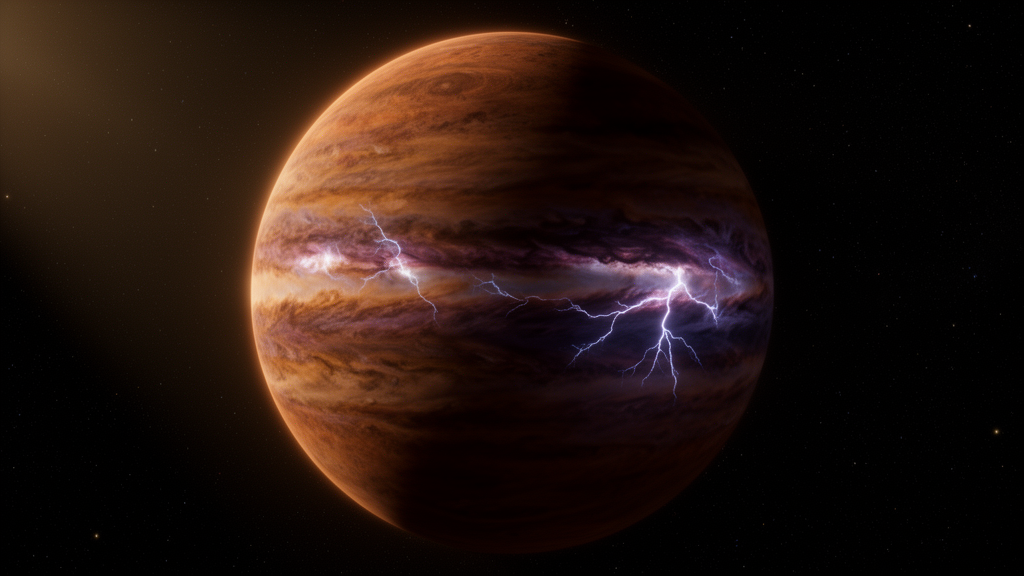
In a result that is already sending ripples through the exoplanet community, astronomers at Trinity College Dublin have worked out a way to read the weather on a world twenty light years from Earth, and what they found is strikingly orderly. The object in question, a brown dwarf known as SIMP 0136, has long fascinated researchers because it shows unmistakable signs of a dynamic, churning atmosphere, and because earlier work had even linked its variability to auroral processes reminiscent of the Northern Lights. Now, using data from NASA’s James Webb Space Telescope and a statistical technique called Principal Component Analysis, the team has shown that the vast majority of the atmospheric variability on SIMP 0136 can be traced back to just two dominant physical processes: changes in temperature and changes in the vertical structure of the object’s clouds. The research has been published in the leading journal Astronomy & Astrophysics.
Brown dwarfs occupy a curious middle ground in astrophysics. They are larger and hotter than gas-giant planets, yet they are not massive enough to sustain hydrogen fusion and shine as true stars. Because of this, they cool and fade over time, and their atmospheres become dominated by huge, fast-changing cloud systems. In many ways, SIMP 0136 is less like Earth and more like an extreme, supercharged version of Jupiter, with planet-sized weather patterns constantly reshaping what astronomers can see from afar. Unlike most exoplanets, which are hopelessly faint next to their host stars, brown dwarfs drift through space alone and can be observed directly, which makes them invaluable natural laboratories for studying the physics of giant-planet atmospheres under extreme conditions.
The technical heart of the new study lies in how the team handled the flood of information contained in the JWST observations. As SIMP 0136 rotates, the light reaching the telescope changes minutely, because different parts of the atmosphere swing into and out of view. The exceptional sensitivity of JWST’s instruments allowed the researchers to record these tiny brightness variations across the light spectrum. Rather than imposing complex assumptions about what the atmosphere should look like, the team applied Principal Component Analysis, a statistical method that simplifies complex data by identifying the main patterns that change together across many observations. In this study, the dominant patterns turned out to be linked to weather-related changes in the brown dwarf’s atmosphere, which allowed the researchers to separate genuine physical signals from smaller fluctuations and random noise in the data.
The outcome was remarkable in its simplicity. The vast majority of the atmospheric variability could be explained by only two dominant components, consistent with changes in temperature and with the vertical structure of the clouds. From these components, the researchers could identify three recurring weather states that rotate in and out of view as the object spins. The result is a patchwork atmosphere: hotter regions with thinner clouds sit alongside cooler areas where the clouds are thicker and vertically extended. Perhaps most importantly, the method allowed the researchers to identify these key physical processes directly from the data itself, rather than relying on elaborate pre-existing models of what the atmosphere ought to contain.
The new research suggests that, despite its apparent complexity, the atmosphere of SIMP 0136 behaves in a remarkably organised way rather than reorganising randomly. This is a crucial insight for anyone trying to model brown dwarf and giant exoplanet atmospheres, because it means the underlying physics is tractable. The weather drivers persist over time even as the detailed appearance of the atmosphere evolves, and the team tracked this behaviour over more than a dozen rotations of the object. In other words, the same fundamental processes keep shaping the atmosphere rotation after rotation, even as the specific cloud patterns and temperature contrasts shift and morph in the interim.
Merle Schrader, a PhD candidate in Trinity’s School of Physics and first author of the study, emphasised both the persistence of the weather drivers and the practical advantages of the target. She noted that the drivers of the weather patterns on SIMP 0136 persist over time, even as the detailed appearance of the atmosphere evolves over more than a dozen rotations. In relative terms, she explained, SIMP 0136 is one of the easier brown dwarfs from which to capture high-quality data, and the data have been studied before by established methods, allowing the team to compare results from the new technique against what is already known about the object. The technique, she said, has helped develop a better understanding of what drives the weather on this faraway world and how those weather patterns interact and co-exist, and, perhaps even more importantly, it shows how the approach can be further refined and applied to other, less well-known brown dwarfs in different parts of space.
There is also a poetic twist to the story that Schrader herself highlighted. SIMP 0136 lies about twenty light years from Earth, which means that light emitted by the object takes roughly two decades to cross the gulf of interstellar space and arrive at our telescopes. The very light that provided the data analysed in the paper, first observed by JWST in 2023, was emitted in the year Schrader was born. Light travels at around 300,000 kilometres per second, she pointed out, but even at that speed it took two decades to reach us through the JWST lenses. When one considers that light takes just over a second to reach the Moon after leaving Earth, the scale of the distance becomes vivid, and so does the scale of the achievement: discerning the intimate weather patterns of a distant world and mapping their interactions, when all that is observed directly of these objects is a single pixel spread across the light spectrum.
The implications of the work extend well beyond one peculiar object. Understanding the weather on bodies like SIMP 0136 matters because brown dwarfs offer a unique window into the physics of giant exoplanet atmospheres. Unlike most exoplanets, they can be observed directly, allowing astronomers to test ideas about cloud formation, atmospheric circulation and heat transport under conditions that no Solar System planet can match. Every insight gained from a well-studied brown dwarf feeds directly into models of the growing population of directly imaged and transiting giant planets, where clouds and temperature structure likewise dominate the observed light. The technique demonstrated here provides an efficient way to extract the dominant atmospheric components before committing to computationally intensive modelling, which is becoming essential as JWST continues to deliver ever richer datasets on faint, distant worlds.
Professor Johanna Vos, Associate Professor in Trinity’s School of Physics and senior author of the research, framed the broader significance of the result. Our findings will transform how astronomers analyse future JWST observations, she said, because the approach rapidly identifies the dominant components of the atmosphere and offers an efficient first step before computationally intensive modelling begins. Applying the technique to a wide range of brown dwarfs and giant exoplanets, she added, will help researchers better understand the diverse weather systems that shape worlds far beyond our Solar System. In effect, the method turns the analysis pipeline upside down: instead of starting with a complicated atmospheric model and testing it against the data, astronomers can now let the data reveal which physical processes matter most, and only then build the detailed models needed to interpret them fully.
There is an even more ambitious horizon beyond the brown dwarfs. One of the reasons scientists care about weather patterns on distant worlds is that atmospheric behaviour encodes information about composition, temperature and chemistry, all of which are essential steps toward identifying the kinds of worlds where life could potentially exist. Decoding the atmosphere of a planet-sized weather machine like SIMP 0136 from a single pixel of light is a demonstration of just how far observational astrophysics has come, and of how much more may be within reach. If the same statistical machinery can be refined and applied to the atmospheres of smaller and cooler worlds, the dream of reading the weather, and perhaps one day the habitability, of planets orbiting other stars moves a significant step closer. For now, SIMP 0136 stands as proof that even a lone, dim object twenty light years away can surrender its secrets when the right telescope and the right mathematics are pointed at the sky.
Subject of Research: Atmospheric variability and weather processes on the brown dwarf SIMP 0136
Article Title: Scientists discover how to decode weather on faraway, deep-space worlds
Article References: Scientists discover how to decode weather on faraway, deep-space worlds. (n.d.). Original publication
Image Credits: AI Generated
DOI: Not provided
Keywords: brown dwarf, SIMP 0136, James Webb Space Telescope, Principal Component Analysis, exoplanet atmospheres, cloud structure, astronomy, weather, Trinity College Dublin, Astronomy and Astrophysics, rotational variability, atmospheric modelling
Cite Scienmag News
Grant Pearson. (October 8, 2026). Weather patterns decoded on a brown dwarf 20 light years away. Scienmag. https://scienmag.com/weather-patterns-decoded-on-a-brown-dwarf-20-light-years-away/
Grant Pearson. "Weather patterns decoded on a brown dwarf 20 light years away." Scienmag, 8 October 2026, https://scienmag.com/weather-patterns-decoded-on-a-brown-dwarf-20-light-years-away/. Accessed 8 October 2026.
Grant Pearson. "Weather patterns decoded on a brown dwarf 20 light years away." Scienmag. October 8, 2026. https://scienmag.com/weather-patterns-decoded-on-a-brown-dwarf-20-light-years-away/


