


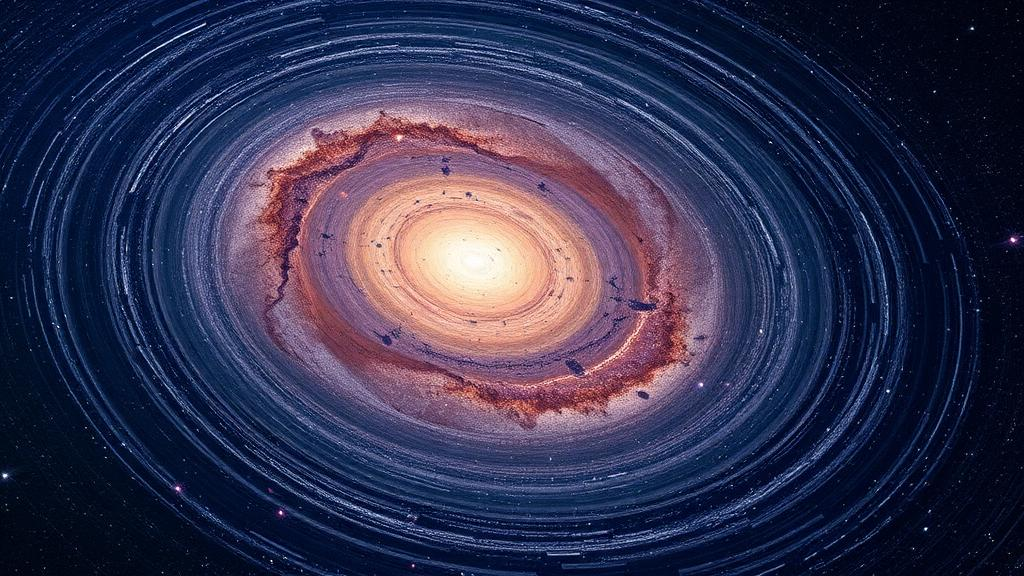
Look at the Milky Way from the side and it is not the serene, flat platter of stars that textbook images suggest. Surveys of stars and gas clouds have revealed a disk that ripples up and down, corrugated like a sheet of paper that has been gently flexed, with vertical displacements reaching 250 to 350 parsecs and alternating peaks and troughs spaced roughly 2 to 3 kiloparsecs apart. A new theoretical study by Evgeny Griv of Ben-Gurion University and Ariel University and Asher Yahalom of Ariel University, published in Astrophysics and Space Science, argues that these corrugations may not need an external bully at all. Instead, the galaxy can bend itself, through a subtle resonance between spiral bending waves and the stars that drift through the rotating disk.
The puzzle is real. Corrugations and warps have been observed in the disks of many galaxies, including systems that appear to have evolved in complete isolation, untouched by any nearby companion. That observation alone hints at an internal dynamical origin. Yet the most obvious suspects have been ruled out one by one. Classic analyses of cold, rotating disks in which every star follows a perfectly circular orbit found no fluid-like bending instability. Studies of nonrotating slabs of stars found stability as well, provided the vertical random motions of stars were not too small compared with their horizontal ones. Something more delicate must be at work.
Griv and Yahalom’s approach borrows a page from plasma physics. A galactic disk of stars, they note, behaves in many ways like a collisionless plasma: individual stars almost never collide with one another, but the whole ensemble responds collectively to gravitational perturbations, just as charged particles respond to electric fields. The authors therefore treat the disk with the same mathematical machinery used for waves in a hot plasma, solving the self-consistent pair of equations that govern the system: the Poisson equation, which links the gravitational potential to the density of stars, and the collisionless Boltzmann equation, which describes how the distribution of stellar velocities evolves under gravity. The analogy is imperfect, since gravity cannot be screened the way electric charge can and self-gravitating systems are always inhomogeneous, but the technique of splitting the problem into an unperturbed equilibrium and a small perturbation carries over cleanly.
The model they analyze is deliberately idealized. Stars are confined to a slab of finite half-thickness, roughly 200 to 300 parsecs in real galaxies, with vacuum above and below. Within the slab the density is taken as uniform, an approximation that goes back to Jan Oort’s pioneering 1932 estimate of the local mass density near the Sun. The disk rotates differentially, meaning that stars at larger radii circle the galactic center more slowly, and the stars possess random velocities in both the horizontal and vertical directions, described by a Schwarzschild distribution of Gaussian components. Into this equilibrium the authors inject small, tightly wound spiral perturbations that are antisymmetric about the midplane: the kind of bending motion in which stars above and below the plane move vertically in the same direction, tilting and rippling the disk rather than merely compressing it.
The crucial physics enters through the fine print of stellar orbits. In a rotating galaxy a star does not simply glide along a circle; it executes a small epicyclic loop around a guiding center, oscillating radially and azimuthally with a characteristic frequency. In a differentially rotating disk, the curvature of that epicycle is slightly greater on one side than on the other, so the guiding center itself drifts slowly backward relative to the main rotation. This drift, first pointed out by Bertil Lindblad in 1959 and familiar to galactic astronomers as the asymmetric drift, is tiny, but it matters enormously here. It means that a star’s oscillation frequency, as seen by a passing wave, is shifted by an amount proportional to the drift velocity, and that shift opens a channel for energy exchange between the wave and the stars.
When Griv and Yahalom solve the linearized equations, they find that ordinary, nonresonant bending waves in such a disk are stable, confirming earlier work. But at specific resonances, where the Doppler-shifted wave frequency matches a star’s epicyclic frequency plus its drift term, the situation changes. At the inner cyclotron resonance the waves remain neutral. At the outer cyclotron resonance, however, the calculation yields a positive imaginary part of the wave frequency: the waves grow. The instability is weak, a slow exponential amplification rather than an explosive one, but it is genuine and it arises even for a perfectly Maxwellian distribution of stellar velocities, with no special population of fast stars required.
The numbers that emerge are strikingly consistent with what astronomers actually see. The most unstable waves have low azimuthal mode numbers, with a single-armed or two-armed spiral pattern dominating, and their growth rate is modest, corresponding to a characteristic growth time of about a billion years, or ten to twenty rotation periods of the galaxy. The waves are vertically short, with a vertical scale set by the disk’s half-thickness of a few hundred parsecs, but radially long, with wavelengths of order ten times the disk thickness, or 2 to 3 kiloparsecs. That is precisely the geometry of the corrugations mapped in the Milky Way and in edge-on external galaxies: ripples that barely lift the disk out of plane but stretch across vast horizontal distances.
Where does the energy come from? The authors identify the free kinetic energy stored in the disk’s differential rotation as the likely reservoir. As the unstable waves grow, they extract energy from the ordered circular motion, and the growth rate vanishes if the rotation becomes rigid, with no shear, or if the perturbation becomes purely radial. Self-gravity is essential throughout, acting both vertically and horizontally to hold the wave together, and the finite thickness of the disk is a decisive ingredient, since an infinitesimally thin sheet cannot support the antisymmetric vertical structure at all. The phenomenon is a resonant cousin of the classic Jeans instability, in which gravity gathers matter into denser concentrations, but here the accumulation happens at the upper and lower edges of the disk and requires the precise phase matching between wave and star that only the drift provides.
The result speaks directly to an ongoing debate about the origin of the Milky Way’s vertical motions. The Gaia mission’s precision astrometry revealed a north-south asymmetry in the stellar disk and a spectacular phase-space spiral in the solar neighborhood, features many researchers attribute to the Sagittarius dwarf galaxy, which has punched through the Galactic disk repeatedly over billions of years. Tidal encounters and dark matter subhalos certainly can excite bending waves, and previous kinetic studies have modeled such responses. But attempts to reproduce the observed amplitude and wavelength of the Galactic corrugation with satellite-impact models have struggled, and the fact that isolated galaxies show the same ripples suggests that an internal mechanism deserves serious attention. Griv and Yahalom’s work supplies an analytic candidate: a self-excited, drift-resonant bending instability that operates with or without a dark matter halo and needs no companion at all.
The authors are careful to frame their conclusions as order-of-magnitude estimates. The analysis rests on a local, short-wavelength approximation, a homogeneous slab, and a post-epicyclic treatment of stellar orbits, and it says nothing about global modes whose wavelengths span the entire disk. Testing the mechanism will require sophisticated particle-based simulations that can resolve the microscopic resonance, as well as numerical solutions of the Vlasov equation, a nearly unexplored regime in galactic dynamics. If the drift-resonant instability survives those tests, it would mean that the gentle undulations rippling across our Galaxy are not scars of ancient collisions but the Galaxy’s own music, played by stars and waves trading energy in a rotating, self-gravitating disk.
Subject of Research: Self-excitation of spiral bending waves in a rotating, finite-thickness galactic stellar disk via wave-star resonances
Article Title: Generation of spiral bending waves in a rotating galactic stellar disk of finite thickness
Article References: Griv, E., & Yahalom, A. (2026). Generation of spiral bending waves in a rotating galactic stellar disk of finite thickness. Astrophysics and Space Science, 371(10), Article 118. https://doi.org/10.1007/s10509-026-04651-8
Image Credits: AI Generated
DOI: 10.1007/s10509-026-04651-8
Keywords: galactic dynamics, bending waves, corrugations, stellar disks, disk instability, wave-star resonance, Milky Way, density waves, collisionless Boltzmann equation, asymmetric drift, self-gravity, galactic structure
Cite Scienmag News
Grant Pearson. (October 8, 2026). Ripples in the Milky Way: How a Galaxy’s Own Rotation Can Bend Its Disk. Scienmag. https://scienmag.com/ripples-in-the-milky-way-how-a-galaxys-own-rotation-can-bend-its-disk/
Grant Pearson. "Ripples in the Milky Way: How a Galaxy’s Own Rotation Can Bend Its Disk." Scienmag, 8 October 2026, https://scienmag.com/ripples-in-the-milky-way-how-a-galaxys-own-rotation-can-bend-its-disk/. Accessed 8 October 2026.
Grant Pearson. "Ripples in the Milky Way: How a Galaxy’s Own Rotation Can Bend Its Disk." Scienmag. October 8, 2026. https://scienmag.com/ripples-in-the-milky-way-how-a-galaxys-own-rotation-can-bend-its-disk/


