


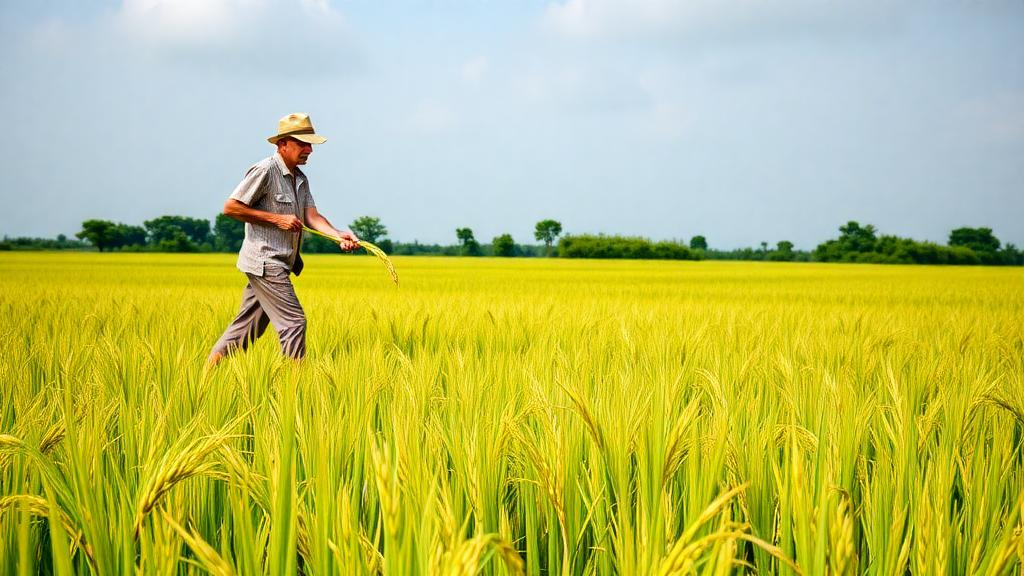
Rice feeds nearly half of humanity, but every harvest leaves behind a mountain of straw—somewhere between 800 million and 1 billion tonnes each year. Farmers have long faced a dilemma: plow that straw back into the paddy to feed the soil, or remove it to avoid supercharging greenhouse gas emissions. A new study published in the journal SOIL suggests the answer is neither extreme but a carefully calibrated middle ground. Incorporating just half of the harvested straw, researchers found, measurably improved soil fertility while adding only about 3 percent to the global warming potential of the paddy—a negligible rise compared with the dramatic increases triggered by heavier applications.
The research team, led by Mengxue Zhang and Rong Sheng of the Institute of Subtropical Agriculture at the Chinese Academy of Sciences, built their experiment on a five-year field trial at the Taoyuan Agroecosystem Research Station in Hunan Province. There, plots had received straw at rates corresponding to 0, 50, 100, and 150 percent of the local rice straw yield. To isolate the biological mechanisms from the noise of weather and field variability, the scientists brought soil from each plot into the laboratory and ran controlled microcosm incubations lasting 91 days, with a 28-day flooded period followed by 63 days of drying—mirroring the wet-dry rhythm of a real rice season.
The fertility results were unambiguous. Five years of straw return had left its signature on the soil: bulk density fell, while cation exchange capacity, total carbon, total nitrogen, available nitrogen, available phosphorus, and available potassium all climbed with increasing straw rates. Even the lowest input, the half-rate treatment, cut bulk density by nearly 3 percent and lifted available potassium by more than 38 percent, available phosphorus by about 15 percent, and available nitrogen by nearly 7 percent relative to the no-straw control. Micronutrients such as manganese, copper, and zinc also rose. In short, the soil was demonstrably better at holding water, nutrients, and cations—the hallmarks of fertility.
But the greenhouse gas picture told a sharply different story depending on dose. Carbon dioxide fluxes rose in proportion to the straw input, with the half-rate treatment emitting 66 percent more CO2 than the control and the full and 150-percent rates reaching 2.2 and 2.5 times the control level. Methane, the more potent concern, was even more dose-sensitive: cumulative emissions from the half-rate treatment stayed low at 4.41 grams per square meter, while the full-rate and 150-percent treatments belched out roughly 23 and 38 grams per square meter—four and eight times higher, respectively. When the researchers converted all three gases into a single global warming potential metric using the latest 100-year conversion factors, the half-rate treatment showed only a 3 percent, statistically insignificant increase over the control, whereas the higher rates inflated the warming potential by up to 151 percent.
The key to this asymmetry lay in nitrous oxide, a greenhouse gas nearly 273 times more powerful than CO2 over a century. Counterintuitively, the half-rate treatment emitted significantly less N2O than the unfertilized-with-straw control—just 1.63 grams per square meter. The explanation emerged from the microbial genes the team quantified. N2O is produced by denitrifiers carrying the nirS and nirK genes and consumed by microbes carrying nosZ-type genes encoding N2O reductase. The half-rate soil harbored the highest abundance of the nosZII clade and the lowest nirS-to-nosZII ratio of any treatment, around 0.81 compared with 1.11 to 1.36 elsewhere. That combination—modest production capacity paired with maximal consumption capacity—meant the soil was effectively eating its own N2O before it could escape.
The timing of emissions added further nuance. Two distinct N2O peaks appeared during the incubation: one about 11 days after fertilization under flooded conditions, and another during the late drying phase. At the first peak, the control plot emitted the most N2O, likely because urea nitrogen sat available for nitrifiers and denitrifiers, while in straw-amended soils proliferating microbes competed fiercely for that same nitrogen. At the second peak, during drying, the order reversed as oxygen penetrated the profile and organic matter mineralization released fresh nitrogen. Yet even here, the half-rate soil kept its N2O fluxes as low as the control’s, thanks to its superior N2O-reducing community.
Methane told its own mechanistic tale. Methanogens, flagged by the mcrA gene, multiplied in proportion to straw input, with average abundances during the flux period rising 32 percent at the half rate and 129 percent at the highest rate. But production alone does not determine emissions—consumption by methanotrophs carrying the pmoA gene matters just as much. The researchers identified a critical threshold: a soil methane holding capacity of roughly 190 millimoles per mole under anaerobic conditions. Below that ceiling, retained methane could be oxidized in place; above it, the excess escaped to the atmosphere. The half-rate treatment’s soil methane concentrations fluctuated right around 200 millimoles per mole, hovering at the edge, while the higher rates blew well past the capacity. Meanwhile, the half-rate soil boasted methanotroph abundances about 81 percent higher than the control, giving it the oxidative muscle to mop up most of what its methanogens produced.
The broader significance of these findings is considerable. Rice cultivation accounts for roughly 12 percent of global agricultural greenhouse gas emissions, and straw incorporation has been identified as one of the key drivers, with reported methane increases in prior studies ranging from 23 percent to a staggering 1,192 percent. By demonstrating that the dose of straw—not merely its presence—governs the climate outcome, the study offers farmers and policymakers a concrete, actionable target: return about half the harvest. Previous work had hinted at this, showing that half-rate incorporation cut methane emissions by 48 percent relative to full incorporation, but the new research goes further by tying the climate benefit to specific microbial mechanisms and by simultaneously confirming that fertility gains are preserved.
The study also resolves a long-standing controversy in the literature. Reports on how straw affects N2O emissions have swung wildly, from 73 percent reductions to 137 percent increases, and the abundances of N2O-related genes have been reported to rise, fall, or remain unchanged. The Hunan results suggest that much of this inconsistency may stem from differing straw application rates across studies, which shift the balance between N2O-producing nirS communities and N2O-consuming nosZII communities in opposite directions. Similarly, conflicting findings on methanotroph responses—some studies found no change in pmoA abundance, others increases of up to 59 percent—may reflect the same dose dependence.
The authors caution that their conclusions come from a single soil type, an acidic Ultisol derived from quaternary red clay under a subtropical monsoon climate. Different soils possess different methane holding capacities and nitrogen transformation dynamics, so field tests across diverse soil types remain necessary before the half-rate prescription can be generalized worldwide. Still, the core message stands as a rare piece of good news in agricultural climate science: with the right amount of straw, rice paddies can grow more fertile without growing warmer, turning an agricultural waste problem into a climate-smart resource.
Subject of Research: Optimal rice straw incorporation rates for balancing paddy soil fertility and greenhouse gas emissions
Article Title: Mechanisms of enhancing soil fertility without obviously elevating global warming potential under an optimal rice straw incorporation rate in a paddy soil
Article References: Zhang, M., Liao, R., Zhang, W., Fang, C., Guerrero-Cruz, S., Táncsics, A., Zhu, B., Wei, W., & Sheng, R. (2026). Mechanisms of enhancing soil fertility without obviously elevating global warming potential under an optimal rice straw incorporation rate in a paddy soil. SOIL, 12(2), 871-883. https://doi.org/10.5194/soil-12-871-2026
Image Credits: AI Generated
Keywords: rice straw, paddy soil, soil fertility, greenhouse gases, methane, nitrous oxide, methanotrophs, denitrification, global warming potential, climate-smart agriculture, soil microbiology, sustainable farming
Cite Scienmag News
Alan Morgan. (October 8, 2026). Half the Straw, Full Fertility: The Sweet Spot for Climate-Smart Rice Farming. Scienmag. https://scienmag.com/half-the-straw-full-fertility-the-sweet-spot-for-climate-smart-rice-farming/
Alan Morgan. "Half the Straw, Full Fertility: The Sweet Spot for Climate-Smart Rice Farming." Scienmag, 8 October 2026, https://scienmag.com/half-the-straw-full-fertility-the-sweet-spot-for-climate-smart-rice-farming/. Accessed 8 October 2026.
Alan Morgan. "Half the Straw, Full Fertility: The Sweet Spot for Climate-Smart Rice Farming." Scienmag. October 8, 2026. https://scienmag.com/half-the-straw-full-fertility-the-sweet-spot-for-climate-smart-rice-farming/


