


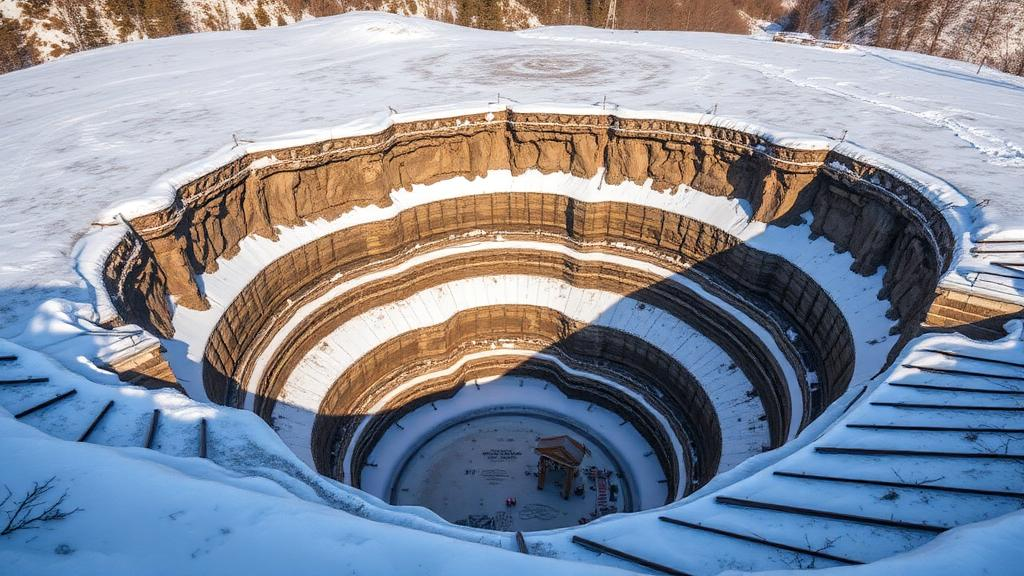
Beneath the quiet Bavarian countryside south of Munich, buried deep below layers of gravel and glacial debris, scientists have recovered one of the rarest time capsules in European Quaternary science: a nearly complete sedimentary record from Marine Isotope Stage 8, a glacial period roughly 300,000 years ago that researchers have long called a “missing glaciation.” A new study published in E&G Quaternary Science Journal describes how a 198.8-meter drill core from an overdeepened basin near Schäftlarn, combined with a famous outcrop known as the Münchner Klettergarten near Baierbrunn, has forced a dramatic rethinking of when some of the most prominent landscapes of the Alpine foreland actually formed.
Glacially overdeepened basins are among the most powerful sediment traps in the geological record. Carved by a combination of glacial abrasion and pressurized, sediment-laden meltwater flowing beneath the ice, these structures erode far below the normal fluvial base level of a drainage system. Once the glacier retreats, the basin begins to fill, preserving nested sequences of glacial, glaciolacustrine and glaciofluvial deposits that can span multiple glacial cycles. Because such basins act as archives of Pleistocene glaciation history, the international ICDP-DOVE project, short for Drilling Overdeepened Alpine Valleys, has been systematically drilling and surveying these structures along the northern edge of the Alps to quantify the age, extent and environmental impact of past Alpine glaciations.
The Schäftlarn core, retrieved in 2017 by the Bavarian Environment Agency as part of this effort, sits within the former ablation area of the Isar-Loisach paleo-glacier, roughly one kilometer south of the ice-marginal position of the Last Glacial Maximum. The core revealed a striking three-part structure: about 83 meters of fine-grained silt and clay at the base, roughly 111 meters of coarse gravel-dominated deposits above, and a thin cap of diamictic sediments at the top. The carbonate content of the fine-grained lower unit remained remarkably constant throughout, indicating a stable catchment area dominated by Molasse bedrock and the Northern Calcareous Alps, with no evidence of a major glacial transgression from the Inn Valley into the foreland during deposition.
Dating this sequence was the central challenge, and the research team led by Gustav Firla of the University of Natural Resources and Life Sciences Vienna turned to single-grain feldspar luminescence dating, a technique that uses mineral grains as natural dosimeters to determine when sediment was last exposed to sunlight. Water-lain glacial sediments are notoriously difficult to date this way because grains are often transported in turbid meltwater and never fully reset their luminescence signal. By measuring individual grains of potassium-rich feldspar rather than bulk aliquots, the team could isolate the small, well-bleached population of grains that faithfully recorded the moment of deposition, applying a post-IR IRSL protocol and a bootstrapped Minimum Age Model to handle the complex, right-skewed dose distributions typical of poorly bleached glacial deposits.
The results were unambiguous and, in places, startling. Five samples from the base of the core clustered at 294,000 years, plus or minus 11,000 years, placing the start of basin infilling in early Marine Isotope Stage 8. A second cluster of samples from sand layers within the overlying gravel unit dated to late MIS 8, around 247,000 years ago. This means the entire lower half of the basin, from quiet glaciolacustrine silts to the first pulse of coarse glaciofluvial gravel, was deposited within a single glacial cycle that most researchers had assumed left almost no terrestrial trace in this region. Hughes and colleagues had previously termed MIS 8 a “missing glaciation” because it was part of a comparatively weak glacial-interglacial cycle, and known deposits from this interval are vanishingly rare in Europe, with only the Meikirch record in northern Switzerland previously documented in the Northern Alpine Foreland.
The team also investigated the Münchner Klettergarten outcrop near Baierbrunn, a celebrated exposure of glaciofluvial gravels on the southern margin of the Munich gravel plain that was first described by Penck and Brückner in 1909 as a classic example of their glacial series model. The lower sections of the outcrop had long been attributed to the Donau or Günz glaciations, which Bavarian stratigraphy places before MIS 12, making them potentially well over 450,000 years old. The new luminescence ages tell a very different story: the basal gravels date to late MIS 8, matching the coarse-grained deposits in the Schäftlarn core, while overlying sediments date to MIS 6, the penultimate glaciation. The long-assumed great antiquity of these deposits simply does not hold.
Corroborating evidence came from an unexpected direction. Gravel petrographic analysis of the Schäftlarn core showed a sharp shift in clast composition, with crystalline content rising from less than one percent at the base to nearly six percent higher up, and the limestone-to-dolomite ratio changing in parallel. The upper samples match the signature of last glacial deposits in the Wolfratshausen region almost exactly, suggesting the top of the gravel unit is far younger than the MIS 8 base. Even more remarkably, the sediments displayed unusually low potassium-40 and thorium-232 activities, verified by independent gamma spectrometry at two laboratories and by downhole spectral gamma logging, and this distinctive geochemical fingerprint allowed the team to correlate the Schäftlarn gravels directly with the Baierbrunn outcrop.
Reflection seismic surveys conducted in autumn 2023 added a crucial third dimension. Three profiles, using both P-wave and SH-wave configurations, revealed not one but two cross-cutting glacial basins beneath the site. The drill core was recovered from the older basin, the one filled during MIS 8, while a younger basin of undetermined age cuts directly through it. Based on comparison with other dated overdeepenings across the Alpine foreland, which consistently show fine-grained MIS 6 infills, the researchers tentatively attribute the younger basin to the penultimate glaciation. The seismic data also show that the younger glacial advance excavated parts of the older MIS 8 sediments and the underlying Molasse bedrock, then filled its own basin with a similar sedimentary succession.
Not every dating method cooperated. Cosmogenic nuclide burial dating of quartz cobbles from the outcrop produced beryllium-10 and aluminum-26 concentrations so low, and with aluminum-26 to beryllium-10 ratios between 0.7 and 4.5, that they could not be converted into reliable depositional ages. Instead, the team interpreted these signals as evidence that the cobbles were last exposed at the surface in the Pliocene or earlier, buried deeply for a prolonged period, and then rapidly redeposited by high-discharge proglacial processes, a reminder of how violently glacial systems can recycle sediment. A palynological screening of the fine-grained basin sediments likewise yielded mostly reworked Neogene and Early Pleistocene palynomorphs, preventing any reconstruction of the vegetation cover during MIS 8.
The broader implications reach to the foundations of Alpine Quaternary stratigraphy. The fourfold division of the Baierbrunn outcrop can no longer be mapped onto the four classical glaciations of Penck and Brückner; instead, it most likely records different stages of just the last two glacial cycles, with MIS 8 deposits at the base, MIS 6 deposits above a weathering horizon, and last glacial sediments on top. This reinforces the idea that the Munich gravel plain, an apparent exception to the terrace stratigraphy of the Bavarian foreland, follows a normal geological sequence but is significantly younger than previously expected. Together, the Schäftlarn core, the Baierbrunn outcrop and the seismic surveys provide the first steps in a re-evaluation of the established depositional chronology of the Bavarian Alpine foreland, and they demonstrate that even a glaciation once considered missing has left its signature, waiting patiently in the dark beneath the gravel plains of Munich.
Subject of Research: Luminescence dating of a glacially overdeepened basin fill from Marine Isotope Stage 8 in the northern Alpine foreland
Article Title: An MIS 8 terrestrial record retrieved from a glacially overdeepened basin in the northern foreland of the European Alps
Article References: An MIS 8 terrestrial record retrieved from a glacially overdeepened basin in the northern foreland of the European Alps. (n.d.). https://doi.org/10.5194/egqsj-75-85-2026
Image Credits: AI Generated
Keywords: MIS 8, glacial overdeepening, luminescence dating, Alpine foreland, Quaternary stratigraphy, ICDP-DOVE, Isar-Loisach glacier, Bavaria, Pleistocene glaciations, Schäftlarn core, Baierbrunn outcrop, reflection seismics
Cite Scienmag News
Violet Maxwell. (October 8, 2026). Buried Alpine basin reveals a rare 300,000-year-old glacial archive beneath Munich. Scienmag. https://scienmag.com/buried-alpine-basin-reveals-a-rare-300000-year-old-glacial-archive-beneath-munich/
Violet Maxwell. "Buried Alpine basin reveals a rare 300,000-year-old glacial archive beneath Munich." Scienmag, 8 October 2026, https://scienmag.com/buried-alpine-basin-reveals-a-rare-300000-year-old-glacial-archive-beneath-munich/. Accessed 8 October 2026.
Violet Maxwell. "Buried Alpine basin reveals a rare 300,000-year-old glacial archive beneath Munich." Scienmag. October 8, 2026. https://scienmag.com/buried-alpine-basin-reveals-a-rare-300000-year-old-glacial-archive-beneath-munich/


