


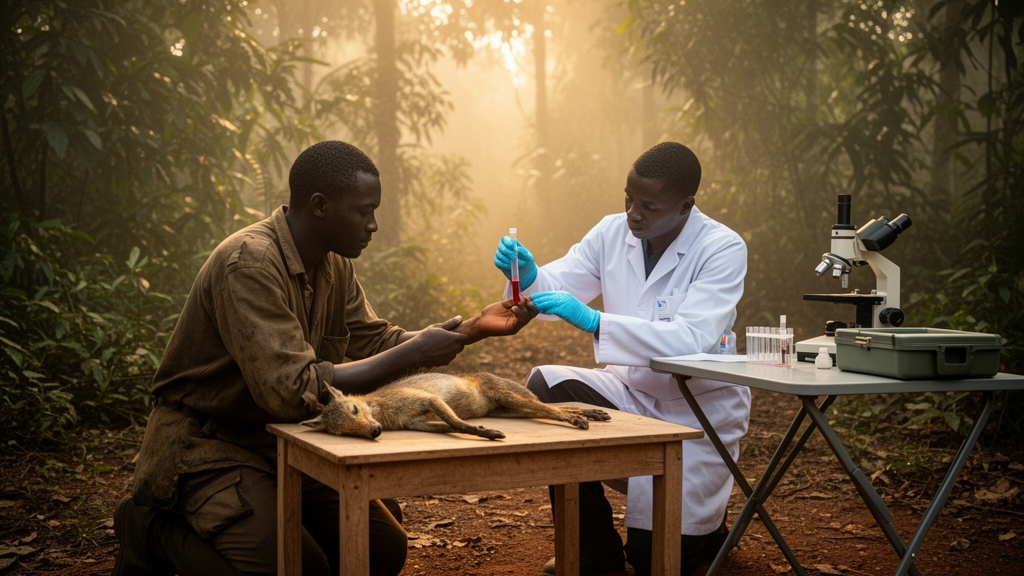
In the forested interior of Guinea, the region that gave rise to the index case of the 2013–16 West African Ebola epidemic, a six-year study of wildlife hunting communities has uncovered molecular fingerprints suggesting that filoviruses are not historical curiosities but active, recurring visitors to the human population. Researchers screened more than 1,100 serum samples collected in 2017 and again in 2023 from hunters and their household contacts across dozens of villages in the Macenta prefecture, using a multiplex microsphere-based immunoassay capable of detecting immunoglobulin G antibodies against the glycoproteins of nine distinct filoviruses. The results, published in Nature Communications, reveal binding antibodies against Ebola virus in 4.9 percent of participants, alongside species-specific reactivity against Bundibugyo, Taï Forest, Reston, Měnglà, Lloviu and Bombali viruses — a pattern the authors interpret as evidence of multiple, previously underreported zoonotic spillover events occurring in these communities.
The study population was deliberately targeted at one of the highest-risk human–animal interfaces in West Africa. Villages were purposively sampled to include 16 communities affected and 28 unaffected by the 2013–16 epidemic, with designations confirmed through national health databases and key informant interviews with village leaders and healthcare workers. Within each village, families known to practice wildlife hunting were approached, and the senior hunter together with a spouse or closest relative was invited to participate. In total, 511 participants were enrolled from 40 villages in 2017 and 648 from 43 villages in 2023, with just over half of the original cohort successfully resampled six years later. Wildlife hunters, all male, made up 56 percent of the study population, while the remainder reported close household contact with a hunter. Farming was the dominant occupation, and questionnaires administered in French and the local Toma language captured detailed behavioral data on hunting, butchering and consumption of wild animals.
Those behavioral data underscore how pervasive wildlife exposure is in this setting. Ninety percent of respondents in 2023 reported consuming bushmeat, and 94 percent helped handle, wash or prepare wildlife carcasses before cooking. Wildlife was consumed a median of seven days per month, and hunters pursued game a median of six days per month, with hunting generally practiced year-round. Agouti was the most frequently reported food animal, followed by rodents, antelope, boar, monkeys, pangolins and bats. Bat exposure stood out as distinctly seasonal, concentrated at the start of the dry season, and bat hunting was a specialized activity involving roughly a third of households. Contact with bats was otherwise frequent and often peridomestic, occurring around the village or inside houses two to three days per week, while cave visits were short and infrequent and guano harvesting was almost entirely absent.
Serologically, the team faced a classic analytical challenge: antibodies against one ebolavirus frequently cross-react with related species, making it difficult to distinguish genuine exposure to a specific virus from heterotypic cross-reactivity. To address this, the researchers applied an unsupervised machine-learning approach, using K-means clustering to partition individual antibody response profiles across all nine glycoprotein antigens into fifteen distinct clusters. Rather than imposing a binary seropositivity threshold for each virus — a strategy prone to misclassifying cross-reactive individuals — the clustering identified groups of people sharing similar exposure signatures. Three clusters comprising 57 individuals showed high anti-EBOV binding with cross-reactivity that declined with phylogenetic distance, a pattern consistent with prior Ebola virus exposure and closely matching profiles documented in PCR-confirmed survivors. Other clusters displayed more restricted, species-specific binding: 49 individuals against Bundibugyo virus, 13 against Taï Forest virus, and smaller groups against Reston, Měnglà and Lloviu viruses, plus a single individual reactive to Bombali virus.
To move beyond binding antibodies and assess functional immunity, the team subjected individuals from these species-specific clusters to parallel pseudotyped virus neutralization assays, in which lentiviral particles bearing filovirus glycoproteins are tested for their ability to infect cells in the presence of serially diluted serum. Among ten individuals from the Bundibugyo cluster, five showed stronger neutralization of BDBV than of Ebola virus Makona, and all five came from two villages that reported no Ebola cases during the 2013–16 epidemic. Two were marital partners from the same unaffected village, and persistent responses were documented in individuals resampled in 2023. Similarly, five of eight individuals from the Taï Forest cluster neutralized TAFV more strongly than EBOV. The convergence of binding specificity, neutralization patterns, household clustering and village-level geography led the authors to conclude that these signatures most plausibly reflect genuine exposure to viruses antigenically closer to BDBV and TAFV than to Ebola virus itself.
The spatial dimension of the findings strengthened this interpretation considerably. Village-level aggregation of antibody responses revealed marked heterogeneity, with one village — designated Village 4 and confirmed by both Ministry of Health records and informant interviews to be unaffected by the 2013–16 epidemic — showing significantly elevated mean BDBV responses in both 2017 and 2023. Some of the strongest BDBV-neutralizing individuals lived within the same household in that village. Epidemiological modeling added a behavioral correlate: consumption of nonhuman primates was associated with roughly five-fold higher odds of BDBV-cluster seropositivity in multivariable analysis, echoing the 2012 Bundibugyo outbreak in the Democratic Republic of the Congo, in which many patients reported contact with bushmeat. The geographic proximity of the Taï Forest findings to Côte d’Ivoire, site of the only documented human TAFV case following a chimpanzee necropsy, further bolstered the plausibility of local spillover.
The study also yielded a striking estimate of antibody durability. Among eleven individuals seropositive for EBOV in 2017 who were resampled in 2023, exponential decay models fitted to individual IgG trajectories produced a population-level antibody half-life of approximately 7.5 years, demonstrating that anti-EBOV antibodies persist at detectable levels a decade after the West African epidemic began. The authors caution that re-infection with subsequent antibody boosting cannot be excluded, particularly given evidence that Ebola virus circulated in the region before 2013 and that new exposures may continue. Nevertheless, the durability finding aligns with longitudinal cohort studies of Ebola survivors and has implications for serosurveillance strategies, since long-lived antibodies extend the window during which past spillover events can be detected retrospectively.
Perhaps the most novel contribution lies in the integration of satellite-derived land-cover data with the serological results. The team extracted metrics of tree cover, cropland, built area and forest fragmentation — including shape index, perimeter-area ratio and fractal dimension — at radial distances from 500 meters to 10 kilometers around each village centroid, then fitted mixed-effects logistic regression models with sampling year as a random effect. The landscape associations differed by virus in ways that hint at distinct transmission pathways. EBOV reactivity was negatively associated with tree coverage, consistent with a signature dominated by past human-to-human transmission rather than fresh zoonotic events. BDBV seroreactivity, by contrast, was positively associated with forest fragmentation within 500 meters of villages and with living in built-up areas, suggesting risk from encroachment at the forest edge. Reactivity to TAFV, LLOV and MLAV was associated with proximity to larger patches of intact forest five to ten kilometers away, a pattern the authors link to hunting deep within the forest rather than peridomestic exposure.
These environmental findings carry direct implications for prevention. If forest configuration genuinely shapes spillover risk, then conservation and landscape management could function as ecological countermeasures, protecting communities by reducing the frequency and intensity of contact between people and reservoir or amplifier hosts. The evidence base for bats as filovirus reservoirs continues to grow — Marburg and Ravn viruses have been isolated from Egyptian rousette bats, Bombali virus genomes have been recovered from free-tailed bats in neighboring Sierra Leone and from bats in Guinea, Kenya and Mozambique, and Lloviu virus has been repeatedly isolated from Schreiber’s bats in Europe — while nonhuman primates and duikers serve as susceptible intermediate or amplifier hosts. Experimental work suggesting that minimal mutations in the Bombali virus receptor-binding domain could enhance entry into human cells adds a note of caution about the spillover potential of viruses whose human pathogenicity remains unknown.
The authors are candid about the limitations inherent in serological surveillance of this kind. Targeted sampling of hunting households limits generalizability to the wider population; ubiquitous bushmeat exposure confounds species-specific risk analyses; children were excluded, leaving early-life exposure unexamined despite documented hunting practices among children elsewhere in Guinea; and historical village classifications of Ebola-affected status are vulnerable to underreporting driven by stigma and limited healthcare access, in a region with an estimated 0.2 physicians per 10,000 people. Cross-reactivity and the possibility of infection with as-yet unidentified, antigenically related filoviruses complicate interpretation, and pseudotyped assays, while necessary for biosafety, imperfectly recapitulate authentic virus neutralization. Yet the convergence of multiple independent lines of evidence — species-specific binding, differential neutralization, household and village clustering, behavioral risk factors and landscape associations — makes a compelling case that zoonotic filovirus spillover is ongoing in forested Guinea. The study’s authors argue that expanding surveillance in high-risk populations, strengthening decentralized local diagnostic capacity, and safeguarding ecosystems from further deforestation and fragmentation together offer the most promising path to intercepting the next outbreak at its source.
Subject of Research: Serological surveillance of zoonotic filovirus exposure and its environmental risk factors among wildlife hunting communities in forested Guinea
Article Title: Filovirus reactive antibodies in wildlife hunting communities suggest ongoing zoonotic spillover in forested Guinea
Article References: Hood, G., Akoi Bore, J., Tipton, T., Onivogui, Z., Sovogui, K., Zoumanigui, K. Z., Timothy, J., Roe, M., Yan, L., Scott, S., Temperton, N., Wright, E., Hughes, G., Boumbaly, S., Laing, E. D., Magassouba, N., Fornace, K., & Carroll, M. (2026). Filovirus reactive antibodies in wildlife hunting communities suggest ongoing zoonotic spillover in forested Guinea. Nature Communications, 17(1), Article 9974. https://doi.org/10.1038/s41467-026-77653-3
Image Credits: AI Generated
DOI: 10.1038/s41467-026-77653-3
Keywords: filoviruses, Ebola virus, Bundibugyo virus, Taï Forest virus, zoonotic spillover, serosurveillance, wildlife hunting, bushmeat, forest fragmentation, Guinea, bats, land-use change
Cite Scienmag News
Margaret Porter. (October 8, 2026). Antibody Signatures in Guinean Hunters Point to Silent, Ongoing Filovirus Spillover from Wildlife. Scienmag. https://scienmag.com/antibody-signatures-in-guinean-hunters-point-to-silent-ongoing-filovirus-spillover-from-wildlife/
Margaret Porter. "Antibody Signatures in Guinean Hunters Point to Silent, Ongoing Filovirus Spillover from Wildlife." Scienmag, 8 October 2026, https://scienmag.com/antibody-signatures-in-guinean-hunters-point-to-silent-ongoing-filovirus-spillover-from-wildlife/. Accessed 8 October 2026.
Margaret Porter. "Antibody Signatures in Guinean Hunters Point to Silent, Ongoing Filovirus Spillover from Wildlife." Scienmag. October 8, 2026. https://scienmag.com/antibody-signatures-in-guinean-hunters-point-to-silent-ongoing-filovirus-spillover-from-wildlife/


