


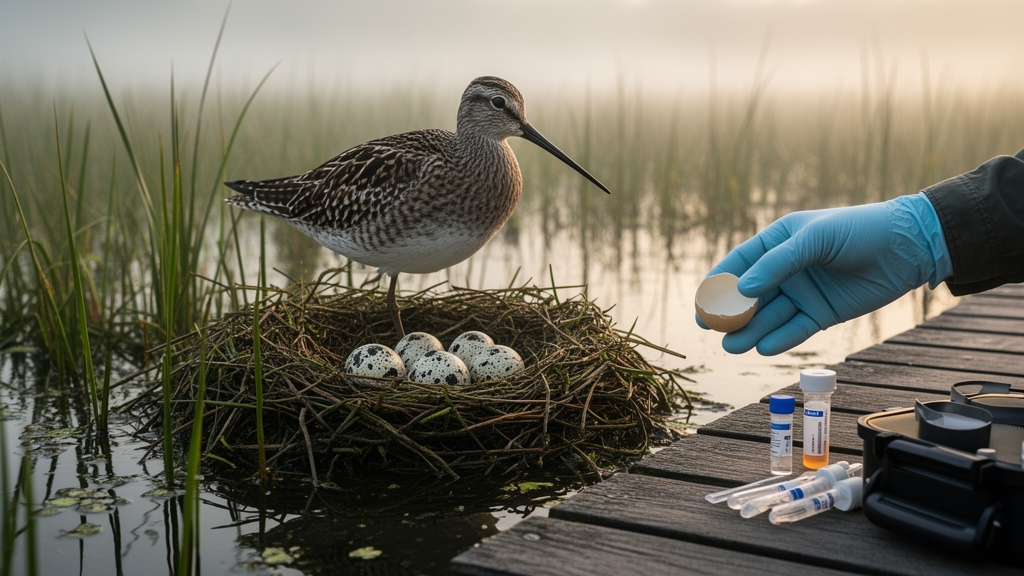
Discarded eggshells, usually little more than debris left behind after chicks hatch, have turned out to be one of the most revealing records of industrial pollution in a threatened Iranian wetland. A new study of Gandoman Wetland, a Ramsar-listed site of international importance in western Iran, shows that lead and cadmium concentrations in the eggshells of three waterbird species exceed established hazard thresholds by wide margins, and that the amount of metal locked into each shell tracks the position a bird occupies in the wetland’s food web. The research, published in Environmental Monitoring and Assessment, offers a non-invasive window into contamination that would otherwise require sacrificing adult birds or eggs to measure.
The study was carried out during the 2023 breeding season by Mohammadreza Ahmadi, Rasool Zamani-Ahmadmahmoodi, Seyed Mehdi Amininasab and Atefeh Chamani, researchers affiliated with Shahrekord University, Sari Agricultural Sciences and Natural Resources University and Islamic Azad University. The team deliberately selected three species with distinct ecological roles: the common tern (Sterna hirundo), a fish-eating predator near the top of the aquatic food chain; the black-necked grebe (Podiceps nigricollis), an intermediate feeder on invertebrates and small fish; and the Eurasian coot (Fulica atra), a largely herbivorous omnivore feeding low on the chain. By comparing metal burdens across this trophic gradient, the researchers could test whether contamination accumulates as it moves upward through the ecosystem, a pattern known as biomagnification.
Eggshells are an unusually convenient biomonitor. As the shell mineralizes inside the female, calcium is drawn from her body and deposited as calcium carbonate, and any lead circulating in her blood can hitch a ride on that process. The mechanism behind this is ionic mimicry: the lead ion Pb2+ is close enough in size and charge to the calcium ion Ca2+ that the biological machinery building the shell cannot reliably tell them apart, so lead substitutes for calcium in the crystal lattice. Cadmium, by contrast, enters the egg through different physiological routes and is generally present at lower levels. Because shells are abandoned naturally after hatching, sampling them leaves breeding colonies undisturbed, a major advantage over studies that require tissue collection from live or dead birds.
Metal concentrations in the collected shells were quantified with an Agilent 240FS AA atomic absorption spectrometer, a workhorse analytical instrument that atomizes a digested sample and measures how much light of a characteristic wavelength each metal absorbs. The results were stark. Lead concentrations exceeded cadmium in every species examined, and mean values for both metals surpassed widely used hazard thresholds of 4 milligrams per kilogram for lead and 2 milligrams per kilogram for cadmium. In other words, every one of the three species is carrying shell metal burdens associated in the ecotoxicological literature with potential reproductive and developmental harm.
The trophic pattern was unmistakable. The common tern, the high-trophic-level piscivore, showed the highest mean concentrations by a large margin: 424.29 milligrams of lead per kilogram of shell material and 23.39 milligrams of cadmium per kilogram. The black-necked grebe recorded intermediate values of 174.60 milligrams per kilogram for lead and 1.75 milligrams per kilogram for cadmium, while the low-trophic Eurasian coot carried 44.58 milligrams of lead and 2.38 milligrams of cadmium per kilogram. The tern’s lead burden was nearly ten times that of the coot, a difference consistent with the idea that predatory fish-eaters integrate contamination from every link below them in the food web. Each step up the chain concentrates the pollutant further, so a tern eating contaminated fish effectively eats the accumulated exposure of the smaller organisms those fish consumed.
Statistical analysis backed up the visual pattern. A one-way analysis of variance confirmed that the differences among species were significant at the conventional P < 0.05 threshold, supporting the trophic-level hypothesis of bioaccumulation in this system. Interestingly, Pearson correlation analysis found no significant relationship between lead and cadmium concentrations across samples. That statistical independence matters, because it suggests the two metals are not arriving from a single shared source. The authors point to likely distinct origins: industrial effluents for lead, and agricultural runoff for cadmium, which is a common contaminant of phosphate fertilizers and can wash from farmland into wetlands during irrigation and rainfall.
Gandoman Wetland sits in Iran’s Chaharmahal and Bakhtiari province and is recognized under the Ramsar Convention as a wetland of international importance, valued for its bird diversity and its role as a stopover and breeding site for waterbirds. Previous work has already documented heavy metal contamination in its sediments, and recent studies have flagged climate-driven vegetation change and other pressures on the wetland’s bird populations. The new eggshell data add a biological dimension to that picture, showing that contamination is not merely present in the substrate but is actively moving through the food web into the reproductive tissues of the birds themselves, with the potential to affect hatching success and chick development.
The concentrations reported are striking by any comparative standard. Lead levels in the tern shells, at over 400 milligrams per kilogram, are orders of magnitude above the 4 milligram per kilogram hazard threshold cited in the study, and even the coot, the cleanest of the three, exceeded both the lead and cadmium benchmarks. Eggshell metal burdens reflect the maternal body burden during egg formation, so these figures indicate that female birds at Gandoman are carrying substantial internal loads of lead and cadmium during the breeding season. Chronic lead exposure in birds is associated with neurological impairment, anemia and reduced reproductive output, while cadmium accumulates in the kidney and can disrupt calcium metabolism and eggshell quality, creating a feedback loop in which contamination may itself weaken the shell’s structure.
The non-invasive eggshell approach has grown into a respected tool in ecotoxicology, with studies of herons, egrets, gulls, cranes, terns and even flamingos using shell residues to trace environmental metal pollution across Europe, Asia and the Americas. What the Gandoman study adds is a clean demonstration of trophic structure within a single wetland, using three co-occurring species that share the same water but occupy different feeding niches. Because the three species forage at different levels, their shells function like a set of nested barometers, each reading the contamination of its own slice of the food web. The strong species-level differences, and the divergence between lead and cadmium, give managers a way to distinguish pollution pathways rather than just measuring a generic toxic load.
The authors describe Gandoman as a high-risk environment and argue that stringent pollution control is urgently needed to protect its wetland-dependent birds. Practically, that means addressing the two suspected sources separately: controlling industrial discharges that carry lead into the watershed, and managing agricultural runoff that delivers cadmium from surrounding farmland. The study also underscores the value of continued eggshell monitoring as a low-cost, repeatable surveillance method that can track whether remediation is working without ever handling a live bird. For a Ramsar site whose international designation rests on its birdlife, the message written into these fragile calcium shells is hard to ignore: the contamination that begins in factory outfalls and farm fields is ending up, concentrated and measurable, in the very animals the wetland was designated to protect.
Subject of Research: Lead and cadmium bioaccumulation in waterbird eggshells at Gandoman Wetland, Iran
Article Title: Trophic drivers of lead and cadmium bioaccumulation in waterbird eggshells: a non-invasive assessment at Gandoman Wetland, a Ramsar site in Iran
Article References: Ahmadi, M., Zamani-Ahmadmahmoodi, R., Amininasab, S. M., & Chamani, A. (2026). Trophic drivers of lead and cadmium bioaccumulation in waterbird eggshells: a non-invasive assessment at Gandoman Wetland, a Ramsar site in Iran. Environmental Monitoring and Assessment, 198(11), Article 1159. https://doi.org/10.1007/s10661-026-15984-w
Image Credits: AI Generated
DOI: 10.1007/s10661-026-15984-w
Keywords: heavy metals, lead, cadmium, eggshells, waterbirds, biomagnification, Gandoman Wetland, Ramsar site, ecotoxicology, biomonitoring, Iran, common tern
Cite Scienmag News
Violet Maxwell. (October 8, 2026). Eggshells Reveal Alarming Lead and Cadmium Levels in Iranian Ramsar Wetland Birds. Scienmag. https://scienmag.com/eggshells-reveal-alarming-lead-and-cadmium-levels-in-iranian-ramsar-wetland-birds/
Violet Maxwell. "Eggshells Reveal Alarming Lead and Cadmium Levels in Iranian Ramsar Wetland Birds." Scienmag, 8 October 2026, https://scienmag.com/eggshells-reveal-alarming-lead-and-cadmium-levels-in-iranian-ramsar-wetland-birds/. Accessed 8 October 2026.
Violet Maxwell. "Eggshells Reveal Alarming Lead and Cadmium Levels in Iranian Ramsar Wetland Birds." Scienmag. October 8, 2026. https://scienmag.com/eggshells-reveal-alarming-lead-and-cadmium-levels-in-iranian-ramsar-wetland-birds/


