


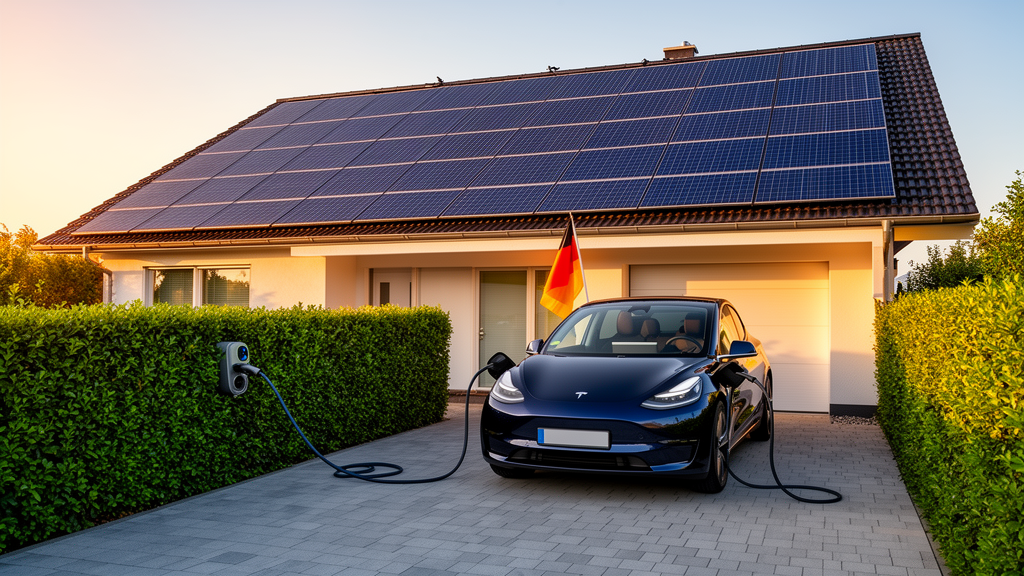
Germany has spent more than two decades building one of the world’s most ambitious clean energy transitions, from rooftop solar arrays blanketing southern villages to a rapidly growing fleet of electric vehicles. But a new study published in Nature Sustainability suggests that this transition is running into an unexpected headwind: the rise of far-right politics. Researchers led by Sebastian Reining and Moritz Wussow of the University of Freiburg’s Climate Action Research Lab found that support for the far-right Alternative für Deutschland (AfD) is consistently associated with lower adoption of both residential solar photovoltaics and electric vehicles, and that the partisan divide has grown in absolute terms even as the technologies themselves have scaled up across the country.
The study is notable for the breadth of its evidence. Rather than relying on a single dataset, the team combined three waves of individual-level surveys with more than 2,300 to 3,000 respondents each, official municipality-level registration records for solar PV systems and electric vehicles, and federal and state election results covering 10,733 German municipalities. The survey waves, conducted in December 2022, May 2024 and August 2024, captured both actual adoption and stated intentions, while the administrative data allowed the researchers to track real deployment from 2000 to 2023 for solar and 2014 to 2023 for electric vehicles. This dual approach matters because self-reported preferences can diverge from observed behaviour, and the fact that both point in the same direction strengthens the overall picture.
The partisan gap is striking, and it differs sharply between technologies. Averaged across survey waves, supporters of the pro-environmental Green party were 48 percent more likely than AfD supporters to report adopting or intending to adopt solar panels, but a staggering 227 percent more likely when it came to electric vehicles. In regression models controlling for income, education, age, household composition and state-level characteristics, AfD supporters were 67 percent less likely to report electric vehicle adoption outcomes than supporters of other parties, a difference that grew stronger among politically engaged respondents. For solar, the equivalent gap was smaller and not statistically significant, hinting that the more mature and economically established technology has become somewhat less politically charged.
Underlying beliefs appear to drive much of this divide. When asked about the climate benefits of swapping a combustion engine for an electric vehicle, only 26 percent of AfD supporters agreed, compared with 61 percent of Green supporters. Just 9 percent of AfD supporters viewed the raw materials needed for electric vehicle production as abundant, versus 31 percent of Green supporters. Perceptions of residential solar were more favourable across all political groups, and partisan differences were correspondingly narrower. This pattern fits a social identity framework in which highly visible, symbolically loaded technologies like electric cars become markers of political affiliation, while technologies perceived as ordinary household investments attract less ideological resistance.
The municipality-level data mirror these individual-level patterns. In 2023, solar PV penetration was 44 percent higher in municipalities leaning toward the Greens than in those leaning toward the AfD, while more than 4 percent of registered vehicles were electric in Green-leaning municipalities compared with roughly 2 percent in AfD-leaning ones. The absolute gap between municipalities in the top and bottom quintiles of the AfD–Green vote-share difference widened in every observed year. Yet in relative terms the gap actually narrowed: solar penetration was initially about 76 percent lower in AfD-leaning municipalities but only 31 percent lower by 2023, and the electric vehicle gap fell from 84 percent in 2015 to 60 percent in 2019. As technologies mature and adoption rates rise everywhere, even shrinking relative differences translate into ever larger absolute shortfalls.
Correlation alone cannot settle the question, because political ideology is entangled with income, education, rurality, housing stock and countless other factors that also shape technology adoption. To address this, the researchers deployed two complementary strategies. The first was a panel regression relating within-municipality changes in AfD vote share to subsequent changes in technology penetration, with municipality fixed effects absorbing time-invariant local differences and county-year fixed effects capturing local policy and economic shocks. These models found that a one-percentage-point increase in AfD vote share was associated with reductions of 0.02 percentage points in solar penetration and 0.03 percentage points in electric vehicle penetration, both highly significant.
The second strategy is the study’s most eye-catching feature: an instrumental-variable analysis that uses wolf attacks on livestock as a source of quasi-random variation in far-right support. Previous research by Clemm von Hohenberg and Hager documented that wolf attacks, which have surged as the animals returned to Germany from Eastern Europe, predict increases in AfD vote share, particularly in rural areas where the party has amplified concerns about safety and rural livelihoods. In this study, wolf attacks strongly predicted AfD support, with effective F-statistics well above conventional thresholds, and a doubly robust difference-in-differences estimate suggested attacks raised AfD vote share by about 1.3 percentage points. A placebo test using the Green vote share produced near-zero effects, suggesting the instrument captures shifts in far-right support rather than broad political realignment.
Using this instrument, the researchers found that municipalities whose voting behaviour was shifted by wolf attacks showed reductions of 0.76 percentage points in solar penetration and 0.18 percentage points in electric vehicle penetration associated with higher AfD support. These estimates are larger than the panel results, which the authors attribute to the local nature of the effect: the instrument identifies impacts only for municipalities, disproportionately rural and agricultural, where wolf attacks moved votes, and the attacks may have made broader far-right positions, including climate scepticism, more politically salient. The authors are careful to note that the instrument’s estimates are not robust to splitting the sample into eastern and western Germany and should be read as complementary evidence rather than definitive causal proof.
Counterfactual simulations translate these associations into concrete terms. The panel models imply that had AfD vote shares remained at their 2013 baseline, solar PV diffusion by 2023 could have been up to 1.3 percent higher nationwide, and electric vehicle diffusion up to 2.9 percent higher. Among wolf-affected municipalities, the instrument-based estimates imply 4.1 to 6.2 percent more solar installations and 2.3 to 5.8 percent more electric vehicles. The researchers stress these are illustrative calculations rather than precise causal counts, but they demonstrate that the political dynamics are large enough to matter for national climate goals, particularly given that households account for over 60 percent of global greenhouse gas emissions through their consumption.
The findings carry implications well beyond Germany. Most existing evidence on ideology and clean technology comes from the United States, where partisan battles over solar panels and electric cars are well documented; this study shows similar dynamics operating in a proportional democracy with a different party system and a much longer history of mainstream climate policy. It also highlights that polarization is not static: the association between far-right support and adoption may have strengthened over time, and the study period predates any substantial far-right governing power, leaving open how adoption might respond if the AfD directly shaped policy. For policymakers, the message is that subsidies alone may not close the gap. As the authors note, durable diffusion increasingly hinges on preferences, cultural acceptance and trust, meaning that the politics of the energy transition may now be as important as its economics.
Subject of Research: The relationship between far-right political support and the adoption of residential solar photovoltaics and electric vehicles in Germany
Article Title: Far-right political support and clean technology adoption in Germany
Article References: Reining, S., Wussow, M., Zanocco, C., Kau, B., Sousa-Silva, R., Köpke, C., Pathiraja, S., & Neumann, D. (2026). Far-right political support and clean technology adoption in Germany. Nature Sustainability. https://doi.org/10.1038/s41893-026-01935-3
Image Credits: AI Generated
DOI: 10.1038/s41893-026-01935-3
Keywords: far-right politics, AfD, solar photovoltaics, electric vehicles, clean technology adoption, political polarization, Germany, energy transition, instrumental variables, wolf attacks, climate policy, Nature Sustainability
Cite Scienmag News
Sloane Callahan. (October 8, 2026). Far-Right Politics Leave Their Mark on Germany’s Solar and Electric Car Boom. Scienmag. https://scienmag.com/far-right-politics-leave-their-mark-on-germanys-solar-and-electric-car-boom/
Sloane Callahan. "Far-Right Politics Leave Their Mark on Germany’s Solar and Electric Car Boom." Scienmag, 8 October 2026, https://scienmag.com/far-right-politics-leave-their-mark-on-germanys-solar-and-electric-car-boom/. Accessed 8 October 2026.
Sloane Callahan. "Far-Right Politics Leave Their Mark on Germany’s Solar and Electric Car Boom." Scienmag. October 8, 2026. https://scienmag.com/far-right-politics-leave-their-mark-on-germanys-solar-and-electric-car-boom/


