


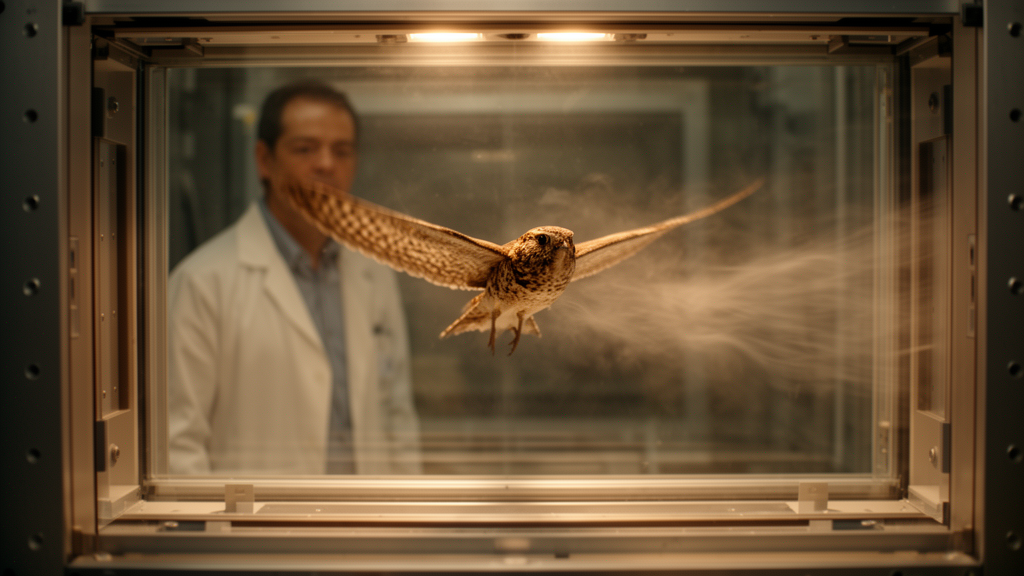
The European nightjar is a bird of contradictions. Every year, Caprimulgus europaeus migrates thousands of kilometers between Europe and sub-Saharan Africa, a journey that should reward wings built for efficient, economical cruising. Yet the same bird also hunts by flying slowly, hovering and maneuvering through the dark to snatch moths and other insects from the air, a style of flight that demands an entirely different wing design. New research published in PLOS Biology shows how this crepuscular bird manages to do both, and in doing so overturns a long-standing assumption about how birds flap their wings.
A team of researchers at Lund University in Sweden, led by L. Christoffer Johansson together with Gabriel Norevik, Sonja Friman and Anders Hedenström, trained nightjars to fly in a wind tunnel and then examined the invisible footprints their wings left in the air. Using wake visualization, a technique that tracks the vortices of swirling air shed behind a flying animal, the researchers could reconstruct precisely how much force the wings produced and how efficiently that force was generated. The results reveal a wing that is a masterpiece of compromise, optimized for neither fast nor slow flight but for a life that requires both.
The most striking discovery emerged at cruising speeds. When the nightjars settled into their steady migration-like flight, the wake behind them showed a peculiar pattern: not one wingtip vortex, as aerodynamic theory predicts for a conventional wing, but two distinct tip vortices on each side. This unusual double tip vortex phenomenon, described for the first time in a flying animal at these speeds, correlated with a measurable reduction in span efficiency, the yardstick of how effectively a wing converts muscular effort into useful lift. In practical terms, the nightjar was paying more to stay aloft at speed than a bird with a cleaner wingtip would.
The explanation lies in the shape of the wing itself. Nightjars have broad wings whose outer feathers can separate into slots, giving the wingtip a slotted, fingered appearance reminiscent of birds such as eagles and vultures. That configuration excels at low speeds, where separated primary feathers act as multiple small winglets, each maintaining lift and delaying the stall that threatens slow, hovering flight. But at cruising speeds the same slotted tip sheds its lift less cleanly, producing the double vortex signature and the associated aerodynamic penalty. The wing that lets a nightjar hover in pursuit of an insect is the same wing that makes its long migration slightly more expensive than it needs to be.
This is the central trade-off the study documents: the nightjar has traded cruising efficiency for hovering capability. For an animal whose feeding ecology depends on slow, agile flight after dusk, the bargain makes evolutionary sense. The energy lost to a less efficient wingtip during migration is offset by the ability to capture food in flight, the very behavior that fuels the journey in the first place. The finding illustrates a broader principle in evolutionary biology that animals engaged in multiple costly behaviors cannot optimize their bodies for all of them at once, and natural selection settles on a compromise shaped by ecological demands.
The second major finding concerns the upstroke, the half of the wingbeat in which the wing returns to its starting position. In the classical view of bird flight, the downstroke is the engine, producing both lift and forward thrust, while the upstroke is largely a recovery phase, folded and feathered to minimize drag. Active thrust production during the upstroke was thought to be a specialty of bats and hummingbirds, whose wings differ fundamentally from those of birds. The wind tunnel measurements told a different story: nightjars in cruising flight were generating meaningful thrust with their outer wings during the upstroke, a characteristic previously attributed only to those other flying vertebrates.
Why should a bird behave like a bat on the return stroke? The researchers’ kinematic analysis points to a mechanical constraint. Birds fold their wings during the upstroke to reduce the surface area presented to the air, but the nightjar’s wing appears to resist full folding, keeping the outer wing extended and in contact with the air long enough to push against it productively. The restricted wing folding effectively turns the recovery stroke into a second, smaller power stroke. The authors suggest that this link between upstroke thrust and limited wing folding may apply generally to flapping flight, meaning the phenomenon could be more widespread among birds than the old paradigm allowed.
The result challenges an existing paradigm that considered an active upstroke in birds to primarily serve weight support rather than forward propulsion. If nightjars, and potentially other birds with constrained wing folding, routinely extract thrust from their upstrokes during ordinary cruising flight, then models of bird flight energetics and performance may need revision. The distinction between bird flight and bat flight, long drawn along the line of the upstroke, becomes blurrier, and the upstroke emerges as a more dynamic and variable component of the wingbeat cycle than textbooks have typically portrayed.
Methodologically, the study demonstrates the power of combining wind tunnel flight with quantitative wake analysis. By measuring the velocity field of the air behind the bird, the researchers could estimate the forces produced throughout each wingbeat without attaching anything to the animal, preserving the naturalness of the flight. Paired with high-resolution kinematics of wing motion and folding, the approach allowed them to connect an aerodynamic signature, the double tip vortex, to a morphological cause, the slotted wingtip, and a second signature, upstroke thrust, to a kinematic cause, restricted folding. Each link in that chain of inference was grounded in direct measurement of the same flying birds.
Beyond its implications for ornithology, the work offers potential solutions for bioinspired engineering. Engineers designing flapping-wing drones face exactly the dilemma the nightjar embodies: wings optimized for efficient cruising perform poorly at low speeds, and wings that enable hovering and maneuvering drag down cruise performance. The nightjar’s slotted wingtip, which maintains lift at low speed at the cost of some high-speed efficiency, and its partially folded upstroke, which converts a recovery phase into useful propulsion, are two design principles that could inform morphing-wing aircraft and micro air vehicles that must operate across a range of flight regimes. The study also carries a conservation note: the European nightjar is a long-distance migrant whose populations depend on intact habitats along vast flyways, and understanding the energetic costs of its flight helps clarify the physiological demands of that journey. For now, the nightjar remains what it has always been, a bird shaped by the night it hunts in and the distances it must cross, its wings carrying the visible signature of both lives at once.
Subject of Research: Aerodynamic trade-offs between cruising efficiency and hovering flight in the European nightjar
Article Title: Nightjars trade off cruising speed efficiency for hovering capabilities and link upstroke thrust production with restricted wing folding
Article References: Johansson, L. C., Norevik, G., Friman, S., & Hedenström, A. (2026). Nightjars trade off cruising speed efficiency for hovering capabilities and link upstroke thrust production with restricted wing folding. PLOS Biology, 24(9), e3004023. https://doi.org/10.1371/journal.pbio.3004023
Image Credits: AI Generated
DOI: 10.1371/journal.pbio.3004023
Keywords: nightjar, flight aerodynamics, wind tunnel, wingtip vortices, span efficiency, upstroke thrust, wing folding, hovering flight, bird migration, bioinspired engineering, PLOS Biology, evolutionary trade-offs
Cite Scienmag News
Drew Townsend. (October 8, 2026). Nightjars Pay a Speed Penalty for Hovering, Wind Tunnel Study Reveals. Scienmag. https://scienmag.com/nightjars-pay-a-speed-penalty-for-hovering-wind-tunnel-study-reveals/
Drew Townsend. "Nightjars Pay a Speed Penalty for Hovering, Wind Tunnel Study Reveals." Scienmag, 8 October 2026, https://scienmag.com/nightjars-pay-a-speed-penalty-for-hovering-wind-tunnel-study-reveals/. Accessed 8 October 2026.
Drew Townsend. "Nightjars Pay a Speed Penalty for Hovering, Wind Tunnel Study Reveals." Scienmag. October 8, 2026. https://scienmag.com/nightjars-pay-a-speed-penalty-for-hovering-wind-tunnel-study-reveals/


