


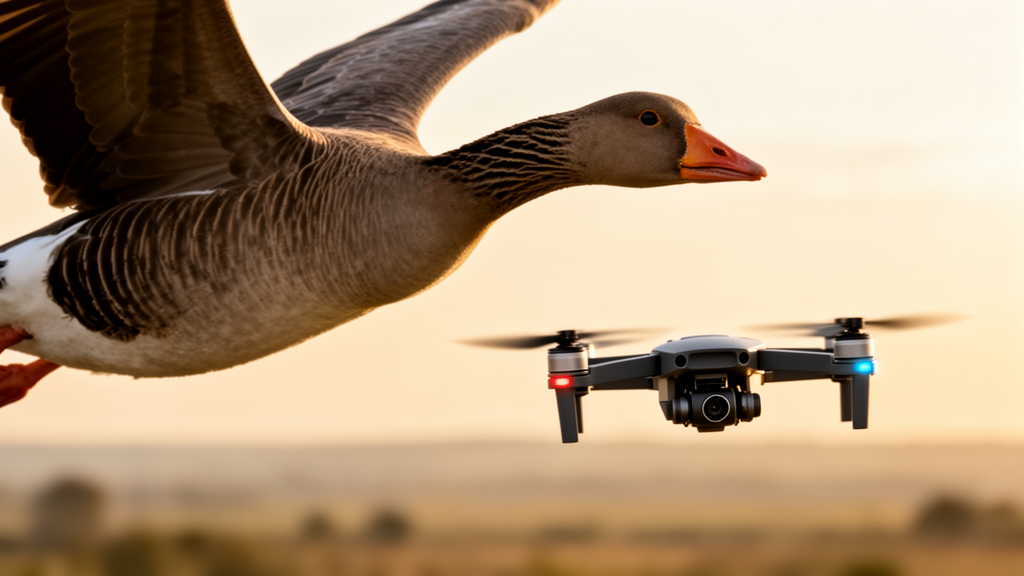
When geese migrate across continents in their familiar V-shaped skeins, each bird behind the leader saves energy by riding the swirling wake of the animal ahead. The savings, however, are only real if the follower holds its position with remarkable precision, because the region of lifted air in a wake is narrow and constantly shifting. Engineers have long dreamed of giving uncrewed aerial vehicles the same trick, but drones lack a reliable way to sense where the energy-efficient pockets of air actually are. A new study published in Communications Engineering suggests the answer may have been sitting on the beaks of birds all along: researchers have shown that pressure sensors arranged like a bird’s nostrils, combined with measurements along the wingspan, can dramatically improve a flying machine’s ability to perceive its own aerodynamic state and find the sweet spots in another aircraft’s wake.
The research, led by Huanglun A. Zhu and Christina Harvey at the University of California, Davis, together with colleagues at the Royal Veterinary College in London and the Rose-Hulman Institute of Technology, set out to test a deceptively simple hypothesis. Birds, the team reasoned, are known to be sensitive to pressure-derived cues, and those cues might allow a follower to identify energy-efficient locations within a leader’s wake without needing to see the leader or exchange data with it. If that is true, then a bio-inspired arrangement of pressure taps on a model wing should carry enough information to predict how efficiently the follower is flying and where it should move to fly better.
To test the idea, the team built a wind-tunnel experiment simulating a single-leader, single-follower formation. The follower model was equipped with two kinds of pressure instrumentation. The first was a set of spanwise pressure taps distributed across the wing, capturing the broader pressure landscape that the wake imposes on the lifting surface. The second was a pair of taps placed in a configuration inspired by the nares, the nostril openings on a bird’s bill. This nares-inspired pair was deliberately minimal, a two-sensor arrangement that a small drone could realistically carry, and it served as a test of whether a tiny, biologically grounded sensing package could punch above its weight in terms of information content.
The analytical backbone of the study came from information theory. Rather than simply asking whether a machine-learning model could make accurate predictions, the researchers quantified how much useful information about aerodynamic state was actually contained in each stream of sensor data, using mutual information as the measuring stick. Mutual information captures the degree to which knowing one variable reduces uncertainty about another, and it allowed the team to compare, on common ground, the value of position measurements alone, pressure measurements alone, and the two combined. This framing matters because a sensor that is cheap and light is only worthwhile if it genuinely adds information that the flight computer cannot already infer from other sources.
The results were striking. When the team trained machine-learning models to predict the follower’s lift-to-drag ratio, the single most direct measure of aerodynamic efficiency in this context, models that received both pressure and position inputs outperformed models that received position alone. In other words, the pressure field acting on the wing carried information about flight efficiency that could not be recovered simply by knowing where the follower sat relative to the leader. The wake is a turbulent, time-varying structure, and its instantaneous effect on a wing depends on more than geometry; the pressure sensors were picking up that extra, dynamic layer of reality.
Perhaps the most surprising finding concerned the nares-inspired tap pair. Despite consisting of only two sensing points, this minimal arrangement captured a substantial portion of the useful pressure information available in the full spanwise array. The nostrils of birds, it turns out, are not arbitrary openings; their placement on the bill positions them to sample pressure differences that are informative about the flow environment. By mimicking that placement on the follower model, the researchers showed that a drone does not need a dense, heavy, power-hungry sensor network to gain meaningful awareness of the aerodynamic forces acting on it. A carefully chosen pair of measurement points, guided by avian anatomy, can do a large fraction of the work.
The implications for formation-flying drones are considerable. Today, most autonomous formation flight strategies rely on relative position estimates, typically derived from cameras, radar, or radio links between vehicles. These approaches work, but they treat the wake as an abstraction: the follower is told where it is, not what the air is doing to it. Pressure-based sensing inverts that logic. A follower equipped with nares-inspired sensors could, in principle, feel the wake directly, estimate its own efficiency in real time, and adjust its position to maximize energy savings, all without depending on communication links that can fail or be jammed. That kind of embodied, self-contained perception is exactly what birds appear to use, and it points toward drone formations that are more robust, more autonomous, and more frugal with their battery reserves.
The study also carries weight for biologists studying formation flight in living birds. Field observations and theoretical models have long suggested that birds position themselves to exploit upwash from a leader’s wingtip vortices, but the sensory mechanisms that allow a follower to find and hold those positions remain debated. By demonstrating that pressure cues alone contain enough information to predict aerodynamic efficiency, the wind-tunnel results lend quantitative support to the idea that birds could use pressure-sensitive structures, including the nares and possibly mechanoreceptors distributed across the wing, as part of their formation-flight toolkit. The work does not prove that birds do this, but it establishes that the physics makes such sensing feasible, which sharpens the questions biologists can now ask.
Methodologically, the paper is notable for its transparency. The authors combined mutual information theory with machine-learning models in a framework documented by a machine-learning checklist, and a preliminary version of the study was presented at the AIAA SciTech 2025 conference before the full peer-reviewed publication. The work was supported in part by a David and Lucile Packard Fellowship in Science and Engineering awarded to Harvey and by the Center for Information Technology Research in the Interest of Society Workforce Innovation Program awarded to Zhu. The collaboration itself is a model of the interdisciplinary approach the problem demands, pairing aerospace engineers who understand sensor systems and estimation theory with zoologists who understand how bird wings and bills actually interact with moving air.
There remain clear limits to what a single-leader, single-follower wind-tunnel study can establish. Real bird flocks involve many individuals, unsteady flapping wakes, atmospheric gusts, and sensory modalities beyond pressure, including vision. Real drones will need to integrate pressure sensing with inertial measurements, control algorithms, and possibly communication, and they will face sensor noise, calibration drift, and the challenge of scaling from a rigid wind-tunnel model to a compliant, maneuvering airframe. Yet the core result stands on its own: a biologically grounded, two-point pressure measurement carries a large share of the information needed to perceive aerodynamic state in formation flight. As uncrewed aerial vehicles are asked to fly farther, longer, and in coordinated groups for cargo delivery, environmental monitoring, and surveying, the marginal energy savings offered by wake riding could compound into meaningful gains in range and endurance. The new study suggests that the cheapest way to find those savings may be to stop reinventing the sensory system from scratch and instead copy the one evolution refined over millions of years of migratory flight, one nostril at a time.
Subject of Research: Bio-inspired pressure sensing for aerodynamic state perception in formation flight
Article Title: Nares-inspired pressure sensing enhances aerodynamic state perception for formation flight
Article References: Zhu, H. A., Bomphrey, R. J., Usherwood, J. R., Haughn, K. P. T., & Harvey, C. (2026). Nares-inspired pressure sensing enhances aerodynamic state perception for formation flight. Communications Engineering. https://doi.org/10.1038/s44172-026-00790-6
Image Credits: AI Generated
DOI: 10.1038/s44172-026-00790-6
Keywords: formation flight, bio-inspired sensing, pressure sensing, nares, aerodynamics, machine learning, mutual information, UAVs, wind tunnel, bird flight, wake energy savings, autonomy
Cite Scienmag News
Denise Maddox. (October 8, 2026). Bird Nostrils Inspire Pressure Sensors That Let Drones Ride Wakes Like Geese. Scienmag. https://scienmag.com/bird-nostrils-inspire-pressure-sensors-that-let-drones-ride-wakes-like-geese/
Denise Maddox. "Bird Nostrils Inspire Pressure Sensors That Let Drones Ride Wakes Like Geese." Scienmag, 8 October 2026, https://scienmag.com/bird-nostrils-inspire-pressure-sensors-that-let-drones-ride-wakes-like-geese/. Accessed 8 October 2026.
Denise Maddox. "Bird Nostrils Inspire Pressure Sensors That Let Drones Ride Wakes Like Geese." Scienmag. October 8, 2026. https://scienmag.com/bird-nostrils-inspire-pressure-sensors-that-let-drones-ride-wakes-like-geese/


